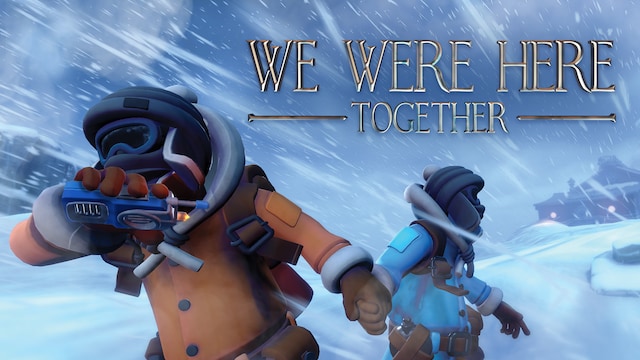
We Were Here Together: trapped apart in a castle, and only your voice gets you both out
It’s no longer being given away · it costs US$12.99 again
See it in the store ↗This page stays as a record of what was given away.
Availability can vary by region.
A co-op game where the puzzle yields less to your logic than to your patience for describing, to someone who can't see your screen, whatever is right in front of you.
Apart in a castle, each with a radio
It's night, the two of you have set aside time to play, and within minutes you're alone in a stone hall the other person will never see. They're somewhere else in the same castle, looking at something else. Between you, only a radio. The door in front of you opens with a combination written on their wall — and their wall you never see.
It starts as a rescue mission: a flare tears across the Antarctic sky, a distress call comes in over the radio, and the pair left back at camp head out after their colleagues. The frozen trail ends inside Castle Rock, a medieval manor where something watches from the shadows — a figure the game calls the Jester. This is the third chapter of a co-op series, and it comes with a rule that's no mere flourish: it's played only in pairs, each on their own computer, each with a microphone. There is no solo mode. What solves the puzzle isn't your logic alone; it's your ability to describe, to someone who can't see your screen, what you're looking at, piece by piece.
The series hasn't stopped — the next chapter is already announced
Anyone taking on this 2019 castle isn't stepping into an abandoned game. In February 2026 the studio Total Mayhem Games announced We Were Here Tomorrow, a new standalone entry in the same line — another pair, another mysterious facility, the same radio between them. Weeks later it released a demo of the opening, available for just a few days.
And a patch even landed for the game at hand here, including a tweak to make picking your microphone easier. It's a small detail that says a lot about where this game's nerve lies: in a title that hinges on the voice, touching the microphone is touching the heart of the thing.
When the two finally understand each other
The praise that comes up most isn't about the graphics or the story — it's about a single moment. One player who finished the game in around nine hours describes the instant when communication with their partner clicks, and what had been a standstill turns into fun; they gave it eight out of ten and moved on. A French couple, seven hours in at the end of July, say that half the difficulty is understanding what the other is trying to describe — the “to the left”, the “no, your left”, the “but I already told you that”. Laughing about it, for them, was part of the game.
Those coming from the earlier titles notice this one asks more of you: a nine-hour player sums it up by saying that here you have to figure out what to do on your own, and sees in that the mark of a good puzzle game, not a flaw. On the Spanish side, someone with eleven hours treats the series as one of the most influential co-op adventures of recent years. Put the voices together and the picture is of people who finished and would come back.
But even the satisfied don't hide the cost. A Brazilian who finished in about nine hours liked the puzzles and still listed flaws along the way — characters that changed color from one day to the next, a friend's radio now crisp, now impossible to hear — and found the story confusing. The praise, here, almost always comes with a caveat attached. These accounts come from the game's Steam page, not the store it's arriving on now — a different house's audience, and a large one, which approves by a wide margin without letting the discomfort go unrecorded.
When the puzzle won't tell you what it wants from you
The harshest criticism isn't “bad game” — it's that the puzzle gives you nothing to work with. A four-hour player, in early August, says this isn't a puzzle game but a matter of clicking on things until the right sequence turns up by chance; he got through all of it on trial and error and came out without knowing how he'd solved it. Another, who quit at three hours, got stuck with his friend on the elevator puzzle and gave up right there — two grown adults, by his account, spinning their wheels for a good while without grasping what the game was asking.
The pattern shows up in almost every complaint: instruction is missing, and without instruction the conversation collapses, because you can't describe to the other person a rule no one ever showed you. A player who passed the twelve-hour mark — and so didn't give up — lands on the same grievance: the story is good, but the puzzles come with no sense of direction, and that jams the communication instead of feeding it. A review that nineteen people marked as helpful goes further and asks for the basics: there's no consideration at all for anyone who's colorblind, and half the puzzles stay out of reach for that person.
Then there are those who came in through the other games in the series and left disappointed: a seven-hour player says that of the ten chapters, only two are actually playable puzzles, that the story doesn't exist and the ending doesn't tie together — only chapter 7 delivers the co-op it promises. And there's the problem that doesn't hang on any skill at all: a Russian review, which in the end recommends the game, describes connection drops so frequent that the pair had to set the server to the India region just to play, and with a VPN the session lasted 5 minutes. When the game is the conversation, dropping the connection cuts the game in half.
Alone, it won't even start
Start with the simplest cut: if you play alone, there's nothing here for you. It's co-op from start to finish, it requires a second person, each with a microphone and a connection. Without the second voice on the radio, the castle won't open. If you're colorblind, go in warned — at least one player showed that there are puzzles closed off to you. And if what you're after is a puzzle with clear rules, where you can reason out the path, you'll likely get stuck at the same elevator so many people got stuck at, somewhere around the two- or three-hour mark.
What's left is a clear picture of who stays: two people patient with each other, willing to describe, get it wrong, repeat, and laugh at “no, your other left”. For that pair, those who reached the end promise that the moment communication clicks pays for everything that came before it. The rest of the world can move along. Because here it isn't your logic that solves the puzzle — it's the two of you, and only if you can understand each other.