
WARSAW RISING: a squad of three insurgents against a battle that can't be won
No deadline: it stays in the catalogue until the store pulls it.
Claim it on GOG ↗You claim it in your own store account; Clairo doesn’t claim it for you.
Availability can vary by region.
The turn-based tactics game, distributed by the Instytut Pamięci Narodowej, splits opinion between those who praise its faithfulness to the 1944 uprising and those who run into the rough edges of a version still under construction.
Three insurgents, a map that crumbles, 63 days of resistance
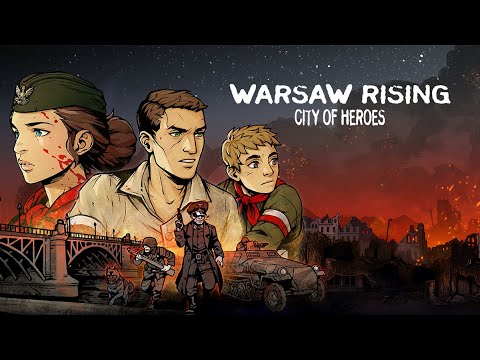
Warsaw Rising warns you, right from its opening, that the outcome won't change: the occupier's advantage grows with each passing day, and the battle, in the game's own words, cannot be won. Even so, you take command of a unit of insurgents and decide, day after day, how to hold out — because the cause, the game says, is just: a free Poland. The campaign opens with only three fighters, whose first task is to get hold of weapons and reach the base camp safely; from there on, the job is to survive as long as possible, gun in hand, across the 63 days of the 1944 Warsaw Uprising.
Command is tactical: each insurgent picks up skills over the course of the campaign, and winning depends more on cunning than on brute force. The routine involves ransacking German hideouts and arsenals for weaponry, rationing ammunition so the group reaches its clashes properly equipped, and deciding, street by street, when to push forward and when to fall back. The map of Warsaw shifts over time — the game mirrors how far the city has been destroyed as the phases of the fighting advance — and slipping through alleys and secret passages, among ruins and obstacles, becomes as much a part of the routine as the shooting.
The version available today, made by the studios Pixelated Milk and Retrovibe Games, has been expanded from the original release: it brings missions based on real events of the uprising, period photographs, archival documents and posters that appear inside the game itself, along with a timeline that follows the main events of the revolt day by day. The project remains in early access — it isn't the final version yet. Distribution is handled by the Instytut Pamięci Narodowej.
The ones who see Darkest Dungeon in the Polish resistance
You feel the game's identity early, even with little playtime: one player who finished the campaign in just under three hours, in April 2026, describes gameplay that is simple, with some strategy but no deep mastery required — and notes that the story starts out hopeful before giving in to historical accuracy, doing justice to the real people who fought in the uprising. Two reviews in different languages, one in English and one in French, land on the same comparison without any coordination between them: the visuals and turn-based combat call to mind Darkest Dungeon dressed in the uniform of the Polish Resistance.
A review in Polish, from September 9, 2025, sums the game up as a history lesson disguised as turn-based tactics and praises the care taken with period documents and accounts. Another Polish review, from September 18, 2025, points to the turn-based combat as its greatest strength, files the game under educational material and closes by praising the institute that distributes the title. A third account, from July 23, 2025, describes the soldiers under your command as tough in a fight but warns that keeping them alive demands constant attention — and doesn't always work out.
The longest review on the list, from June 16, 2026, is also the most divided: its author recalls that the title was once sold for a price and that the mechanics were simplified after the change of model, praises the story's faithfulness to the uprising, but points to a concrete flaw — you can win fights simply by dragging out the turn until the allies' healing runs dry, and there are no real options to choose a mission or a reward. The very Polish review that opens this section admits the same pattern: players' opinions split between the atmosphere and the historical research on one side, and technical flaws on the other.
Who a resistance that begins already knowing the outcome is for
Warsaw Rising is for anyone up for turn-based tactics with real historical weight: you ration ammunition, gamble on routes through Warsaw's alleys and accept that a lost soldier is a genuine loss, not a statistic on the game-over screen. It's also for those who value primary sources: photographs, archival documents and a timeline appear inside the game itself. It isn't for anyone after freedom of choice — with no real option of mission or reward, the campaign follows a single track. And it isn't for anyone who demands polish: the project remains in early access, and more than one review points to technical rough edges that the final version still has to sort out.