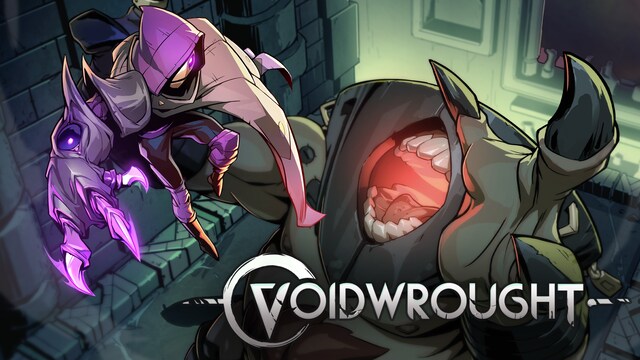
Voidwrought: the blood of the gods runs under the Grey City
It’s no longer being given away · it costs US$19.99 again
See it in the store ↗This page stays as a record of what was given away.
Availability can vary by region.
A studio lets you swap your whole loadout mid-stride — and charges you for it in corridors that ask to be walked twice.
The blood of the gods under the Grey City
You climb out of a cocoon with a single duty: collect Icor, the blood of the gods, from the creatures that have guarded it for generations. The arrival of the Scarlet Star changed everything beneath the Grey City, and those ruins are where Voidwrought unfolds — a Surface scorched by red light, the frozen tunnels of the Past Waters, whatever is left of the Abandoned Expedition.
The studio Powersnake drew the setting by hand and bet on fast platforming action, all measured jumps and sprints toward the next shrine. Along the road, the game hands you more than fifty relics and souls, active and passive, to shape how you fight. It reached Steam in 2024.
As you push deeper, you also raise a shrine for the few who still keep the original faith: the further you dig into the ruins of the First Civilization, the more followers you draw, and the more secrets the building gives up.
The art wins over even the players measuring it against the genre's giants
On Steam, where the game is sold, players past the twenty-four-hour mark of relic hunting say to buy it sight unseen, for the exploration and for the range of combinations between weapons and passive powers. The hand-drawn art comes up early in the comments as the one thing nobody argues about. You swap gear without breaking stride: one player who reached seventeen hours rates that freedom above what more famous rivals in the genre offer, because no distant workbench locks the swap mid-fight.
One player who went the whole distance says the true final boss came around the twelfth hour, with nearly every power already in hand — proof that the game fills hours even at its compact size. But the yardstick fans praise it with is the one that makes them hesitate: the same player who prefers the gear-swap system admits the setting stirs curiosity yet falls well short of what the genre's giants pull off, and that the world of Voidwrought is far smaller than the worlds of the games he holds it against. Another, forty-four hours on the clock, praises the look and the universe but calls the jump over bosses and platforms clumsy — awkward enough to get in the way.
The freedom that opens up the combat is what blocks the road
Not everyone buys the fog around the story. In a July comment, thirteen hours in, a player wrote that the art, the soundtrack and the gameplay all work, but that it wasn't enough to hold his interest: the script never explains who the Simulacrum is, why he collects Icor, or what the Scarlet Star actually stands for. The answers, he says, sit scattered across symbols that are easy to miss, and even after searching outside the game he turned up nothing but theories from other players trying to close the gaps the script itself left open. It is the feeling of finishing a chapter and being unable to say, in one sentence, what it just told you.
The very architecture fans praise in the combat — swapping gear at any moment — is what jams the movement: going forward means going back first. You know the moment: you fight the same pack of enemies again just to reach the double jump the next area demands. A player who stopped at seven hours says the art and the soundtrack had him excited in the first new area, but that crossing corridors he had already cleared, only to unlock a dash or a jump, turned into dull repetition, and that the first five hours drag. Even so, when he thinks back to the bosses, the complaint changes key: the fights were never the problem — everything between them was.
Who reaches the finished shrine, and who quits on the way
Anyone willing to cross the same corridor again to unlock the next power comes out the far end with a loadout that is theirs alone, assembled piece by piece across the descent into the Grey City. Anyone expecting every step to lead somewhere new drops out in the first half — like the player who stopped at seven hours. And anyone who finishes the game looking for answers about the Simulacrum, about Icor, about what the Scarlet Star really wants, finishes without them: this story would rather stay scattered in symbols than be told straight, and completing the shrine changes nothing about that.