Trash Goblin: the same scrubbing, therapy to some, a work shift to others
It’s no longer being given away · it costs US$19.99 again
See it in the store ↗This page stays as a record of what was given away.
Availability can vary by region.
The store page itself pushes back on the simulation tag stamped on it — the game would rather define itself by one repeated motion: scraping away grime to find whatever is worth selling.
A store page that refuses the word simulator
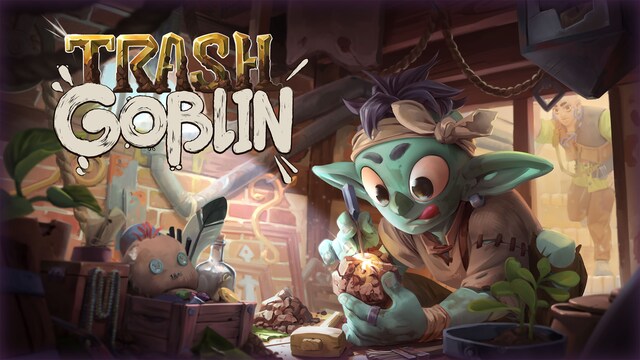
On Steam, Trash Goblin is filed under Casual and Simulation. Two sentences later, the store's own copy contradicts the tag: “It's not a simulator, just good vibes and nice customers to serve.” The contradiction isn't an accident — it is the game's definition. You dig out trinkets caked in soil and grime, chisel them free to reveal the object underneath, sponge them clean and recombine parts into something new. Whatever leaves the workbench goes to a queue of oddball customers, each with a specific request or just the curiosity to browse. The money coming in pays for better tools and for expanding the shop itself — a doormat that draws customers in by product, a bathtub that cleans while you sleep, an honesty box for dumping what's left over.
Spilt Milk Studios Ltd has its name on the game, with Gamersky Games also credited on distribution. It landed on Steam on May 28, 2025 promising the opposite of the hustle other shopkeeping games run on: no risk of going under, no one right way to play, customers who come back however long you take. That promise, more than any single mechanic, sets the terms for everything that follows.
The tool the studio named Hugh
The update christened “Maker's Fortune”, released alongside the game's first paid expansion, brought in an internal tool the team calls Hugh: it strips the colour and properties from any part of a trinket and applies that material to another piece, leaving the original in “bare wood”, ready for a new look. Spilt Milk describes the idea as a long-standing wish for the project, there from the moment the game was conceived. In the same run of posts, the studio celebrated 100,000 copies sold.
That same expansion shipped with a bug that stalled progress on certain quests; the fix only arrived in an update published later, alongside lighting tweaks for scenes that were coming out too dark. If you followed the launch and stopped because of that blocker, this is the update that would hand the game back where you left it. Months later, the studio added one more fully functional trinket shaped like a gnome, the fruit of a collaboration with the team behind PowerWash Simulator 2.
The same motion, called catharsis
On Steam, home to both the store page and the opinions drawn on here, whoever wanders into the goblin's shop comes away recommending it — even when they point at a flaw on the way out.
A player with 37 hours behind the counter stresses that it works in small doses — a bit here, a bit there, slotted between other commitments — and that the range of tools and customers keeps the core of the game, always that same chisel-and-scrub, from wearing thin. It's the kind of game left for you after the house has gone to sleep. Another opinion, posted on September 23, 2026, calls the process cathartic and says the writer had bought the paid expansion the moment the text was finished. In Portuguese, a review showing 22 hours played praises the translation despite the odd slip and describes the game as fresh air for the store's indie catalogue.
Not every compliment comes unqualified. A 32-hour review describes varied characters and genuine creativity, but concedes that the game feels unfinished and buggy, and that there's little pull to come back once it's over. Another recommends it with reservations: it cites physics glitches and quest elements that don't fire properly, enough to force a reload more than once — 15 hours played, in a review from September 2026.
The same motion, called a work shift
The most consistent criticism aims squarely at what the fans call relaxing: for anyone the game never won over, chiselling and scrubbing is repeated labour with too little to show for it. A review at 8 hours played works out that turning junk into antiques pays far less than the game promises, and complains that the customers' stories stay loose from progression — no branching, no consequence. It is dated September 6, 2026.
Bugs weigh heavier on those who stayed longer. A Russian review at 28 hours asks for basics like sorting the items you collect and questions why the expansion's achievements turn up mixed in with the base game's. Another, at just 1 hour, reports an achievement unlocked by mistake, textures that vanish and the feeling that part of the code was automated — both went up on September 18, 2026. A player who reached 13 hours describes a confusing tutorial and complains of wrist pain from all the repeated clicking the cleaning demands — if your wrist already aches, that's the detail that decides whether you carry on. A bug nicknamed “Lute” turns up in an account from September 17, 2026. The player who hit it says they tried 3 workarounds without fixing anything, even after reporting the problem more than once.
Some of that wear already shows up patched in later updates, according to the studio itself — the bug that stalled expansion progress, for one, was cleared in a dedicated update. But some complaints no gameplay tweak can answer: a review in Portuguese, logged with 0 hours played, says the game arrived entirely in English, with no option found to translate it. It is dated April 5, 2026 — the exact opposite of what another review, also in Portuguese, would describe months later.
Who it's worth sitting down with, unhurried
The same motion — dig, clean, reassemble — is therapy for anyone with the patience to repeat it, and frustration for anyone who wants a new goal every session. If you like a fixed task, with no risk and no clock on your back, you'll find long company here; if you need a story that reacts to your choices, or an economy that pays back the hours you put in, you'll hit the same wall the harshest critics describe. Check the language when you install it — the account from the player who got the game in English with no alternative is real — and spare the wrist of anyone already sore from so much repeated clicking. The store page calls this simulation; what the game really defines itself by is the time of whoever has the patience to sit down and repeat the motion.