The Ouroboros King: sharp chess tactics locked inside menus that explain nothing
It’s no longer being given away · it costs US$9.99 again
See it in the store ↗This page stays as a record of what was given away.
Availability can vary by region.
Pocket-sized battles with pieces that rebuild themselves after every defeat — except that working out the game takes more effort than winning it.
A board that starts over with every defeat
Pick up a piece in The Ouroboros King and the game warns you it will turn into something else when it levels up — without saying what. It is the kind of friction that surfaces in review after review: sharp tactical thinking, held back by a game that does not always explain its own rules.
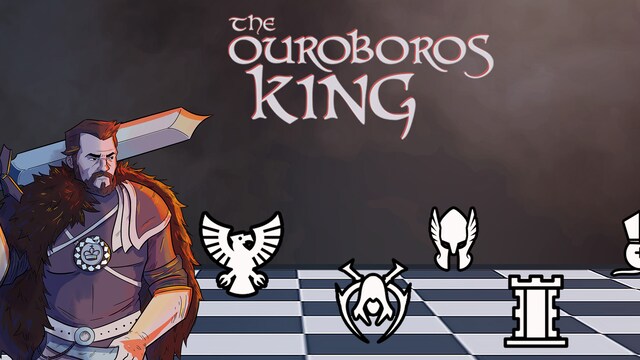
Released on February 27, 2023, it gathers classic pieces alongside others no ordinary board has ever seen, relics that hand out bonuses and items good for a single round, all of it feeding an army raised against the Lair at the end of the road. The rule underneath is a blunt one: one piece at a time, and every choice weighs on the ones that follow. Losing does not close the game out — it drops you into another timeline, with the map, the enemies and the rewards drawn again from scratch, so defeat becomes material for the next attempt instead of a dead stop.
A run lasts 15 to 45 minutes, short enough for a quick break and long enough for a proper sitting. Every piece of content is open from the start, with nothing gated off, and anyone who has never studied chess can step in too: the game asks for no baggage from the classic board, and its text is fully translated into Portuguese. Isaac Murgadella drew the illustrations.
After release: Steam Deck, mods and a second game
Oriol Cosp Games has kept tinkering with the game long past launch. In late October 2024 the studio announced full Steam Deck compatibility, with resolution tweaks and complete controller support — you can play away from a desk without giving up the full experience.
In February 2025 it opened a modding test built together with IngoH, who collaborates with the studio: anyone who owned the game could switch to a test build and create new pieces from documentation the studio itself put out.
In May 2025 the same developer released a second game, Gods vs Horrors — a run-based strategy game cut from much the same cloth, but aimed at assembling the perfect set rather than the piece-by-piece tactical execution that defines The Ouroboros King.
Even the ones who recommend it take a swipe at the interface
On Steam, where the game is sold, the balance of player opinion leans favourable, though it is far from settled — and two reviews from players who recommend it help explain why.
One player with 13 hours on the clock, writing on September 6, describes an experience that is fun for anyone who already likes chess but lacks the legs to last: more a curiosity to see through once than a game you come back to.
Another, at 6 hours and writing on September 25, praises the twists the game puts on classic chess and the pace of its matches — and in the same breath calls the interface one of the worst to be found in any game: pieces that announce a coming change without saying what it is, menus where nothing explains itself. It is praise with a caveat: liking the board spares nobody a fight with its menus.
The scale tips: pieces that don't play by their own rules
On the other side of the scale, the same complaint repeats itself: the game does not always play by the rules it sets for itself. One player who stopped at 3 hours, writing on September 7, puts much of the frustration down to the opposing artificial intelligence, which on that reading falls back on cheap tactics to swing matches already decided.
A player who reached 23 hours, writing on September 6 — the heaviest clock among the critical voices — digs deeper: one specific achievement is flagged as near impossible to finish without pain, a move is described that ignores a defence meant to stop it, and two pieces are put up for balancing: one sits practically out of harm's way the moment it takes an enemy, the other is judged flat-out too strong for the rest of the game.
A third reading, from a player who stopped at 6 hours and wrote on September 9, sums up the idea behind the other two: the concept convinces, but the execution has not caught up with what it promises. The deeper anyone plays, the better the odds of hitting a rule that seems to have forgotten itself.
Who the board is for
It works well for anyone who wants to decide fast and settle things in a single sitting: matches of 15 to 45 minutes, everything open from the first turn, no chess-club credentials asked for at the door. It works too for anyone with somebody beside them — two people can play on the same device, with pieces that exist on no classic board to throw at that other person.
It does not work for players who bristle at a game that hides its own information, nor for anyone planning to stack up dozens of hours poking at pieces that, according to those who have got that far, do not play by the rules they promise. On both counts — the silent menu and the questioned balance — the ones who recommend it and the ones who don't are describing exactly the same thing, just from opposite ends of their patience.