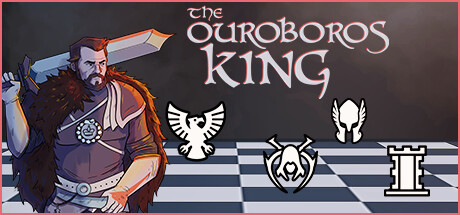
The Ouroboros King turns every defeat into a fresh board
It’s no longer being given away · it costs US$7.99 again
See it in the store ↗This page stays as a record of what was given away.
Availability can vary by region.
Praise for the army of pieces, complaints about an interface that explains nothing: the Oriol Cosp Games strategy title splits even the players who recommend it.
Chess that rewrites its own rules every time you lose
Some players recommend The Ouroboros King and, in the same breath, warn you not to expect too much: a score of five out of ten, and the warmest thing said about it is that it was worth one round of curiosity. That is the right way into this chess of war — it promises more than an ordinary board, and that promise is where opinion splits.
It reuses the classic chess pieces and invents others, each with a function of its own, and lets you stack relics and items that grant temporary advantages, assembling an army all your own. Only one piece moves per round, so every decision is made with no way to take it back on the spot. Losing does not end the run: it drops you into another timeline, with a map, enemies and rewards different from the attempt behind you — and for players who want something tougher to chew on, the difficulty options climb to insane levels.
You can play alone or take on someone else on the same screen, with no content locked behind progress: everything is open from the first match, and winning or losing comes down to skill. Isaac Murgadella did the illustrations, and a single match runs between fifteen and forty-five minutes — short enough for a quick break, long enough to stretch into a proper session. Oriol Cosp Games designed this board and released the game on February 27, 2023.
Meanwhile, the studio had a second board in testing
Oriol Cosp Games did not walk away from the game after release. It opened a testing phase for mods, put together with the help of a collaborator, and published documentation for anyone who wanted to build new pieces from a ready-made template. Months earlier, it had fitted the game to the small screen of the Steam Deck, with a resolution adjustment and full controller support.
The same announcement that opened the mod testing also pointed to another project: a second strategy game, Gods vs Horrors, which the studio itself called its work in progress at that point. That second game got a public demo and later reached stores on the very day the studio spoke about Ouroboros King again in an announcement. Oriol Cosp Games was playing two boards at once.
Recommended, with a caveat: it is not built to last
On Steam, the store all this feedback comes from, a player who reached thirteen hours recommends the game all the same. The score attached is five out of ten — closer to an honest warning than to warm praise, the verdict of someone who believes more in a curiosity worth a single run than in an adventure worth returning to. That reaction is not an isolated one. Another player, with six hours logged, praises the variations the game builds on top of the rules of chess and calls the rhythm of the rounds addictive.
The praise arrives with a scolding, though. The same player describes the interface as one of the worst seen in any game: icons with no explanation, buttons in places that make no sense, pieces that promise an upgrade without saying which one. Picture opening a new piece, reading that it evolves into something better, and never finding out into what. The people who like the board complain about the frame around it.
One piece out of control, one achievement that punishes
Among the players who do not recommend it, the target of the complaint shifts, yet the pattern repeats: the trouble is not the board, it is everything around it. A player with three hours blames the machine-controlled opponent, which in their reading finds ways to swing a match outside what the rules ought to allow. Difficulty is not what stings — it is the feeling of having lost outside the rules rather than inside them.
A player who reached twenty-three hours aims at two specific targets: an achievement they describe as close to a punishment, hard to complete because an enemy explosion cuts straight past the shield that is supposed to block it, and a piece — the musketeer — they consider out of control, since it becomes protected the moment it takes an enemy down. The prince lands on the same list, called a piece too unbalanced for the rest of the army to keep up with.
From a player who spent six hours with the game and did not come back, the verdict is blunter: the concept is interesting, but the execution still feels unfinished for what the game asks in return.
Worth opening a match; staying is another matter
Ouroboros King is for players who like to close out a quick match, lose, and immediately want to try a new combination of pieces and relics — alone or beside someone on the same screen, with no progress lock in the way of the opening move. It is for the reader who takes a low score, handed out along with a recommendation, as an invitation: the curiosity of one run pays off, even with no promise of lasting company.
It is not for anyone who cannot stand opening a menu without understanding what each button does, or who bristles when a single piece settles the match on imbalance rather than strategy. That complaint came from players with only a few hours and from the one who reached twenty-three alike — the mark of a problem that more playing time alone does not fix.