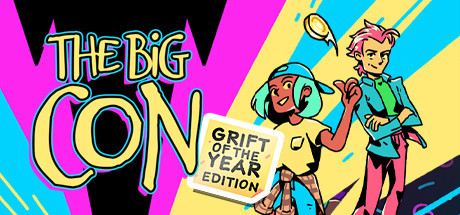
The Big Con: the teenage con artist hiding her double life from her own mom
ends in 6 days — October 15
Claim it on Epic ↗You claim it in your own store account; Clairo doesn’t claim it for you.
Availability can vary by region.
The deadline is the same instant everywhere; what changes is the time on each country’s clock. We show it in your time zone. Near the end, go by the exact time — the store closes the promotion, not us.
Players praise the scams and the cast; the ones who quit all quit in the same spot — pulling the same heist a second time in Las Vegas.
A grifter's life, squeezed into a phone call home
In its first hour, the game makes a promise: you can ride an attraction named Hormipillar as long as you like — no objective, no reward, just because you feel like it. That tone carries across all of The Big Con, an adventure about crime that refuses to take itself seriously. You go in aware that you'll be doing a lot of lying. What the game never mentions is how much you'll enjoy it.
Ali trades music camp for the open road in one move: the family video store owes money to loan sharks with no scruples, and the way out she lands on is learning to deceive people. Disguises, lifted wallets, doors listened at, a break-in when talking won't do the job — an older grifter turns up to teach her the trade, and the game treats that apprenticeship as its real subject, more than the crime itself. Between jobs, she still calls her mother. The two of them argue almost every time.
The setting is a road trip through an America still living in the nineties: flannel shirts, pay phones, VHS tapes. Anyone who was around for that decade gets memory; anyone who wasn't gets a toy museum — and under the gag, a teenager lying to her own mother every single day.
A year spent patching its own con
Mighty Yell released the game on August 31, 2021, then spent much of the following year chasing one specific bug: players who loaded saves made in older builds hit a crash whenever they opened the quest journal, the inventory or the menu. Buy the game around the turn of 2021 into 2022 and the odds of ending up with one of those corrupted saves were real — and the studio took months to announce that the bug had been fixed.
The payoff for the people who stayed came the year after: in a single drop, the studio handed over puzzles, dialogue and collectibles none of them had seen, plus extra quests and a bonus arcade game called Rad Skater, all inside the same game those people already had installed.
The loudest complaints come from the people recommending it
On Steam, where the game is sold, the players who weigh in come away recommending it, with the art and the characters at the top of the praise. One player, 9 hours on the road with Ali, was won over by the visual style and the minigames scattered along the way, and owns up to an unexpected soft spot for the character called the Collector. Another, at 11 hours, points somewhere else: the game's three emotional threads — the complicated relationship with her mother, a crush on a girl, the battle of wits with her rival — and hands the mother thread the place of honor, for the mix of needling and complicity between the two. A third, who finished with 7 hours on the clock, adds the soundtrack, hip-hop and R&B folded into a 90s mood, and spots something rare: the studio swapped out the game's translated title after listening to the reaction from the public — and, in that player's view, what came of it is better.
The recommendation, though, has a complaint folded inside it. A player with just 3 hours in, attempting a second run without giving away a plot secret, gripes about frequent crashes and the absence of a save point partway along — enough to ask, good-humoredly, for a middling grade the store itself doesn't offer. The 11-hour player had to replay the whole game three times, from scratch, because progress lives in a single file and every chapter you close locks the way back. Chase every achievement yourself and that same road will turn up on your screen all over again. And an 8-hour player, happy with everything else, watched the script send her back to the same desert town — identical streets, the same people to work, the same pockets to pick — purely so she could move on to the casino.
A lot of walking for a thin take
Not everyone is the audience for this one. A player who walked away at 3 hours, having tried to cross the desert chapter without bailing halfway, faults how stiffly Ali moves and a map too big to explore from memory alone, picking up item after item and ticking off task after task with no clear direction. A player who held on for 15 hours — long enough to finish the game without ever warming to it — takes the list of grievances further: repetitive pacing, mechanics that never develop, a narrator who fills your ear with lines that amount to nothing, and a color palette that tires the eyes instead of charming them. If your ideal game changes the challenge every hour, here you repeat the same act of theft while the mechanics stay put.
Even that harshest account lets a concession slip: some of the script's jokes land. That's where praise and criticism cross, even at the extremes — nobody disputes that the team who wrote the dialogue can be funny; the argument is only about everything around the joke.
The second Las Vegas sorts the stayers from the quitters
If you like a simple story told with humor and don't mind doing something you've already done, the ending here pays off: the relationship between Ali and her mother justifies the whole trip, and players who come for that tend to end up recommending the game even while listing fault after fault. If you play to solve systems — you want a pickpocketing system with real depth, puzzles that climb in difficulty, nimble movement across the map — you drop out at the same spot: the second run across Las Vegas, robbing the same people on the same streets, with no new script ahead of you. Ask yourself whether, having beaten something once, you're willing to beat it again the same way; the answer decides whether it's worth installing. In between sits the idea each account returns in its own words: the game asks someone who has already cleared the chapter to clear the chapter again — and the players who go along with that request keep playing, while the ones who don't stop right there.