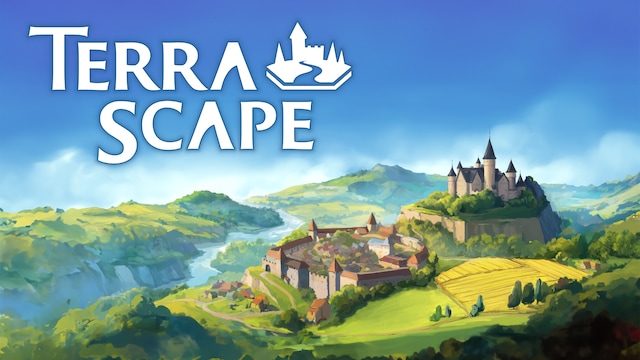
In TerraScape the clock stops, but the deck shows no mercy
ends in 6 days — October 15
Claim it on Epic ↗You claim it in your own store account; Clairo doesn’t claim it for you.
Availability can vary by region.
The deadline is the same instant everywhere; what changes is the time on each country’s clock. We show it in your time zone. Near the end, go by the exact time — the store closes the promotion, not us.
Floating islands, building combos and a deck that decides what you get: the Bitfall Studios puzzler splits its players between devotion and frustration.
A deck decides what your kingdom gets to build
You start by picking your first deck of buildings, and from there every call is about placement: a kingdom takes root on a floating island and grows as you slot in houses, workshops and temples to score. Nothing pushes you along — build at your own pace, with no clock running against you. The difficulty sits elsewhere. Each building reacts to its neighbours, to the resources under it and to the biome it lands in, and not every influence close by is a welcome one.
Paying attention to those combinations pays off in Merged Buildings: fit pieces into specific patterns and they fuse into larger complexes, with stronger influence, bonus points and sometimes effects of their own. The game promises more than a dozen of them to uncover, and anyone playing in company can test those combinations against another player or alongside one in co-op, with leaderboards for people who like to compare results.
Weekly challenges and maps drawn fresh for every run try to keep that kingdom from turning into the same puzzle solved twice.
From Early Access to shared leaderboards
TerraScape was built at Bitfall Studios, with Stray Fawn Publishing and Sidekick Publishing handling release, and it left Early Access on 17 July 2024. The studio itself credits that crossing to the people who had been playing since the 2023 version: listening to that group and hunting bugs alongside it is what carried the game to its current state.
Development did not stop at launch. In a recent update, the studio folded the multiplayer modes of every platform into a single match, with a leaderboard shared across all of them — the kind of bet you only place on a game that still expects new faces. The updates that followed brought reworked multiplayer tutorials, small fixes such as cards locking up when the glossary opened and scores falling out of sync in co-op matches, and one sign that the kingdom has genuinely grown: those same updates cover a scenario set in Ancient Egypt, with its own panel for raising monuments and a co-op mode on the banks of the Nile.
Players who come to unwind end up studying the combos
And on Steam, the store that sells the game and the source of the reviews used here, getting in is easy, and people who try it tend to come away recommending it. One player with 5 hours in September sums up the bargain: you can have fun with no strategy at all, but raising a large empire means understanding the mechanics and the combinations that multiply points. Another account, also 5 hours that month, describes a turn-based medieval puzzle: the goal is to earn medals by completing scenarios and missions, and every choice of where to plant a building carries weight — a modest house is worth few points, a ranger station in the right spot is worth far more.
Further in, you can tell who stayed. A player who spent 24 hours with the game in October likens the mix of building and puzzling to Dorfromantik, but notes that here the complexity of the combinations — a tavern that feeds off neighbouring houses as much as off nearby breweries — holds the interest for longer. Another, at 84 hours in September, calls the result a careful blend of solving riddles, planning and building in a cosy mood, and recommends it without reservation.
The thread tying the two ends together is the same: nobody praises the game for being easy. What they praise is what it gives back once the synergies between buildings stop being a mystery — and that crossing, rewarding as it is, is work before it is rest.
When the deck refuses to help, calm turns to irritation
Two people stopped within their first hour of play, and their complaints overlap. The one who gave up in April, after 1 hour, compares the game to Terra Nil: a good premise, a competent introduction, but says they got lost among options that led to nothing — and admits this disappointment is the exception among players.
The other account — also 1 hour of play, but in September — runs more technical: the tutorial starts up, yet it never explains which category the piece an objective asks for belongs to, nor how to get hold of it, only its name; and a combination pattern gives up its own name only after someone has built it once by accident. Add a card draw that sometimes hands back houses far too basic just as the next piece is missing, and the result is maps that begin with barely any open ground, short of building over their own natural resources.
Both complaints live at the front door, in the same first pair of scenarios the tutorial was supposed to handle — not in the game the longer accounts describe. But an opening that stalls decides whether anyone reaches the rest.
For players with patience for the deck, not for the clock
If what you want is a shallow city builder to switch your brain off with on a Sunday, this is not that game: the first combination with no visible name will stop you exactly as it stopped the player who gave up after 1 hour. The game never tells you how the next piece unlocks — you find out by trying, and the card draw decides whether that attempt comes quickly or not at all.
For anyone who takes that bargain — studying which building pairs with which neighbour, accepting that the deck sometimes will not cooperate — what remains is the game that people with dozens of hours describe: a kingdom that grows in layers, combinations to uncover, modes to play beside someone or against another player, and leaderboards for those who like to compare the result. It is not for people who want to build without thinking. It is for people who like a puzzle that pushes back.