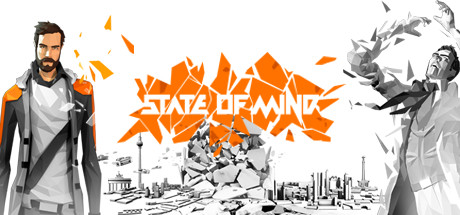
Richard Nolan wakes without his family in a Berlin torn between two futures
It’s no longer being given away · it costs US$19.99 again
See it in the store ↗This page stays as a record of what was given away.
Availability can vary by region.
A story about what remains of identity once the mind can be turned into a file splits players between admiration for its plot and the complaint that the promised investigation never arrives.
Richard Nolan wakes with no memory of the blast — and no family
Richard Nolan comes to in a Berlin hospital in 2048 with no memory of the explosion that put him there — and no sign of his wife and son, who vanished in the chaos. A journalist, he is one of the few who still bluntly criticizes the direction the city has taken: dwindling resources, illnesses brought on by polluted air and water, rising crime, the threat of war, and a handful of governments and corporations promising salvation through technology. Drones and robots are replacing people across the public sector, and surveillance has become part of the scenery.
His family's disappearance pushes Richard into a larger conflict: two opposing visions of how to save humanity, one tied to a collapsing material reality, the other pinned on a digital utopia. The question driving the plot is not who took whom, but whether that second path — an entire life uploaded into a machine — is redemption or sentence: a superintelligence might save us, or it might conclude, having never learned the value of compassion, that we are expendable.
You piece Richard's past back together by playing as him and five other controllable characters, blending deduction with investigation. Visually, the game bets on an unusual combination: realistic-looking environments inhabited by polygonal characters, a contrast that holds up the mood of a world split down the middle. It also supports eye-tracking control through Tobii technology, designed to deepen the sense of being inside the augmented reality that pervades the story — a feature rarely seen outside games built for accessibility.
A script with a name behind it, and a flaw that persists
The launch announcement on August 15, 2018 made a point of saying where the story came from: the script is the work of Martin Ganteföhr, whom Daedalic Entertainment itself presented as a name already well known in interactive storytelling. Knowing this changes how you read every dialogue choice — you are not following just any script, you are following someone with a craft.
Later in 2018, a patch fixed logic problems in dialogue and glitches in the dynamic cameras during conversation scenes — the kind of tweak that usually closes a technical chapter. Even so, players using a controller still report the camera spinning endlessly, unrelated to any setting: the very system the studio tried to repair seems never to have been fully sorted out.
Those who finish praise the plot; those who log more hours praise it with reservations
Anyone browsing the game's Steam page, where it is sold, finds a reception that leans toward praise — though opinions remain divided. A player who finished the game in 9 hours, on August 15, 2026, recommends it, stressing that the story grips because it hands out no easy hero or villain: for him, it felt like returning to a dark science fiction of corporations and technology after a long time away.
Those who put in more time weigh it differently. Someone who spent 20 hours with the game, on September 3, 2026, also recommends it, but describes the experience as closer to an educational or art film than to a fun session — and notes that chasing the achievements nudges you toward a partial second run, since the autosave records a point very close to each important choice, letting you go back and redo only the ending rather than the whole game. The feeling is easy to place: you go in wanting a story and come out debating whether it was entertaining or merely absorbing.
A third account, from 12 hours of play on August 12, 2026, sums up the shift in expectations: the game surprised him by leaning more on story than on visuals, even as he praised the character design and the world-building. He confirms that the plot mostly follows a linear path — most choices change only the tone of a scene — and that just two decisions, near the end, genuinely alter the outcome and the characters; the game saves on its own shortly before, so you can go back and replay only that stretch without repeating the rest. Taken together, the three voices make it clear that the tension here is not liking versus disliking: it lies between the investigative mystery the premise promises and the guided tour the game delivers.
The promised investigation never shows up, and sometimes the game won't even open
On the other side, the frustration springs from that same unkept promise. One player who came in expecting a science-fiction detective story, with clues and twists, and logged 18 hours, posting on August 29, 2026, describes the opposite: too many characters with no closed arc, choices that change nothing in practice, and action confined to 3 or 4 environments walked over and over. Picture spending a whole night chasing leads through a city full of alleys, only to realize on your way back that not one of them led anywhere — that is the complaint that keeps recurring. The odd look, according to this account, becomes acceptable over time; what fails to convince are the pointless minigames and a plot that promises tension and never delivers it.
The dissatisfaction is also technical, and more serious. One player who never got past the start menu, posting on June 7, 2026, reports the game freezing before it even loads, and says he is not alone in the complaint. Another case, with only 1 hour played and posted on May 20, 2026, describes the camera spinning endlessly when using a controller — the same flaw the 2018 patch tried to fix. And there is the saddest account of all: someone who played 3 hours, posting on August 25, 2026, says he liked what he saw — an intriguing story with a cinematic, dystopian mood — except that one day the game stopped opening, with no warning; unable to figure out why, he keeps his files stored, hoping for a repair that gives the access back.
For those who'll walk slowly through a mystery with no chase
State of Mind is for anyone up for a slow-paced mystery about identity and surveillance, willing to accept an almost entirely linear path that only truly opens up near the end, where two choices carry real weight. It is not for anyone after an investigation with real branches or a game free of technical stumbles: a camera that turns on its own and a game that, for one player, stopped opening are complaints separated by years and alike all the same. State of Mind delivers its answer about what stays human once the mind becomes a file only to those with the patience to reach it; for everyone else, the loading screen gets there first.