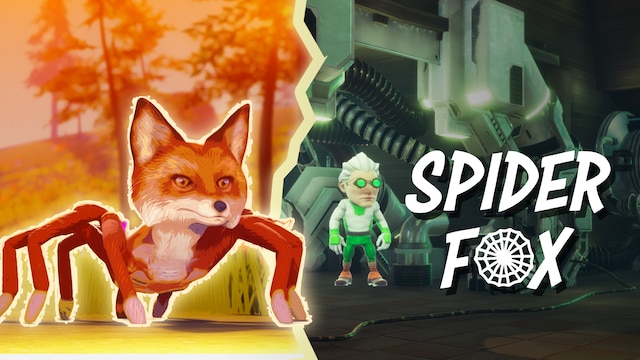
Spider Fox: the web-slinging fox who unpicks a mad scientist's creature mash-ups
It’s no longer being given away · it costs US$7.99 again
See it in the store ↗This page stays as a record of what was given away.
Availability can vary by region.
The work of a one-person studio, it stakes everything on a single task — healing one creature after another — and that's where the players who unwind part ways with the ones who tire of it.
A fox with a web, a scientist, and a heap of half-and-half animals
A mad scientist has been gluing animals together, and it falls to a fox who shoots webs like a spider to undo the mess. That's the whole premise of Spider Fox: you swing from web to web, reach each scrambled animal and heal it, one at a time, until you get to the man behind the chaos. There are no weapons and no death screen — the game treats its creatures as something to rescue, not to hunt.
Progress runs on a single gear. Each new area opens once you've healed enough animals and upgraded your web and your climbing, paying for those upgrades with what you gather along the way: coins, hidden items, chests. Anyone who wants to can set out to heal every animal in the game, which its own store listing describes as something for any age.
Where does an idea like this come from? A Brazilian player who streamed it live in April 2024 says the fox grew out of the ideas and reactions of the creator's five-year-old son — and he sees that as a strength, not a flaw. It fits: the web here is almost a bond of affection, and the logic of joining animals only to pull them apart really does taste of a child's inventions.
The man behind the fox — and the figurines he had printed
Spider Fox is not the work of a big team. Its author, Wes Abrams of Planet 47 Games, always speaks in the first person in the studio's announcements and runs other games alongside this one — after the fox, he released Bigfoot Life in November 2025. And he didn't let the character go: he even commissioned 3D-printed figures of her, made to order, for anyone who wanted a piece of the game on their shelf. In one of his notices he thanks people for the support he received during health troubles. It's the portrait of a small studio, and that shifts the weight of some of the criticism further down: what looks like a lack of ambition may just be the size of the person who made it.
Those who stay call it calm — and the sharpest note comes from a fan
Among those who recommend it, the word that keeps coming back is rest. A player who streamed the game live, four hours into it, in April 2024, says it was relaxing even for the people just watching, and that he ran into no bugs at all; it runs smoothly on a weak machine. It's the sort of thing you leave running late in the afternoon without paying much attention. Another, who played it live for about an hour, had fun naming every creature combination and insists it gives more than it lets on, running past five hours for anyone who takes it slow. One father went straight to the point of it: he sat his young son down to play and gave it nine out of ten.
The sharpest note, though, doesn't come from someone who hated it — it comes from someone who recommended it. The player who logged the most hours, six, right at launch, likes the stroll of chasing easy achievements, but admits in the same text that it lacks a clear purpose and that the stages have no defined end: you go in, gather what's there, and it's over. It's a fan pointing out the hole before the critics do. And it's only fair to say where this praise comes from: not from the audience receiving the game now, but from its page on Steam — people from another store, where the handful who spoke up leave it as "Very Positive," with barely a dissenting voice.
Those who quit run into the same task all the way through
The loop that lulls some is what wears on others, and the game is made of a single loop. One player stopped at two hours, in April 2024, because he healed every animal in the first area without realizing he didn't have to — and within half an hour he felt he'd already seen it all. He also complained about losing the collectibles amid so much green and so much color. It isn't the grumbling of someone who hates the genre: he himself praises the idea and the look.
The complaint repeats in other voices. A reviewer with two hours of play, also in early 2024, found the stages far too big for how little there is to do, and sums it up by saying the web is only good when the game lets you use it. A third, with four hours, cut to the bone: the heal-a-creature formula never changes, the settings don't hold you, and demanding every upgrade to face the final boss is asking too much for so little variety. None of them curse the game; all of them say there was something good in there, smothered by the repetition.
Half an hour is enough to know whether you'll stay
You can find out fast whether Spider Fox is for you — half an hour was all it took the bored player to see everything there was. If you're after something that doesn't punish, doesn't rush, and asks almost nothing of your attention — for a child, for the end of a heavy day, for a low-key stream — the fox delivers that calm from the start all the way to the final boss. If you want things to change, a new challenge to show up, a mechanic beyond swinging on the web, a goal that pulls you onward, the repetition turns into a wall. The fox has eight legs, but she always walks at the same pace: those who find that restful stay; those who expect it to change leave before the second map.