
South Scrimshaw poses as a nature documentary about a whale science has never seen
No deadline: it stays in the catalogue until the store pulls it.
Claim it on GOG ↗You claim it in your own store account; Clairo doesn’t claim it for you.
Availability can vary by region.
Across four chapters painted in watercolor, ink and digital media, a lone creator traces the whole life of a whale calf on a planet that doesn't exist.
A documentary about a creature no one has ever seen
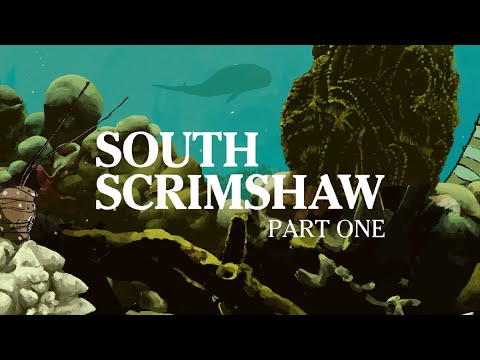
The opening credits thank the backers who funded the documentary, in the same tone public broadcasters use — except there's no broadcaster here, no film crew, and the species on screen never existed. From start to finish, South Scrimshaw, Part One pretends to show a real recording: a consciousness stirring awake inside an aquatic egg, a whale calf becoming aware of its own body for the first time.
The game is a linear narrative, closer to a narrated album you leaf through than to anything with branching choices, yet you can pause and save at any point — you decide nothing and simply follow along at your own pace. More than 400 illustrations, painted in watercolor, ink and digital media, carry a score of music and sound effects built to sound like a genuine nature documentary. This first part gathers four chapters and covers the calf's life from birth to the end of adolescence, weaving in hints of an interplanetary human expedition that discovered the planet.
The store page credits a single person with everything — writing, art and publishing: Nathan O. Marsh. The game arrived on August 7, 2023, and the store still lists it as early access, which fits the request that keeps recurring among those who wrote in praise of the work: they want to know what the next chapter holds.
Whether it even counts as a game is debatable — and no one minds
One person, writing on August 9, 2023, calls the experience short and relaxing and singles out the freedom to pause and save at any moment. Another, that same month, likens the result to a cross between a David Attenborough-style nature documentary and evolutionary speculation — a fine way to spend an hour or two.
A review from April 27, 2024 acknowledges the polished, hand-drawn technical artwork in the manner of an educational video, but raises the question that hangs over the whole genre: when there's barely anything to do beyond watch, is this really a game? The answer it gives seems not to care — the blend of narration, sound and art holds up a story with gentle humor and moving moments, and closes on the promise of more.
Anyone already steeped in real nature documentaries and speculative fiction found familiar ground: a review from October 2023 lists those favorite touchstones and thanks the author directly, looking ahead to the next installment. In December 2025, someone else still recommends the work to fans of older science fiction and to visual artists, calling the experience time well spent and rooting for more chapters. The pattern holds: praise for the art and the documentary voice, and the same lingering request at the end every time — more chapters of a story that, here, stops at the calf's adolescence, short of the rest of the life it promised.
When the very same style turns into the flaw
Not everyone buys the documentary disguise. The dissenting voice — a review published in Spanish on May 14, 2026 — describes the presentation as middling in picture, sound, score and story, and boils the whole thing down to a drawn-out soap opera or documentary that merely wears the shell of a game as a costume. It's the same recipe praised in the previous section — little interaction, the pace of guided narration — read here as the problem rather than the virtue. If you come in expecting to decide something, the calm the fans admire comes across as stalling.
For those willing to be spectators, not players at the controls
South Scrimshaw delivers what it promises to anyone willing to sit back and watch: you settle in, let the camera tell the calf's story, and accept that pausing and saving are the only controls left to you. It's an experience for people who love nature documentaries, grown-up science fiction and hand-painted illustration — the same audience that reaches the end wanting the next chapter. Anyone who opens it hunting for choice — a wrong turn, a second try — closes it during the first scene, without waiting for the whale to grow up: there's nothing to decide, only to follow, and that is precisely what divides those who recommend the work from those who call the result a plodding soap opera. A finished second chapter isn't inside this package — only the promise, left behind by those who hoped for a sequel, that the calf's life continues elsewhere.