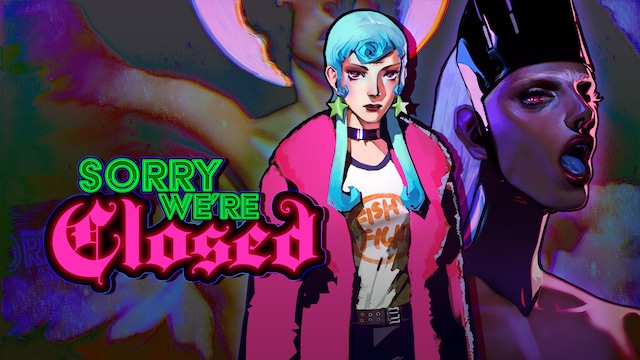
Sorry We're Closed: Michelle's curse comes with neighbors
It’s no longer being given away · it costs US$24.99 again
See it in the store ↗This page stays as a record of what was given away.
Availability can vary by region.
A fixed-camera horror game where talking to the neighbors matters as much as the gunfights — and that's exactly where players split.
A curse born of love, and a street full of odd neighbors
The curse threatening Michelle's life came from an archdemon looking for love. That's how Sorry We're Closed, à la mode games' 2024 release, begins: Michelle is short on time, lives in a London neighborhood full of eccentric residents, and has a power, the Third Eye, that lets her peek between worlds.
Her time is split between two places. In the demon world, the camera is fixed, tank controls are an option, and combat switches to first person for frantic shootouts, where the Third Eye exposes an enemy's weak spot and well-placed hits charge up a finishing shot. On her own street, the game turns into conversation: dialogue where you pick what to say, residents wrestling with their own demons, and multiple endings that hinge on how you treated them.
In between, Michelle manages items and resources. The question the game asks is where you'd rather be — in the hallway with a pistol or on the sidewalk with the neighbors — and players answer in opposite ways.
The art wins over both camps; the cast keeps people playing
On Steam, where the game is also sold and where these impressions come from, the most frequent praise goes to the visuals: characters and enemies drawn with personality, bosses with memorable music, and old-console graphics that players treat as part of the charm. A Japanese player with 22 hours sums up the mix as the interface and costumes of a demon RPG laid over classic horror gameplay. Others celebrate the cast of LGBT characters and say they wanted to talk to every resident just to hear what they'd say.
Those who stick around longer talk less about scares and more about rhythm: a short dungeon, a boss, back to the neighborhood to chat, and repeat. At 10 hours, one player likes that the difficulty is neither punishing nor lax, and that with water and ammo in short supply you have to decide whether a fight is worth it or you should run. At 11 hours, another says the choices confronted them with moral dilemmas and that they want to see the other endings, though they can't quite face starting over.
But the praise comes with a catch. A player with 7 hours admits that switching between the fixed camera and first-person shooting felt clunky at first and, five hours later, still did — he just learned to like it. Another, at 6 hours, calls combat the roughest part, since dropping into first person is as awkward as the tank controls. Fans don't hide the friction. They accept it as the price of everything else.
The same conversations that hook some wear others out
The dispute here isn't over the art, which hardly anyone questions, and several players open their comments by saying they don't think the game is bad. It's about what happens between one fight and the next. A player with 5 hours says it feels like a visual novel with action scenes sprinkled in, and that most of the conversations could fit on a sticky note.
You've just taken down a boss, the tension is rising, and the game sends you back to the street to listen to the neighbors. At 10 hours, one player blames the day-night cycles and the side stories, with their well-drawn but shallow characters, for wrecking the pacing. At 8 hours, another found the residents weightless and the take on love toothless.
Combat takes the second hit. Several say it gets old after the first few encounters, that resources pile up and that the puzzles are lukewarm, so the tension that defines the genre is missing. Those who quit early, at 2 and 3 hours, have more practical complaints: one finds it tedious to put up with the residents to make progress, while another watches the fixed camera turn into an overhead view in narrow corridors, which gets in the way of moving and fighting. A comment from September 2026 says the ambiguous morality ended up coming across as polarized. Both sides are talking about the same thing: the game is the conversation, and the conversation is what may not work for you.
One artist painted every face, and the studio kept working on the game
The studio's Steam news feed tells the story of a game that didn't stop at launch. In June 2025, an update added Chinese language support and five new portraits, so every named character got a portrait painted by artist C. Bedford, along with tweaks to the tank controls and to the cameras during dialogue. One player remarks that the visuals are impressive for such a small team.
A little over a year after release, the studio listed what it had added since: difficulty modes, a new playthrough option and a race against the clock. The difficulty modes address the most common complaint about combat. There was also a digital art book, with cast bios and discarded enemy designs.
Come for the neighborhood, not the scares
If what you want from horror is tight corridors, scarce ammo and enemies that pose a real threat, the complaints taken together suggest this isn't it: combat is considered easy, and one dissatisfied player says the horror atmosphere simply never shows up.
If you're happy with horror that spends its time on conversation, where you choose endings by what you say to a resident, and you want visuals that even the detractors call the high point, Michelle's street is the reason to stay. Anyone who treats that street as an intermission between shootouts will feel the game has lost its spark. Sorry We're Closed only scares those willing to listen to the neighbors before facing the demon.