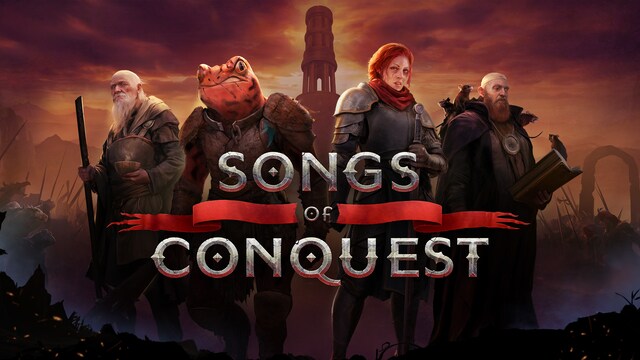
In Songs of Conquest, every campaign writes a song of its own
It’s no longer being given away · it costs R$ 116,29 again
See it in the store ↗This page stays as a record of what was given away.
Availability can vary by region.
The same mana system that hooks the most dedicated players is what drives off anyone short on patience.
One song per campaign
Every campaign in Songs of Conquest comes with music of its own. Bards recount in verse the rise and fall of whoever leads it, and each mission you finish unlocks another stanza — the song is only complete once the campaign is over. It is a small detail that explains why the game's name is no accident.
The setting is Aerbor, a world split among four factions locked into the same conflict: the knights of Arleon, who fight one another for control of the land; the tribes of Rana, scraping out survival in the swamp; the necromancers of Loth, raising the dead in pursuit of a future they consider glorious; and the mercenaries of Barya, running on gunpowder and their own independence. Recruiting troops, researching technology, laying out cities and mounting sieges all taste different depending on the banner you pick.
Aerbor can be crossed alone, with a friend on the same screen or over the internet, computer-controlled allies and enemies set up however you like. Anyone who would rather build has a map editor bundled into the game itself, and the choice between conquest maps, for head-to-head fights, and challenge maps, built around tactical puzzles, decides what kind of match comes out of it.
A faction almost ten years in the making
Lavapotion, the Swedish studio behind the game, with Coffee Stain Publishing handling distribution, treated Songs of Conquest as a living project long after release. Yulan, the largest faction expansion the team has ever built, arrived shaped around three ancient houses and a choice between Order, Arcana and Creation — an idea that had been circling the team since its earliest conversations about the game's factions, almost ten years of waiting to take shape.
The upkeep carried on after the expansion shipped: the team tuned spell damage, fixed campaign maps and opened the same roster of factions up to other game modes across successive updates — the kind of care that usually stops the moment a studio moves on to its next project.
The art and the essences that win over the players who stay
On Steam, where the game is sold, the balance tips well toward praise, and players who log long hours tend to converge on the same two things: the art and the magic system. Reviews in Portuguese, English and Russian keep landing on the same comparison, each in its own words: this is turn-based strategy the way the 90s did it, cut to the pattern of Heroes of Might and Magic. One player who reached 102 hours, in September 2026, describes the change this group cites most — magic runs through essences instead of a single pool, which keeps every battle from turning into an exercise in mana budgeting.
A player with 104 hours, in August 2026, praises the look and asks for a queue to find opponents — a sign that, for all the general enthusiasm, the crowd playing against other people is still small. Another, after 198 hours, still recommends the game but calls the online mode unstable and misses having more ready-made maps to choose from. A third, 165 hours in, sums up what much of this group feels along the way: the early and mid game are polished, while the endgame still leaves content gaps that are obvious to anyone who gets that far.
The mana some players master and others never grasp
Not every player reaches the point where the essence system clicks. One who stopped at 3 hours, back in 2023, complains about the exact opposite of what the veterans praise: what was wanted was a single mana pool, with the freedom to cast whatever spell came to mind, and instead the game pushed toward building armies around the type of energy each unit produces. The complaint and the praise come out of the same system — all that changes is where on the learning curve each player stands.
Difficulty splits opinion in much the same way. One player with 29 hours had to replay the same campaign over and over, memorising each turn as a sequence of near-perfect decisions — seen from there, the curve does not teach, it only punishes. Players trying to team up over the internet report similar frustrations for different reasons: one, 11 hours in, describes losing the connection repeatedly even with fast internet at home; another, at 18 hours, does not recommend it, judging the multiplayer unbalanced and packed with too many random mechanics to hold up as serious competition.
The same art that opens with praise elsewhere turns into a complaint here: a player with 1 hour on the clock reports that the small squares making up the scenery blur together on the map, so much so that it becomes hard to recognise what is drawn there. Another, at 24 hours, points to the lack of content as the central problem — in that view, what exists outside the main campaigns is thin, and the game world does not hold up on its own beyond them.
For players willing to learn the logic of their own magic
Songs of Conquest asks for patience at the door: understanding how each faction generates and spends magical energy counts for more in the outcome of a battle than any single unit, and that curve separates the players who click with the game from the ones who give up early. Playing solo, or beside someone in the same room, comes with the side of the game that draws the most praise; leaning on the internet to find an opponent is a gamble — the network holding that plan up is the point repeated most among the complaints.
For anyone hoping to open the game and grasp everything at first glance, the answer is no: the essence system only pays off once a player accepts losing a few battles to learn how it works.