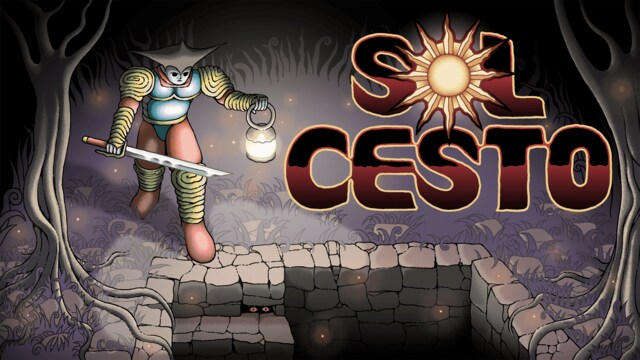
Sol Cesto: the dungeon where luck opens the doors
It’s no longer being given away · it costs US$13.99 again
See it in the store ↗This page stays as a record of what was given away.
Availability can vary by region.
Those who love it and those who hate it describe the same game with the same word: a gamble.
You pick the door, not what's behind it
You face a screen with four rooms and a single click to choose among them. Behind one might wait an enemy ready to wound you. Behind another, a chest of gold. Behind the third, a secret that reveals itself only once you open it. The fourth always stays a mystery. You decide the path; what lies on it, you don't.
That is how, screen after screen, Sol Cesto tells the story of the sun's flight: it vanished years ago, and it falls to the player to descend the floors of a dungeon that rearranges itself with every attempt until they find it. Every step makes the character stronger — items and abilities gathered along the way pry open gaps in the worst runs, yet they never erase the risk of choosing the wrong door.
The variety comes from five biomes whose traps and monsters behave differently from one another, and from seven characters with powers and stats of their own. A set of cursed teeth shifts the odds of running into certain dangers, and a long list of objects serves both to get rid of an enemy and to bend chance in the player's favor.
One programmer, three years, until the request became a patch
Behind the dungeon stands a minimal team, as the studio itself, Tambouille, describes it: Géraud Zucchini handles design and programming, Chariospirale takes care of the art, and a composer rounds out the group. The game left early access and reached its final version on April 10, 2026. After the second batch of fixes, Géraud said publicly that he had come out exhausted — three years of development handling all the programming on his own. Only with the third batch of fixes did another programmer come aboard, Everade, who had already worked on the game Zombiehood, and the quality-assurance team at publisher Goblinz kept helping to hunt down the toughest problems in the game's engine.
If you play today with the option to save in the middle of a run and pick it back up later, you owe that to an old request the studio finally answered. The announcement thanked those who had long been asking for the feature — and it landed right on the eve of a harsh account: a French player, 21 hours in, said he had twice lost his star progress to a bug in the game.
The art wins you over fast; the fatigue takes its time, but it arrives
On Steam, the source of the reviews used here, the response to the game is overwhelmingly favorable, and the dissenting voices are rare — but they exist, and they are worth reading further on. Those who recommend it repeat the same admiration, from someone who played 18 hours in early August 2026 to someone who spent 116 hours inside the dungeon: the art and the animations are, by a mile, what stays with you. A player who finished everything there was to finish compared the feeling to being a quantum particle and called the visuals something you rarely get to see. Another, after thirty-five hours, described the mood as dark in a good way — and said the art alone carried the rest.
Recognizing that early rush is easy: you too feel the urge to open one more room just to glimpse the next biome. Except the enthusiasm has an expiration date. Anyone past ten hours reports the same fatigue — the same bosses come back, the runs start to look alike, and what changes from one attempt to the next comes to hinge more on what was drawn than on any decision made. A player who reached eleven hours summed up the problem: he liked the visuals and the risk mechanics, but admitted he had grown tired of the gameplay loop right at the tenth hour.
Some boil the tension down to a single line: fans and detractors alike describe the same game as a casino gamble. The difference is that, for one side, that is the whole point of the thing — seventeen hours played without minding a loss to chance — and for the other, luck stands in for skill. It is that same crack that separates those who recommend it from those who quit before the end.
When luck turns into a crash
On the other side, the most common complaint is that the decorative risk hides little depth. One player stopped at two hours, arguing that behind the charismatic look the mechanics are too simple to hold on to. Another, also two hours in, found the characters nearly interchangeable — he tried the first three available and felt little difference between them before giving up. A third, after eight hours, summed up the between-run progression as needlessly stretched out: repeating the same clicks with no decision involved, wrapped in a story that starts out intriguing and ends without holding its mystery together.
The most serious complaints, though, are technical. The French player who twice lost his star progress to a bug, at his 21 hours in, said he could not recommend the game until that was fixed. Another, four hours in, reports freezing outright when he faced the same boss a second time: the screen stopped responding to any click, and the contact he made with the team over Discord got no reply. If your game freezes like that, all that's left is to file a ticket and wait.
A review in Japanese, written after five hours down to the fourth floor, sums up the deadlock from another angle: the atmosphere convinces, but the urge to run the dungeon again — the engine of any game in the genre — doesn't hold. And it is exactly that kind of failure, crashes and lost progress, that the studio's own announcements, posted since launch, say they are chasing patch after patch.
For those willing to lose the hand to chance
Sol Cesto is made to be played alone — there is no way to share the dungeon with anyone else — and it rewards those who treat every closed door as part of the fun rather than an obstacle. Anyone who enjoys taking in a beautiful screen while accepting a loss to chance will find short sessions that fit into any given evening.
Anyone after control — tactical decisions that truly weigh on the outcome, characters that genuinely change how you play — runs into the same ceiling the fans themselves describe: somewhere around the tenth hour, the dungeon stops surprising you. And anyone who can't stand losing progress to a technical fault would do well to wait for the next batches of fixes before diving in. Sol Cesto doesn't ask you to beat luck — it asks you to accept losing to it, door after door, until you decide whether the next one is still worth opening.