
Sang-Froid: Tales of Werewolves: the trap delivers, the axe falls flat
No deadline: it stays in the catalogue until the store pulls it.
Claim it on GOG ↗You claim it in your own store account; Clairo doesn’t claim it for you.
Availability can vary by region.
Fans and quitters land on the same complaint from opposite sides: the melee combat isn't up to the rest of the game.
Two estranged brothers, and a Devil hunting their sister
The O'Carroll brothers aren't on speaking terms, and that changes when they learn the Devil himself is after their sister. The brute strength each has built up alone comes nowhere near enough against what prowls the frozen forest where they live: all that's left is a well-laid plan and a cool head. That's the starting point of Sang-Froid: Tales of Werewolves, written in partnership with Canadian author Bryan Perro, a major commercial success known for Amos Daragon and Wariwulf, and set in a 19th-century Canada where legend and history blur together.
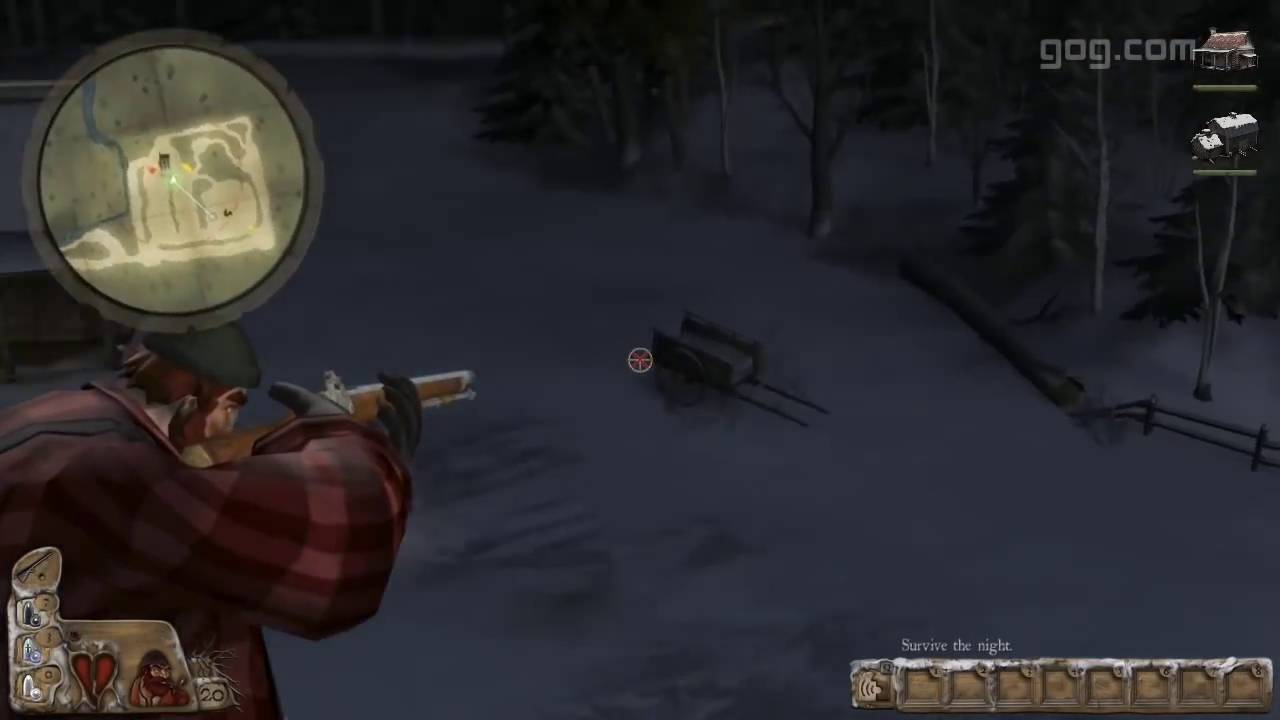
The answer isn't to charge in head-on. By day, you choose where to plant traps across the property; by night, werewolves and other beasts bear down on what you've set, and whoever wins the encounter is whoever frightens the other more — stoking the enemy's fear counts as much as landing a blow. You can pick between the two brothers the way you'd pick a difficulty level, buy period weapons and gear, and level up the character's skills over the course of the missions.
The game is credited to Artifice Studio itself, which also handled distribution — a small studio seeing its own creation through from start to finish. The release is dated November 12, 2013, and its GOG page, even after all this time, is still marked as early access.
The praise goes to the trap, not the axe
The people who recommend Sang-Froid barely mention the melee combat. They talk about the soundtrack, the cold, gloomy atmosphere and the variety of enemies — the kind of beast you're facing forces you to switch weapon and trap with every fresh assault. A review from May 24, 2017 goes so far as to say it lingered on the title screen just to hear a little more of the music, and regrets that the score was never released on its own, as a separate package.
A player who came to the game on September 7, 2021 sums up its length in a few words. It runs ten to fifteen hours, and treats that as a virtue — preferring a short, well-rounded adventure to a long, drawn-out one.
A review published on November 12, 2013, the very day of release, sums up the design as a clever twist on the tower-defense genre: winning depends more on gauging a beast's fear than on landing the blow. The same review, though, is blunt about what falls short — calling the melee combat slow, repetitive and tiring — and recommends the game anyway. It isn't an isolated case: a player from June 18, 2014 calls the story weak and the dialogue bad, admits to skipping the story scenes as early as the first campaign, and kept playing for the sheer pleasure of building the defense.
Two complaints that never meet: the game that won't launch, the game that won't convince
Approval prevails, but it's far from unanimous, and the dissenting voices split into two groups that never meet. Two French-language reviews don't get as far as judging the game: they report that it won't start. One is from August 20, 2020; the other, from October 30, 2024, cites a disk write error the moment it tries to launch. Neither logs a single hour of play — the complaint comes before any match.
Those who did manage to play have a different list of gripes, this one about the game itself. On June 12, 2021, after enduring a sluggish load before you even begin playing, one review sums up the feeling of a game that can't decide whether it wants to be a shooter, a tactics game or strategy. It doesn't convince on any of the three fronts. On December 16, 2017, another calls the story shallow and the finish crude. On October 27, 2020, a third sums up the concept as interesting but poorly executed and dull.
None of these criticisms contradicts what the fans say about the traps and the atmosphere: it's the same combat, the same genre indecision, seen by players who had no soundtrack to make up for the wait.
Who it's worth setting the trap for, and who it isn't
Sang-Froid rewards players who like to plan before they act. You choose where to plant each trap, weigh a beast's fear before the first blow, and accept that the payoff comes from strategy, not brawling. It's for anyone who can put up with a plot the fans themselves call weak and a melee combat that no one — not even those who recommend the game — calls good.
Anyone after a story that grips from start to finish, or a nimble, satisfying fight, will come away frustrated. And anyone with the slightest instability on their computer risks not even getting past the title screen, going by the reviews that couldn't so much as open the game.