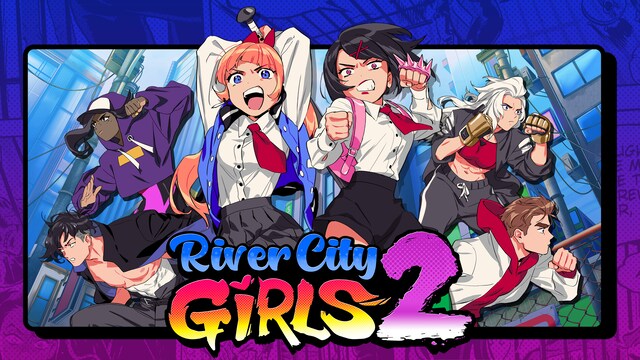
River City Girls 2: Knock a Rival Out, Then Put Him on the Payroll
It’s no longer being given away · it costs US$39.99 again
See it in the store ↗This page stays as a record of what was given away.
Availability can vary by region.
A co-op brawler that hits home for anyone who grew up splitting a controller — and that stutters right when the punch lands.
Knock Him Out, Then Hire Him
An old enemy comes back hungry for revenge, and Misako, Kyoko, Kunio and Riki take to the streets of River City again — this time with two newcomers alongside them, Marian and Provie. The sequel widens the roster to six playable fighters, each with a distinct way of throwing a punch, in a city that has grown along with it: more neighborhoods to explore, more scenery to smash, and a day-night cycle that shifts the backdrop without warning.
Combat picked up layers the first outing lacked — guard breaks, aerial combo strings, attacks with elemental effects — and leveling up unlocks new moves, on top of the chance to spend whatever the fight left over on accessories scattered across more than 40 shops. The strangest idea in the package is a different one: you drop a rival on some random corner and, several stages later, you may be fighting at their side, because the game lets you recruit defeated enemies and even hire mercenary bruisers to pad out the team. The city doubles as a résumé.
WayForward, the same studio behind the first game, released the sequel in December 2022, keeping Megan McDuffee on the soundtrack, giving every character voice acting of its own, and building a game that never forces a fixed stage order. Co-op, local or online, is where all these pieces lock together.
After Launch, the Lee Brothers Showed Up
The studio wall is not just a discount board: it also logs what the game gained once it was finished. A paid add-on brought in the Lee brothers — Billy and Jimmy, of Double Dragon — as playable fighters, each with a signature move of their own and voiced by two names Game Grumps fans recognize on the first word, Dan Avidan and Arin Hanson. A song was written for the occasion with the series composer, Megan McDuffee, and the pack threw in a new dojo master, Boro. Alongside the paid material came an update at no extra charge for anyone who already had the game installed.
The soundtrack, for that matter, did not slip by unnoticed outside the game either: that same McDuffee, with Dale North and a guest turn from Mega Ran, was up for Best Soundtrack at Steam's own awards in 2023 — the kind of recognition that backs up what players keep saying on their own.
Back on the Couch, With the Second Controller
On Steam, where the game is sold and where the reviews used here come from, the praise that comes up most is about sound. A player who reached 61 hours calls the whole thing imperfect, yet says it is a pleasure to revisit every corner of the map; another, who took 40 hours to close out the campaign, sums it up by saying combat and music hold up as well as they did in the first game. A Turkish player finished the campaign in 18 hours with no break along the way, and credits the art direction and the music for it.
A Brazilian review logged at 49 hours, published on July 4, gets more personal still: it talks about being ten years old again, playing with a friend beside you, about the same happy tears of someone rediscovering the series after finishing everything all over with characters that did not exist before. Another player, 8 hours on the clock, describes the mood as one nod after another to the golden age of old video games. There is always a catch, though: a review at 29 hours — one that calls the game a new favorite of the genre, solo or in a group — admits to hitting the character's level cap while still in the first half of the adventure, a sign that the character grows faster than the story can keep up with.
The Brawling Stutters Exactly When You Swing
On the other side of those same Steam reviews, the most common complaint is not about the brawling, it is about what holds the brawling up. A review with 51 hours on record describes smoothness pinned under a low ceiling most of the time. You break a crate or a lamppost, the scenery reacts, and for a moment the image comes loose — then it seizes up again once the dust settles. Another, at 3 hours, calls the multiplayer mode stiff to move around in and tiring in the way enemies keep pouring in, and notes the same drop in smoothness even on a computer that runs far heavier games without breaking a sweat.
Those who went further ran into worse. A review at 31 hours, with the whole game completed, describes the version on sale as broken and says it only works properly after switching to an alternate test build Steam itself makes available — a recourse that owners of the physical PlayStation 5 edition do not have. And when the Lee brothers add-on reached computers, a review rewritten more than once over more than a year records a different kind of trouble: the delay, and the clumsy way the team gave word of it, though it grants that over time, and with an update that added support for more people playing online at once, the game turned solid.
Two narrower complaints take aim at the controls. In a 3-hour review, blocking and countering arrive late, closer to a warning than to an answer to the enemy's swing. In another, at 2 hours, skill keys overlap when several moves share the same combination — the same flaw the first game had, and the sequel never fixed it. A Korean review at 6 hours adds a minimap that points the wrong way, bosses with repetitive patterns, few fast-travel points around the city and badly translated lines — and recommends the game anyway, for the taste of the old arcade and the side-scrolling scrap it brings back.
For Anyone With a Partner — Not for Anyone Chasing Polish
The game delivers on its promise best when someone sits down beside you with the second controller: that is where the elemental moves, the aerial strings and even the squad of hired bruisers make sense as a scene rather than as a stat sheet. Solo, the same game loses the joke — it turns into a corridor of enemies who respawn too fast for one person to manage.
And anyone expecting to boot it up and play without a snag hits an obstacle in the first few hours: the smoothness that drops out, the block that lags, the key that fails to answer the way it should. Anyone drawn in by the memory of playing in pairs, or by the idea of recruiting whoever they have just flattened, has plenty of reason to push past that early stumble. Anyone after a street brawl with no technical slack will rather wait for another round of fixes.