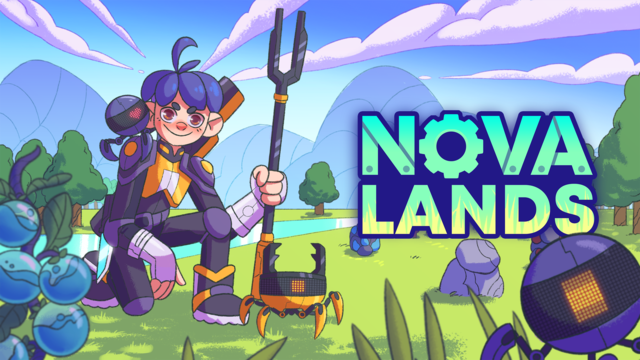
Nova Lands: the boss you beat without a fight
It’s no longer being given away · it costs US$19.99 again
See it in the store ↗This page stays as a record of what was given away.
Availability can vary by region.
Some players praise the calm of its automation, others stall in an endgame built on waiting — what they really disagree about is how much patience is worth.
The boss you beat without a fight
Every boss in this game keeps an exit that skips the violence: find the puzzle tucked into the room it lives in, or hand over an offering that costs more than the fight would. Combat is a choice, not a requirement — and survival on an uncharted planet comes down to automation, not aim.
The opening job is to raise a home out of wood, stone and rare minerals that have no name yet. Every new structure unlocks another possibility, and the hands that gathered resources soon give way to self-sufficient machines, put in charge of whole production chains spread across separate islands. As new islands open up, they arrive with biomes, creatures and residents of their own. That is Nova Lands: the real decision isn't what to build first, it's what to automate first.
They patched the bug, then moved on to another game
The update board of BEHEMUTT, the studio that released the game in June 2023, also holds a run of small fixes. One of them cleared up a quiet error in how the magnetoids pick their target — the same part that, according to a 38-hour review, still jams the whole factory once in a while, when the antennas stop responding out of the blue.
Follow that board month by month and you watch the list of fixes turn into the announcement of a different game: in November 2025, BEHEMUTT unveiled its next project, Fourleaf Fields, a miniature country life led by people the size of an insect. After the announcement, silence. A February 2026 review — which also describes the character obeying keyboard and controller input even off screen, and walking off on its own into dangerous places while the player keeps an eye on another program — reads that silence as abandonment: it takes the flaw to be the kind the studio has stopped fixing. That is one player's reading, not settled fact.
The pirates came back and paid for it
On Steam, where the game is sold, approval remains the dominant note, and the voices against it sit in a clear minority. Some people had finished the pirated build and went back to the legitimate one on purpose, as a gift: their write-up, dated September 2026, logs 17 hours and spends no praise on the technical side — it grants that the factory here never reaches the complexity of others in the genre, and sits down to play anyway, without stopping.
Anyone coming from another survival-and-gathering game lands on familiar ground: one English-language review compares the experience straight to Forager and recommends it to players who miss the same thing. Sink too many hours into Forager and you read this screen without effort. A player logging 73 hours describes the opposite of haste — good-looking, no clock chasing anybody, automation that grows in small steps — and says the search for another game like it has been on ever since.
Not every compliment is only a compliment: an 18-hour review admits the game gets confusing after a while and recommends it all the same — a sign that patience with the learning curve is the price this audience pays without much complaint.
When the factory starts playing for you
The same automation that frees your hands early on is what leaves plenty of people standing around, staring at nothing, further in. You come in expecting to build a perfect machine and you leave, hours later, having mostly supervised a progress bar. A 12-hour review from May 2025 calls the first half fun and the second a letdown: endgame items take so long to come off the line that the only thing left to do is look at the screen, empty-handed, waiting. A 41-hour Russian review agrees in its own way, reckoning it spent half of its playtime at a standstill, just waiting for resources to pile up.
For others, the worse problem is the factory that keeps running once the player steps away from the screen. A 25-hour review notes that switching to another program pauses nothing: keyboard and controller input still count, and the character can cross the whole base alone and end up in a dangerous area. Some never got that far: 8 minutes were enough to fill the inventory and ask for a refund, with no time even to decide whether going on was worth it.
A 13-hour German review sums up the discomfort of reaching the end: there is no ultimate goal, no arrival point such as leaving the planet, only more playing — and the resource management that looked tidy at the start becomes a mess once too much is happening at the same time. Even so, almost all of that discouragement shows up after many hours inside the game: the people complaining had, for the most part, already gone past its halfway point.
For players who set the factory up once and let it repeat
Nova Lands suits people who enjoy management and automation without a stopwatch pushing the next task at them — people who would rather solve a problem once and watch the solution repeat itself. This is an audience that spots Forager from a mile off and takes a muddled learning phase as part of the deal, not as a defect.
It does not suit anyone after a steady pace or an ending that rewards the hours put in: whoever gets there finds fewer goals than islands, and more waiting than decisions. The strangest evidence against the game comes from a 6-hour review that recalls no scene, no screen, nothing it did — all that is left is the record of having played. In a game built so the machine works once it has been configured, a player can come out the other end with no story to tell about it. That is the bargain: you program the factory, and the factory takes over the repeating.