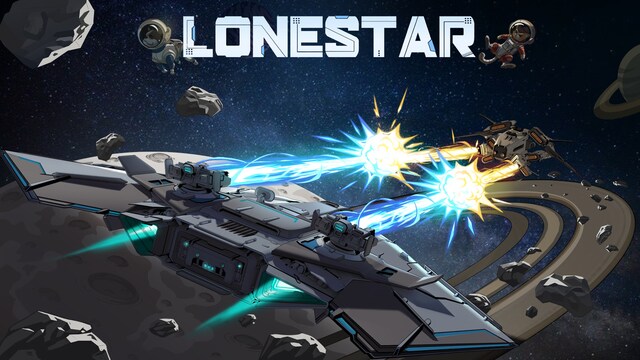
LONESTAR: the bounty hunter guild that pays every win in vacation days
It’s no longer being given away · it costs R$ 17,19 again
See it in the store ↗This page stays as a record of what was given away.
Availability can vary by region.
The store page sells it as card strategy aboard starships. Players who have sunk hours into it say the real engine of the system is something else.
Win the battle, take a vacation
You sign on with a bounty hunter guild that treats violence as salaried work: finish a contract and the payout isn't just loot — it's time off. A rest stretch with its own events, choices and resources, and only after that does the next hunt open up.
The store page sums the combat up as card strategy aboard your ship. What actually settles a fight is a shockwave clash: both ships build up energy, split the numbers into groups, and weigh which side is heavier in each one. The shield on the losing side wears down, and once it hits zero it releases an extra strike. Each ship carries close to a hundred parts of its own, and the crew fills out as the player stacks other pilots' abilities onto their own.
After launch, a pilot nobody has seen in full
Math Tide's update board didn't stop at release. On 3 March 2026 the Guild took on a new pilot, christened R3SET: the text introducing it swears nobody has ever seen its true shape, that it is older than the guild itself, and that it may be an independent operator hiding inside an old ship. Come back to the game after a break and this is the pilot who greets you — alongside an elite enemy with a heavy weapons system and badly handled cooling, plus balance tweaks to the random talents the game hands out.
Months earlier, on 25 November 2025, the same studio had asked its community for votes in a Steam award for most innovative gameplay. Innovative is the very word that comes back from the people playing it, though it never arrives alone: a caveat always trails behind.
The complaint that lives inside the praise
A player with 11 hours in the game, writing on 23 September 2026, went straight for what the store page lets slip past: this isn't really a game about stacking cards. You kit the ship out with parts that fire on energy it generates on its own each round, and luck sits only in the color and the value of that energy — everything else is sequencing what goes into the slots and lining the ship up to hit the right group. It is closer to solving a plumbing puzzle than to assembling a deck.
A player who reached 46 hours, on 26 September 2026, credits the urge to keep going to variety: different powers, treasures and ships every attempt, with pilots and crew combinations that reshape the same fight several times over. Another, at 11 hours on 24 September 2026, saw something there that sounds genuinely new for the genre: splitting energy into groups and wearing shields down one at a time felt fresh enough to hold them, even in the game's harder stretches.
That same 11-hour player from 24 September names the cost of the novelty: the parts have no face of their own, nearly all of them look like the same cog, and that drives the player back to the explanatory text over and over. A 5-hour player, on 23 September 2026, adds another gripe — the game never makes clear why a round's damage came out the way it did, and certain rare effects never manage to trigger the way they should. The economy doesn't help either: with no steady source of resources, a run either fattens up far too fast or ends early and the player starts over from scratch. And on Steam, the store where the game is sold, the people playing it came away recommending it all the same.
For the player who reads the part first and uses it second
If you like optimizing systems, testing what order the slots go in, and you don't mind stopping mid-run to work out a new part, the game yields dozens of different attempts — pilots, crews and ships reshape the same fight several times over. If what you wanted was to stack cards the way other games in the genre let you, you'll miss it early on: luck here lies in the energy the ship generates, not in a hand of cards, and the reading curve is the toll you pay for parts with no face of their own. Whoever accepts that toll comes away satisfied; whoever doesn't gives up the first time they have to stop and read an explanation.