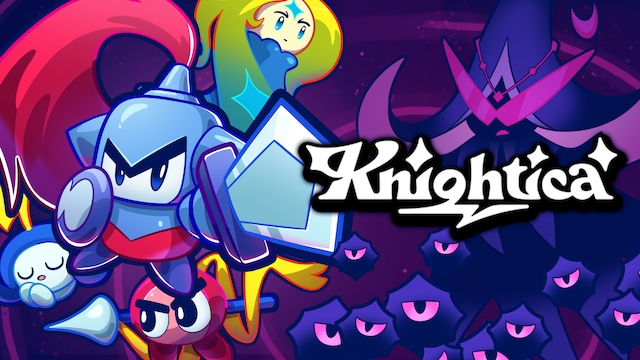
Knightica's power numbers don't tell you who really hits harder
It’s no longer being given away · it costs US$14.99 again
See it in the store ↗This page stays as a record of what was given away.
Availability can vary by region.
An auto-battler about building armies, praised for its art and seemingly endless combos, and taken to task for hiding the math.
You build the army, then sit back and watch
Two soldiers show the same power number on screen, and one of them hits far harder than the other. It's the most common complaint among people who have played Knightica, and an odd one for a game built entirely around comparing numbers.
The premise is easy to explain. You pick a commander, recruit units of every size and shape, place each one on the field and rotate it so its talent lands where it's needed. Then the battle plays out on its own, and your preparation decides the outcome. Between fights the map branches: stop at a shady-looking shop or take on an elite demon. Every run starts from scratch, so no two adventures play out the same.
It's made by Mad Mango Games and came out in 2025, Windows only, single-player, with adjustable difficulty and controller support.
The art hooks you, the combos keep you, for a while
On Steam, where the game is sold and where every opinion gathered here comes from, most players liked it, and the praise barely varies from one person to the next: the art is lovely, the animations are well made and the unit combinations seem endless. One player with 83 hours describes a game that's easy to learn and hard to put down, and another says they got hooked during the demo.
The praise has a ceiling, though. The same 83-hour player warns that you see almost all the content in the first few hours, and that after that all that's left is testing formations and setting yourself challenges. Another, at 19 hours, stopped one step short of completing everything: the final endless-mode challenge felt impossible, and the urge to replay runs just to unlock two items faded. With 11 hours on the clock, one player reached the last stage of endless mode on the highest difficulty and had fun, their only gripe being that strategies end up looking alike late in a run, even after switching commanders.
If you're on your third run of the night, swapping half your army for a fresh idea, you may be exactly the audience this loop makes happy. If not, the praise won't hold you.
The number on screen isn't what does the damage
The harshest complaints come from people who wanted to like it. Players with 9 and 19 hours describe the same trap: the number shown on each unit works as a multiplier on a hidden value, so two soldiers with identical power behave in opposite ways. The in-game encyclopedia lists the real value, but you have to open the page, multiply, divide by the number of figures in the unit and repeat the math for the opponent, for every single comparison, in a game that lives on comparisons.
Other gripes orbit around this one: units so far above the rest that a run can be won by stacking just one of them, with no synergy at all; missing explanations; and a defeat that always costs the same amount of health, whether it's a massacre or a single unit left standing with a sliver of life. The player who stuck around for 59 hours was still having fun but watched frustration take over. The 47-hour player, for their part, saw the campaign end at the third boss and found endless mode a short loop against the same enemies.
Even those who love the game agree some things are confusing: one 42-hour player lost many runs without understanding why, learned, and went on to win on the highest difficulty. It's the fairest picture of the game: clarity arrives, but only after you've paid for it in defeats.
The studio heard the complaint and came back with more
In February 2026 Mad Mango Games released a patch whose headline change answers the core complaint: a settings toggle that shows units' real health, real damage and real attack speed. It doesn't settle the debate, but it shows the studio treated the hidden numbers as a problem.
A year after launch came the first expansion, with three new commanders, each with its own mechanic: one fills the field with rocks that break as they level up and leave rewards behind, another completes missions with escalating rewards, and the third unlocks bonuses for grouping troops of the same type. There are also new troops for every commander and new events, and the studio released a challenge update for all players alongside it. It's the answer to the other lament: that the content runs out early.
Hidden numbers: a puzzle for some, a flaw for others
Knightica suits players who enjoy building combinations, are willing to lose runs to figure out the rules and are content to uncover what the game leaves unsaid. The art and animations reward that patience, and endless mode gives anyone who wants to test formations on the highest difficulty something to chew on. Anyone who demands clarity from the first run will give up early, the first time two soldiers with equal power behave in opposite ways. Anyone looking for a long campaign will give up once the third boss falls and the game starts repeating the same enemies.
The game hides the math, and the only ones who stay are those willing to work it out, paying in defeats.