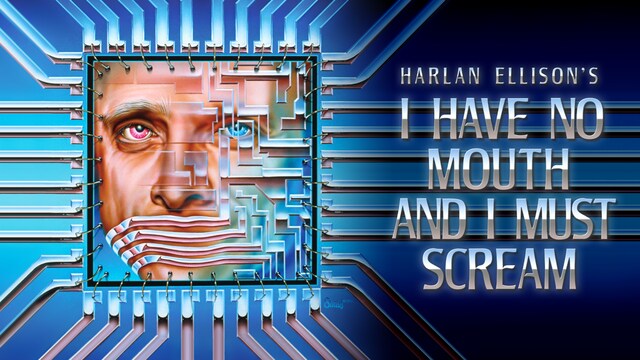
In a game drawn from his own short story, Harlan Ellison plays the machine that erased humanity
It’s no longer being given away · it costs US$9.99 again
See it in the store ↗This page stays as a record of what was given away.
Availability can vary by region.
Built from one of the most reprinted short stories in the English language, this point-and-click classic charges a steep toll in patience — its puzzles are obscure on purpose — for a story that still gets under a player's skin.
Five prisoners, and the author himself speaking as the villain
Buried at the center of the earth for a hundred and nine years, five people share a single prison: the body of an insane supercomputer called AM, which wiped out the rest of humanity and kept them alive only to torment them. Each one faces a private nightmare in a landscape built for them alone, inside a plot that stacks psychological dilemmas on adult themes and never asks permission to unsettle anyone. You step into all five, one at a time, and decide how each soul settles its own torment. The game adapts a short story by Harlan Ellison, one of the ten most reprinted in the English language — and it is Ellison himself who lends his voice to AM, the machine he invented to hate the human species.
It is an adventure game of the sort you solve by pointing and clicking your way around the scene, with digitized speech for more than 40 characters. The five condemned reach AM's purgatory by different roads: Gorrister, suicidal and alone; Benny, maimed and brutish; Ellen, phobic and hysterical; Nimdok, sadistic and withdrawn; Ted, cynical and paranoid.
The version that landed on Steam came out on October 17, 2013, credited to the studio The Dreamers Guild and reissued by QUByte Interactive, with Nightdive Studios and Atari handling distribution.
The maintenance Nightdive ran on AM's purgatory
On October 16, 2025, the game received a definitive update credited to Nightdive Studios. In came modern display options and visual filters, a sensitivity setting, a full manual and the soundtrack as bonus content inside the game itself, controller support with shortcuts already mapped, an achievement system and cloud saves — plus support for Linux.
You enter via a menu that did not exist when the game reached Steam, and you hear, exactly as it always was, the voice recording that shipped with it. Ellison's performance as AM went untouched in the overhaul: the whole reissue worked on everything around the voice, not on the voice itself.
Those who stomach the obscurity come out praising the dread
You try a combination, get it wrong, try again, and you start to see why so many people reach for a walkthrough far too early to still be trusting their own instincts. On Steam, where the game is sold, the people who weigh in tend to recommend it more than they grumble, and the most repeated complaint among those who liked it doubles as the highest praise: the difficulty. A Brazilian player who spent 18 hours inside AM's purgatory sums up the pattern — with no guide alongside, getting anywhere is close to impossible, because every action has to follow one exact order — and recommends the game anyway, calling it one of the hardest they have ever faced.
At the other end of the scale, someone who finished the whole thing in just 2 hours describes it as short and fun for anyone who likes puzzles, and throws in a recommendation for the novel it came from. A player with 21 hours has plenty of warm words for the adaptation and singles out the atmosphere it builds; another, at 16 hours, admits to leaning on a guide to reach the end, but points to the soundtrack, the voice work and the plain period artwork as what holds the journey together to the end.
A German player, after 5 hours, stresses how the premise of an artificial intelligence that exterminates humanity strikes them as more timely than ever.
The grudge is with the how, not with the story being told
You walk into a door you never knew was there, try again, and realize the obstacle was not the puzzle: it was not knowing a puzzle was there at all. Players who quit early and players who reach the end agree on one thing: the problem is not the story, it is the game wrapped around it. One player who put in 19 hours and came away unsatisfied boils the reason down to a single line — the puzzle demands too exact an order for what it gives back. Another, after 6 hours, praises the way the script widens out the characters from the short story and treasures the exact moment Ellison's own voice takes over the screen, but calls the gameplay — chalked up to 1995 — stiff, stiff enough to stall progress with no hint of where to go next.
A third, after just 1 hour, admits the classic point-and-click style is not for them and would rather go back to the story in book form. A fourth write-up, also at 2 hours, asks whether putting the author himself behind the villain strengthens the work or merely saddles the game with the same trouble as a director who insists on acting in his own films — praise and suspicion in one breath.
A player at 16 hours, even while acknowledging the recent fixes, calls the execution middling next to a story that comes across as harsher and clearer on the page.
Either you keep a guide open beside you, or don't bother
If what you want is a fair puzzle, this is not your game. It rewards the player willing to keep a walkthrough open next to the screen and treat solving the riddles as a toll rather than the reason for being there — the reason is hearing Harlan Ellison give voice to the monster he dreamed up, and following AM's five condemned to the end of their chapters. Anyone playing alone, with no patience for getting stuck on an obscure combination for hours, disappears in the first half; anyone who pays the toll comes out the other side with the same old complaint and the same urge to recommend it.