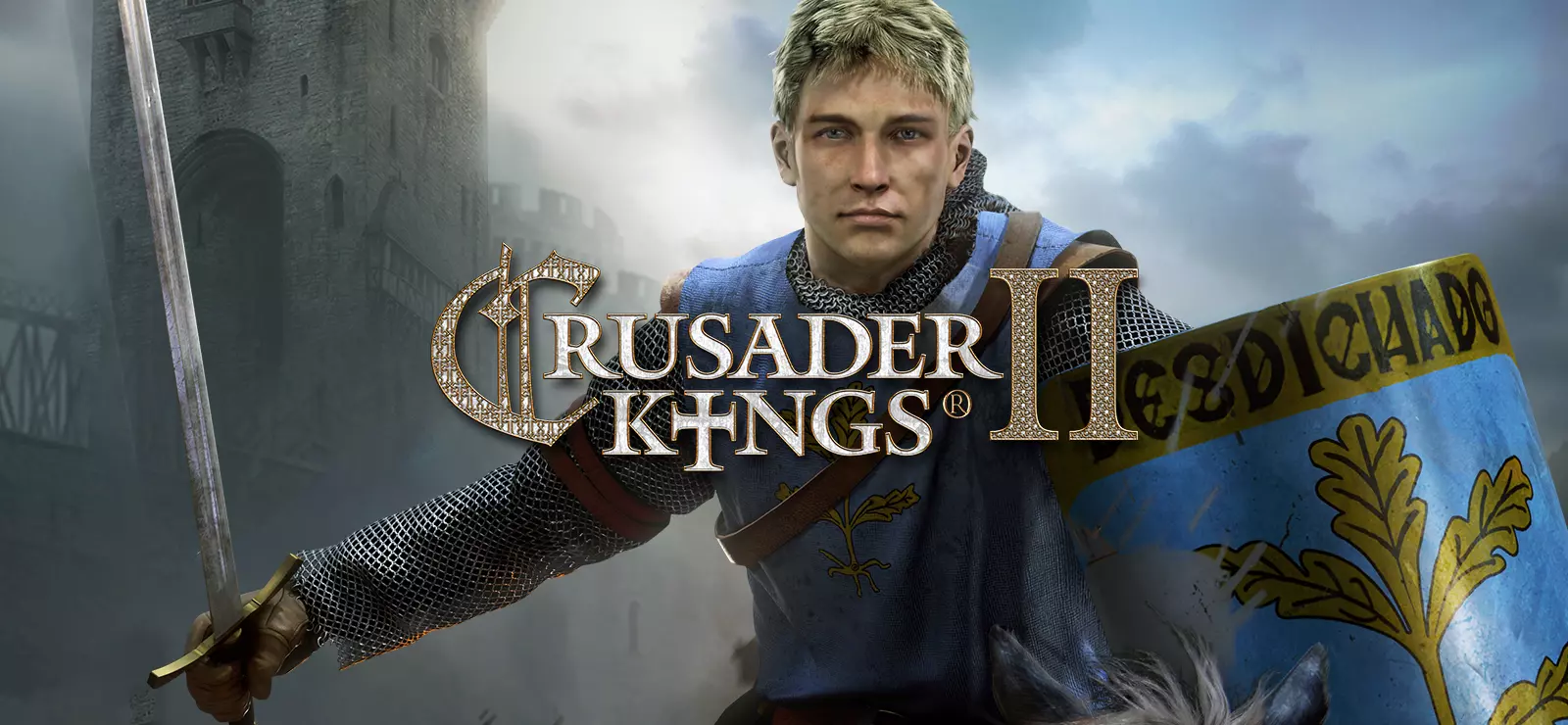
Crusader Kings II: the dynasty that devours your real life
No deadline: it stays in the catalogue until the store pulls it.
Claim it on GOG ↗You claim it in your own store account; Clairo doesn’t claim it for you.
Availability can vary by region.
A medieval dynasty simulator with no set plot and no victory screen: the only measure is how far your bloodline can get.
Ruling with no victory screen
One player says the game nearly made him fail organic chemistry for the third time in college, because he couldn't pull himself away from it — and that he kept playing anyway. 2,424 hours later, he still hasn't stopped.
Crusader Kings II doesn't hand you a country to run; it hands you a bloodline. A campaign can begin in any year between 1066 and 1337. If the dynasty survives calculated marriages, scheming vassals, succession disputes and the ever-present shadow of the Crusade, it reaches 1453 still standing — no victory screen, no objective pinned to the map: the game ends when your family dies out, or when the medieval clock runs down.
The competitive mode fits 32 players onto a single map, but the soul of the game lives in the solo campaign: every succession choice rewrites the story the next generation inherits. Walk in without a plan and you walk out with one — keeping alive the bloodline you've just built.
The news feed carries more mods than announcements
The game is the work of Paradox Development Studio, published by Paradox Interactive — the same publisher that turned part of its expansion catalogue into a subscription service, one of the most frequent targets in players' complaints.
The game's news board on Steam also keeps a record of the people who build mods. In April 2025, PCGamesN reported that the Game of Thrones mod for Crusader Kings II had left testing behind, arriving in a version that avoids giving away twists from the books and the show. A year earlier, PC Gamer captured the modding scene at its peak by pointing to Leper Roulette, a tongue-in-cheek variant that hands the player's dynasty an equal shot at fortune and ruin.
The writer of that piece had, by then, logged 585 hours since the 2012 release — and said the challenge was no longer surviving, but noticing in time that he was about to conquer all of Europe by accident.
No two games alike
Players who have stuck with it for years keep coming back to the same praise: there is no right way to play this. A Portuguese-language review from someone with 356 hours describes the series as a kind of interactive board game, and says they took up following fan-made versions set in worlds like The Elder Scrolls and A Song of Ice and Fire.
A player with 111 hours on record, writing in August 2026, sets the game side by side with the series' sequel: the personality-trait system feels more unpredictable here — traits are won and lost to random events all the time — and they say they prefer the characters' two-dimensional portraits to the newer game's three-dimensional models, which strike them as more off-putting than charming. Even so, they grant that the sequel moved things forward on artifacts, religion and culture.
The same reaction turns up across languages in the reviews — German, Russian, Polish, French — a sign that the fascination isn't the accent of any single community. It's the pattern on Steam too, where the game is sold: those who reach the end of one dynasty tend to leave recommending the next.
One dynasty, a catalogue that never stops growing
The most common criticism doesn't come from people who hated the game — it comes from people who wish they could recommend it without a caveat and can't. The base game is seen as no more than the front door: the rest of the experience is scattered across dozens of paid expansions released over the years, and that catalogue has itself become the biggest obstacle to recommending the game to anyone who hasn't played it.
Some of those expansions can also be reached through a subscription, and the complaint that comes up most about that model is always the same: the price keeps climbing, and someone who only wanted to finish assembling the collection ends up paying for a service rather than for something they get to own.
Getting this far takes a patience the game itself never teaches. A player with 5 hours on record, writing in July 2026, tried the official learning scenario and found little beyond the start year and an instruction to figure out the rest alone — they found the invitation hostile to anyone who had never touched the series before. There's also still no Brazilian Portuguese translation: another review, from someone already at 94 hours, lists the languages the game does offer and notes the gap.
Who this crown is for
It's for people who like to learn by playing, without a tutorial that solves everything for them, and who don't mind leaning on the guides the community writes for itself when the game goes quiet. It's for people who prefer an open system, with no objective pinned to the map, over a campaign whose beginning, middle and end were written by someone else.
It's not for people who want to get in, finish, and feel they've seen everything the game holds: what sits in the base is the start of a collection of expansions Paradox never stopped releasing, and ignoring them means playing with half the pieces on the board. Nor is it for anyone who needs Brazilian Portuguese to feel at home in an interface — the most recent reviews still note that this translation is missing.
Getting in costs the patience to learn without a tutorial; staying costs the appetite to buy, piece by piece, the rest of the map. If you have both, this medieval dynasty will give you one of the few games that genuinely never ends.