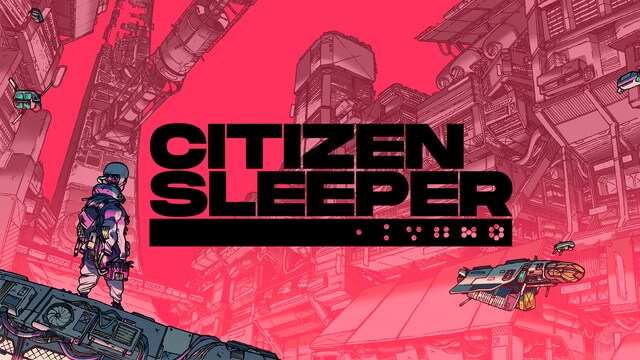
Citizen Sleeper: breaking away from the company that owns your body, one die at a time
It’s no longer being given away · it costs US$19.99 again
See it in the store ↗This page stays as a record of what was given away.
Availability can vary by region.
Built on tabletop RPG bones, the game trades full control for dice that decide what there is time to do — and not every player takes the deal.
A body someone else holds the deed to
The body isn't yours. The mind inside it was downloaded from somewhere else and poured into an artificial shell that a corporation filed as property — and wants back. That is how life starts over on Erlin's Eye, a crumbling station where thousands of people scrape by on the edges of a capitalist society that stretches across the stars.
Every cycle, you roll the dice you have and decide where to spend them: on a friendship that might become an alliance, on a debt that has to be settled, on a lead that points to another corner of the station. Clocks track how much time each of those bets has left, and they keep ticking while you look the other way. The tabletop influence is stated outright, and it shows: less choreographed combat, more people with a problem and a tight window.
The station draws every sort — treasure hunters, engineers, hackers, street-food vendors — each carrying a history and a favour to ask. In time, the dice open another door: access to the station's own datacloud, where decades of corporate secrets and artificial intelligences that were never meant to exist sit waiting to be found. The plot never hedges about who is to blame — Essen-Arp, which owns the body you wear, treats people as portfolio assets — and it was that story that earned the game a The Game Awards nomination in the year it shipped.
The sequel already exists, and so does the next world
Jump Over The Age did not stop at Erlin's Eye. The studio has already released a direct sequel, Citizen Sleeper 2: Starward Vector, and its name is also on Signet City, a first-person RPG set in a decaying coastal town in a world where the biological computer outgrew the silicon chip. There the player is born a parasite in the murky water of the bay and learns to inhabit human minds, steering the town — and the hosts who fill it — toward the end of its last season. The first Citizen Sleeper, the one that started it all, later reached Nintendo Switch 2 alongside the sequel.
A book you read by playing it
Steam, where the game is sold, is home to most of the people who have played it — and there, those who push past the first hour tend to come away recommending it. That is what happened to one Brazilian reviewer: they nearly gave up over the lack of voice acting, but the story hooked them inside that first hour, and part of the credit went to the community's Portuguese translation. By the time they wrote, they had 14 hours in.
The station clock plays on that confidence. You arrive certain that time is on your side; then two bets run dry at once, the marker slips past halfway, and the slack you counted on is gone — the feeling one 22-hour review describes as the tightest squeeze any game has ever put them through.
A 27-hour review likens the experience to holding a beautifully illustrated book: the credit there goes to Guillaume Singelin's art and to the soundtrack, and the reviewer traces the feeling back to the same hunger Disco Elysium left them with. Another, at just 12 hours, calls the score close to perfect. Not every recommendation arrives whole, though: one review played start to finish on Steam Deck, at 8 hours exactly, recommends the package and admits in the same breath that the dice system pushes back at nothing — the friction is missing where the risk should be.
The choice that leaves the ending untouched
The complaints converge on one thing: the choice that looms large in the moment and weighs nothing afterwards. One 36-hour review reached the end convinced that the decisive moments — the ones that promise to change a character's fate — all land in the same place, whatever you do. Another, at 5 hours, puts the irritation plainly: the story belongs to the person who wrote it, not to the person playing it.
A third review, at 7 hours, sees a larger shadow over the game — Disco Elysium's, the same name that turns up in the praise, only here without the force of the original — and feels the mechanical tension evaporate after the first hour; the soundtrack still comes off well. Someone who got to 18 hours ran into a more practical problem: quests that stall near the end and no tracker to help find them.
Where patience pays, and where it charges for the privilege
It suits players who treat a game like a book that also asks for decisions: accepting that time is short, that not every contact will answer, and that the reward lies in how a scene is written rather than in how much it changes later. That is the audience the Brazilian review and the 27-hour one describe — people happy to read a lot and settle little on the controller. It does not suit anyone who wants to feel the weight of their own choices from start to finish of the story: that promise breaks exactly where the 36-hour review stopped, at the point where the ending pays no attention to what came before. Anyone after real resistance in the dice, and not just narrative wrapped around them, has had fair warning from the player who finished everything on Steam Deck: the risk here is decorative.