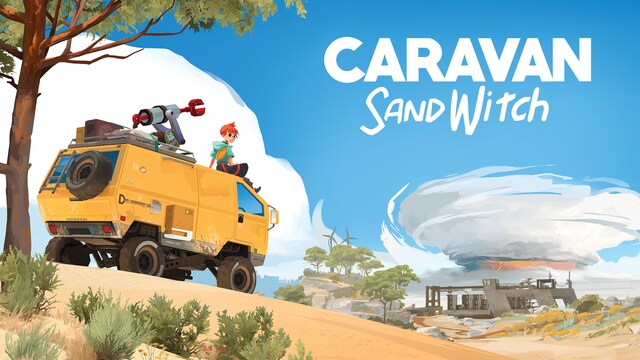
Caravan SandWitch: a hunt for a missing sister across an alien Provence, with no rush and no combat
It’s no longer being given away · it costs US$24.99 again
See it in the store ↗This page stays as a record of what was given away.
Availability can vary by region.
The very script that moves one set of players is, for another, the reason they walk away halfway through — and the split shows up in the reviews themselves.
In Cigalo, a toaster does the job of a phone
On the van crossing the planet Cigalo, the phone that rings is a toaster. Players who've sunk hours into it hold on to that detail as shorthand for everything else: a small joke, slipped in without fanfare, that says more about the game's tone than any review could. It's in that van — among patched-up panels and dirt roads — that the heroine sets off after a sister presumed missing, and the mystery unfolds little by little, with no deadline and nobody pointing a gun at anyone.
Cigalo was a green, living planet before human activity and overexploitation turned it into a desert world. Against that backdrop — science fiction with a Provençal accent — several peoples share the same ground: the Reinetos, an ancient native species; the robots left behind when the planet's mining came to an end; the humans who stayed after everyone else moved on to another planet; and the mysterious SandWitch herself, who gives the game its name. They all live in peace and help one another. Upgrading the van with parts scattered across the map opens up passages and ruins that were closed off before — that's the kind of progress the game asks of you.
The studio wrote the story to portray a real community, with its particularities, and built in accessibility options — logged on the game's store page as part of the design, not as a footnote. There's no combat, no death, no clock: the invitation is simply to drive slowly.
From a Cigalo anniversary to your phone: what the studio did after launch
Studio Plane Toast didn't set the game down on release day, in September 2024. If you played through the first week and never came back, you missed a year of quiet work: once the first anniversary had passed, and at no extra charge to anyone who already owned the game, the studio added a new mission and a machine for repainting the van to the final chapter — the kind of gesture that only makes sense from a team planning to stick around.
The van is set to roll beyond Steam and Epic, too: the studio has confirmed a mobile version, and a hundred thousand people have already pre-registered on the app stores before it has even arrived there.
And a few days ago, the studio answered a complaint that kept coming up in the reviews: it hired a professional translator and rebuilt the game's English version from scratch, line of dialogue by line of dialogue, after hearing that the earlier translation didn't read the way it should.
The praise that keeps recurring: the art carries the game even where the rest tires
On Steam — where the reviews used here live, since the game is being distributed on another store — players tend to recommend it, and the dissenting voices are the minority. The most common bit of praise is always the same: the art direction and the soundtrack hold the game up even when the rest wavers, the kind that keeps playing in your head hours after you close it. One player who finished with sixteen hours logged, in late July, describes the effect as medicine after a tiring day at work; another entry, at eleven hours, points out how every resident of Cigalo treats the heroine with care — even those who don't believe her story about the missing sister, nobody treats her as though she were mad.
A Brazilian player compared the setting's mood to a blend of two very different references — a sign of how the look sidesteps the obvious — but made a point of noting the one rough edge he found: the Portuguese translation stumbles over gender-neutral language, now including one group, now forgetting another. Someone who reached the ending, after fifteen hours, in August, said they were left sad as it closed — they weren't ready to leave that world yet.
But the same crowd that recommends it is the first to admit what the calm costs. One player at eight hours described the exploration as something that wears thin toward the end, and the finale as too weak for the rest of the journey. Another, at seventeen hours, disagrees with the first ones: he finds the game short and feels the second half shift in tone, as the writing starts to speak more openly about politics.
Two criticisms that look nothing alike: one aims at the van, the other at the script
Those who don't recommend it fall into two groups that complain about very different things. The first takes issue with the game itself: a player with nine hours logged noticed that, for all the open-world talk, each mission locks you onto a fixed path — the feeling of sitting behind the wheel after being told you can go anywhere, only to find the game has already chosen the route for you, sometimes without even letting you out of the van. Another, also Brazilian, at twelve hours, sums up the writing as thin, the puzzles as scarce and the van as hard to steer. In English, a six-hour player took the same line: the mission structure and the text wore him out before the halfway mark — what should have been a short, fun experience turned into a chore. Technical hiccups show up too: a twelve-hour review describes brief freezes whenever the game saves on its own — above all when picking up parts and pulling levers.
The second group isn't talking about mechanics: it's talking about what the script asks you to accept. A Brazilian review at eleven hours flatly rejects the text's gender-neutral language, calls the choice ideology and asks that games like this carry some warning on the store page. In English, a three-hour player described the sense of needing a separate course just to follow the plot. A third read, at nine hours, is more measured: it says it welcomes the diversity of the characters but finds the result forced — nearly every romantic pairing in the cast is of the same kind, without the writing digging into what that means for them, and what's left is a sense of missed opportunity.
Taken together, the two criticisms don't just add up to a list of flaws: they show what the game asks in return for what it offers. It promises a world with no rush and no enemy — and pays for that promise with guided missions, a van that's hard to handle and a script that doesn't ask permission to be what it is. Those who take the deal come away satisfied; those who don't leave before the end.
Who driving unhurried through Cigalo is for — and who it isn't
Caravan SandWitch asks for a double dose of patience: with a van that won't quite obey, and with a script that treats neutral pronouns and unconventional families as part of the scenery, not as a topic set apart. Take on both and you'll find, on the far side, a community that welcomes without judging and a soundtrack worth turning the sound on for on its own. Come looking for a real challenge in the puzzles and you'll be frustrated; bristle at the cast's deliberate diversity, and you'll quit before the halfway point, just as the reviews themselves warn. What's left, somewhere along the road, is whoever's willing to drive slowly after a sister that memory may have remembered wrong.