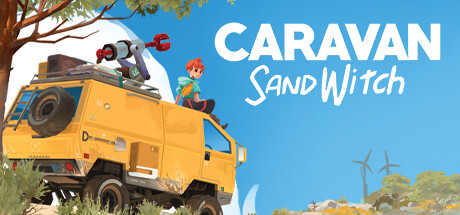
Caravan SandWitch: crossing a parched planet to find the sister who vanished
It’s no longer being given away · it costs US$7.99 again
See it in the store ↗This page stays as a record of what was given away.
Availability can vary by region.
The art and the soundtrack are the one thing nobody argues about; the script's gender-neutral language is another matter, and it's what divides the players who finish from the ones who quit.
A phone that used to be a toaster
On Cigalo, the gadgets left behind are given a second life: one player recalls taking calls on a handset that used to be a toaster, rebuilt from whatever the planet's scrap heap still had to offer. That sets the game's tone before any spec sheet does. You play Sauge, who picks up a distress signal from a sister she had already given up for dead, aboard a van that doubles as home. Life here is deliberately simple: no combat, no dying, no clock ticking against you — just the road, the van and whatever is left of the planet ahead.
The planet was green once. Human exploitation stripped Cigalo down to desert, and those who stayed learned to share what little was left: the Reinetos, an ancient native species; the robots abandoned when the mining stopped; the humans who never boarded the ship to another world; and the enigmatic SandWitch who lends the game its name. The van grows alongside the journey, part by part — every new component unlocks passages and ruins that used to be just scenery in the distance.
The translation the studio threw out and did over
Studio Plane Toast released the game in September 2024 and didn't stop there: it took the complaints about the English translation to heart and hired a professional translator to redo the text from scratch, line by line, quest by quest, until the game reads the way it was meant to from the start. If that was where you gave up, the studio itself is now inviting you back to Cigalo.
The same team came back for the game's first anniversary with new content at no cost: an extra quest in the final chapter and a machine that repaints the van. This isn't the kind of studio that ships and walks away.
They praise the apocalyptic Provence, hesitate over the writing
And on Steam, where the game is actually sold and where the reviews used here come from, players tend to walk away recommending it. The art direction and the soundtrack are the praise that recurs in whatever language you open: an Italian review, after twenty-nine hours on the road, likens the world to a high-tech take on Breath of the Wild and credits the final chapter with the same command of color that brings Blade Runner 2049 to mind. A French review calls the look a rarity — a post-apocalypse with a Provençal accent that you don't run into often. Others put it more plainly, sixteen hours in: it's the kind of game that's good for unwinding after a hard day.
The hesitation shows up inside the praise itself. A Brazilian player, nearly finished with a literature degree and nine hours in, backs the script's push for gender-neutral language but is puzzled by how it's carried out — why does one group turn neutral in the text while another, a few lines later, doesn't? A French review, also recommending the game after nine hours, goes further: it says the neutral pronouns crop up even for babies and robots, pulling the player out of the scene, and that nearly every relationship on Cigalo came across as gay without the story doing anything with it — and without the reviewer grasping why. The art wins you over, no argument; the writing is the first place the consensus cracks.
For the players whose trip stalled in the first chapter
The technical gripes come before the writing gripes. A Brazilian player, nine hours in, says the open world is an illusion: every quest pins you to a set route, and on some you can't even step out of the van. Stick with it and you run into driving that more than one player calls sluggish, into shallow puzzles and into characters who never grow past the first scene they show up in. An English review, six hours in, wanted to find a successor to Sable and instead found a loop of fetch a part, drive back, repeat, until it turned into a chore. Another, eight hours in, calls the look handsome and expensive at once: every character has a single talking animation, and it wears thin far too fast.
The most repeated complaint, though, cuts across languages: players writing in Portuguese and in English, in different reviews, call the script's neutral language forced. One asks the store to flag games with this kind of language before purchase; another says he had to stop the game to puzzle out words he'd never seen in school; a third, three hours in, sums it up by saying that following the plot demands a knowledge he doesn't have. On the other side, one review complains of the opposite: that the cast's diversity feels like decoration pasted on top, with no real weight in the story. The English translation has already been redone after the complaints about quality — but this second objection isn't about translation, it's about the choice to write this way, and the studio didn't address it in the statements it put out afterward.
Who turns the key and who steps out before the garage
It's for anyone up for a slow game about loss and community, with no time pressure and no combat, who doesn't mind a quest pinning them to a set route in exchange for the scenery. It's for anyone who can read, without missing a beat, a cast in which most relationships fall outside the heterosexual norm — that's part of the world, not its subject. If all you wanted was to drive, the complaint is yours too: the hemmed-in van and the on-rails quests show up early, and they don't go away later.
It's not for anyone who rejects a script in gender-neutral language from the outset: that rejection turns up in good reviews and bad ones, in Portuguese and in English, always in the same spot — right at the start, before the van leaves the garage for the first time. Anyone thrown by an unfamiliar pronoun already knows, before turning the key, that this trip isn't for them.