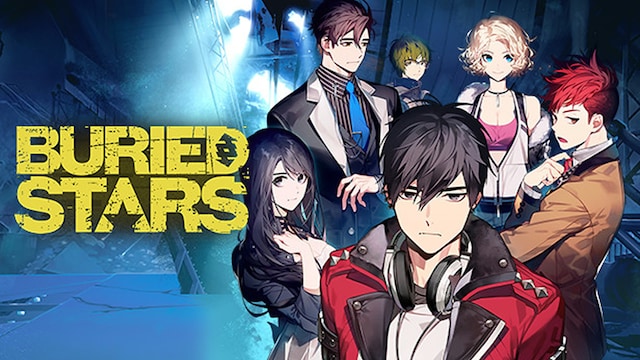
Buried Stars: the body left in the rubble when the live broadcast comes down
It’s no longer being given away · it costs US$39.99 again
See it in the store ↗This page stays as a record of what was given away.
Availability can vary by region.
The game sells the messages the trapped survivors trade as the trail to follow — and that is exactly where part of the audience grinds to a halt.
A corpse under the building that went down on air
A survival audition is live on air when the studio building collapses. The contestants left trapped in the rubble find more than a disaster: someone inside has killed one of their own, and nobody has any idea who or why.
You do not investigate by walking 3D corridors. You follow the audience reacting outside and each survivor's timeline on a social network built into the game, picking up clue after clue in the messages that surface on screen. 2D character art sits over 3D sets, and every dialogue choice you make opens a different branch of the story, each with an ending of its own — a second run is not the same scene with one line swapped, it is a stretch the first run never shows. The voice work was recorded in Korean and in Japanese, with a cast in each language.
The script is signed by Studio LARGO, the team behind Panic Room and City of Mist, in partnership with LINE Games, which also publishes the game. Buried Stars came out on November 29, 2021.
The duo that holds the plot together, and what a second run costs
On Steam — the store that sells the game, and where most of the player write-ups used here come from — players who finish the investigation tend to come away telling others to play it, and the handful who come away against it are anything but shy about why. The longest of the accounts used in this article, at 46 hours, keeps a particular fondness for what arrives after the credits: a counselling programme for the survivors, run by one of the characters, which closes the story on a gentler note than the rest of the game suggests. If you like finishing a game feeling that someone cared what became of its characters, that is the kind of detail that stays.
The player who finished in 25 hours praises the pair at the centre of the plot for dodging the genre's clichés and closing their arc coherently. That write-up, dated September 25, 2026, also suggests a return trip along the alternative routes: each one uncovers a piece the first run hid.
Hardly anyone gets the killer wrong. A 17-hour log describes suspecting the culprit almost at once, from the faces in the portraits alone, and playing on regardless for the pleasure of watching the story get there. That one is dated August 30, 2026, and the same player admits to skipping much of the supporting text to avoid stalling in the middle of conversations. Irritation with the saving is not this player's alone: unlocked only at certain points in the dialogue, it turns any wrong choice into a whole stretch replayed, a complaint that recurs from one account to the next.
The same talk that drives off the players who quit early
The conversation that carries the investigation is also what makes part of the audience put the game down. One player left at 11 hours calling the pacing a slog: the plot stops moving to fit in chatter that leads to nothing, and the characters hold the story up only by acting against their own logic. For this player, the first ending is sealed with no real chance of shifting the outcome with your choices — and when the game unlocks a second run, instead of rewriting fate it repeats the same way out, which empties the twist that was meant to close the first run. If you have ever finished a game on a bitter ending only to find, second time around, that the choices changed nothing after all, that is the frustration this player describes.
Another account, also at 11 hours, describes conversations with a string of survivors, each with a long list of topics and no clear sign of which one carries the investigation forward — trial and error, in practice, over trust and sanity meters that climb or drop without warning. This player's advice is blunt: it is worth it only for someone who wants to read celebrity gossip for hours on end instead of a real mystery.
Not every complaint is about pacing. A 10-hour player came in for one particular actor's voice work and left grumbling that the deduction side is close to non-existent — a sign that the game delivers for anyone drawn in by the voices or the relationship plot, and delivers little for anyone who came to solve a crime.
For the players who stay, and the ones who give up in the first round
Anyone who enjoys watching a character give themselves away piece by piece, and who does not mind returning to the same question from other angles, comes away satisfied — with alternative routes to spare for a return later on. If you want to solve a crime with logic and hard evidence, you will give up in the middle of the first round of conversations, as soon as you see that the next right step is a guess, not a deduction.
What separates the players who drop out early from the ones who cross the whole game is not patience: it is what each of them expects to find when news of a body cuts into the live broadcast of a survival audition.