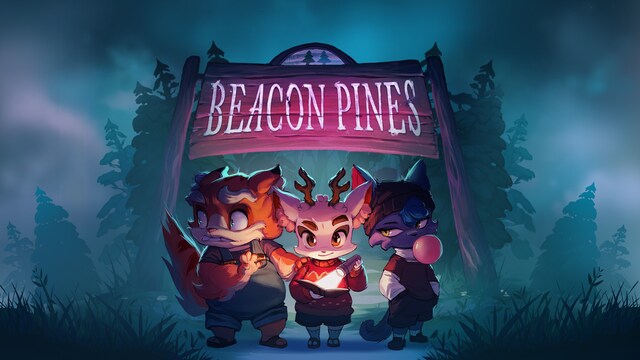
Beacon Pines: a book that hands you words to change its own ending
It’s no longer being given away · it costs US$19.99 again
See it in the store ↗This page stays as a record of what was given away.
Availability can vary by region.
The promise is to rewrite fate with every word you slot into place; the complaint that comes up most often—and even from those who recommend it—is that the path is narrower than the book lets on.
A book warns you that your story hasn't been written yet
Right from the opening pages, a book warns you that your story hasn't been written yet—and that you'll have a hand in it. In Beacon Pines you occupy two places at once: you're Luka, the boy who slips out at night to snoop around an old warehouse, and you're the reader leafing through the book Luka lives in.
What you gather along the way are golden charms, each engraved with a word. At the moments that decide where things go, you slot one of those words into a blank in the sentence—and what follows changes. Pick the wrong word and something goes wrong, and the book sends you back to the start of the chapter; you can turn the pages back and try another route.
The tone is the very blend its own tagline claims: adorable and sinister. A small town where everyone knows everyone and something out of place stirs beneath the surface. It's more about reading than doing—closer to an illustrated novel that wanders across a hand-drawn map, with conversations, townsfolk and a few fishing and restaurant minigames. Start to finish, it runs about four hours.
From the same studio comes another game—and it's born in rhythm
Beacon Pines is the work of studio Hiding Spot, published by Fellow Traveller. In mid-2026 they announced their next project, Wicked Delights: again a visual novel, this time crossed with a rhythm game. The idea they lay out themselves is to keep what Beacon Pines does well—the art, the music, the story—and add a genre the studio has been chasing since 2011, when it made its first rhythm game. In other words: if it's the look and the tone here that grab you, that's the direction the studio is heading.
The art is what everyone comes back to
The praise running through nearly every review is the hand-drawn art. One player who spent eleven hours in the game came in expecting something childish and left calling it one of the best indies they'd played in years; another, at eight hours, said they found nothing to fix and would spend days with the story in their head. The voice acting draws praise too, and more than one player mentions the artwork as something lovingly crafted in every frame.
The comparisons help place the game. A player who finished it in four hours reached for a spot-on image—Winnie the Pooh crossed with Twin Peaks—a cozy fairy tale that every so often dives into dark, adult matters; another set it near Pentiment; and a Russian who stayed twenty hours called it a spiritual heir to Gravity Falls, that feeling of a small, isolated town with some strangeness prowling around. Even players who usually find visual novels boring give in to the trick of hunting for words and fitting them into the story.
It's worth saying where these voices come from: they're on the game's page on Steam, a different store from the one where Clairo came across it, and there are plenty of them—approval over there is all but unanimous. And read closely, even the most enthusiastic keep a "but": the four-hour player who loved it still notes that the game tries too hard to look like it branches; the twenty-hour fan still wished there were more to do.
The complaint that cuts across both sides: the freedom is staged
A game whose promise is that you rewrite fate draws, in return, a stubborn complaint: the path is narrower than the book lets on. A Polish player who dragged herself to the nine-hour mark finished more out of a dislike of quitting halfway, and summed up how she felt without mincing words—a spacebar-pressing simulator. She'd expected puzzles and minigames woven into the story and found, past a certain point, a world that closes in and a walk that starts being steered from above; almost everything there is description and dialogue.
And it's not only those who quit. Within reviews that recommend it, the twenty-hour Russian wanted a dozen side stories the game never tells, with trails pointing to places the player can't reach—the impression of something wrapped up in a hurry; another Russian, who finished everything in four hours, found the ending lukewarm and rushed after so much buildup. The criticism, then, lives inside the praise, not against it.
The earlier exits come for other reasons. A Brazilian gave up after an hour—the book's animation stuttered on his computer and, he admits himself, he skipped the dialogue out of laziness, so take it with a grain of salt; another stopped near the two-hour mark, bothered by what he read as the game pushing certain agendas. The knot, in the end, isn't quality: it's expectation. Nearly all these critics still hit "recommend"—what they're warning is not to expect to decide as much as the book promises.
Who steps all the way in and who hits the wall
If you like settling in with an illustrated story, reading a lot, walking slowly through a small town and letting the mood between cute and dark carry you for about four hours, Beacon Pines was made for you—and the art alone is worth the time, that's what most people repeat. If you want real puzzles to solve, freedom of direction you can actually feel in your hands, or little reading, you'll hit a wall at the point where the world closes in and the stroll becomes a rail—and by then you'll have noticed that the charms change less than the book makes it seem. The game hands you words to rewrite fate; those who quit found that the essentials were already written before you arrived.