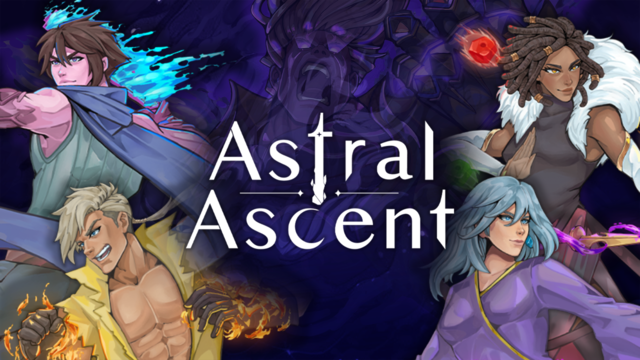
Astral Ascent: twelve zodiac guardians stand between you and the astral prison's exit
It’s no longer being given away · it costs US$24.99 again
See it in the store ↗This page stays as a record of what was given away.
Availability can vary by region.
Four escapees, fast-paced combat, and a run that punishes anyone who has to get up from their chair partway through.
Twelve guardians, four escapees, a prison that rebuilds itself
Twelve guardians, each named after a zodiac sign, watch over the exit of a prison called the Garden, and every one of them has a personal reason to let no one leave. Escaping comes down to picking one of four prisoners and learning, run after run, the attack pattern of whoever stands in your way.
Ayla is an assassin who trusts her speed: two blades, targets cut down before they can react. Kiran grew up without his parents and settles everything with brute force, punches that send out shockwaves. Calie was a sculptor before she became a warrior, and she drives magic crystals into the defenses of anyone crossing her path. Octave learned from a powerful witch and fights with weapons he conjures himself — short and brutal or long and precise, whatever the moment calls for. Each of them unlocks dozens of their own spells over the course of the game, and how you combine them is left to whoever is holding the controller.
The story doesn't arrive fully formed: it assembles itself piece by piece, revealed a little more each time a character grows stronger, slowly painting the picture of why those twelve figures chose to imprison someone in a world bursting with color. You can take it all on alone or alongside another player, on the same couch or remotely.
The studio didn't stop at launch: a new tool, a new system, a new hero
The studio released an application of its own dedicated solely to reworking the game's look: you can swap out a character, a mascot, a spell, an effect, or a screen for a version made by someone else, without touching a hidden file or a config folder. By the studio's own account, this is the start of a tool meant to grow further according to what the community asks for.
Another addition changes how people play together even when they're apart: each run came to be generated from a number that locks in the draw of enemies, rooms, and rewards, and re-entering that number makes the game replay the very same sequence, point for point. Two players can compare the same run, or take another shot at the same layout to see whether a better path turns up.
After the original launch the team also added a new hero, the warrior Arven, who arrived alongside the she-wolf Kat as his fighting companion, and it thoroughly overhauled each character's talent system — a change big enough to scramble a run saved under an earlier version of the game. A video put out by the studio showed the behind-the-scenes of this hero: scenery concepts, the animation of a new enemy, a glimpse of the work that carried on after the game was already on sale.
Combat that demands reading, not just reflexes
Anyone who has put together a strong spell combination repeats the same praise: the combat calls for coordination and, further in, for strategy — not reflexes alone. One player with 32 hours in compares the result to Dead Cells: easier, they say, and still lean on content, but with plenty of room to grow.
The progression pleases because it never stalls: each run frees up something new, and what piles up changes how you play the ones that follow. The same holds for the story, which offers more world-building than the genre usually bothers with — a player with 28 hours praises the care taken with the dialogue and with the world built around the four heroes. Not everyone buys the whole package: a 15-hour player admits to having hated the plot, yet keeps playing for the combat alone, proof that here the two live apart from each other.
The approval crosses languages: people play it in Italian, in Danish, in Simplified Chinese, always circling back to the same praise — the art and the variety of combat. And on Steam, where the game is also sold, those who came through the prison left recommending it more often than not; the list of those who grumble is long less for its size than for how the same gripe keeps recurring. Only, making sense of each new spell is work too: the list grows fast, and if all you want is to swing without thinking, you feel that weight in your very first runs.
The run that won't forgive a pause
You're mid-run, the computer freezes or someone calls you from the kitchen, and when you come back the score has reset to zero: a player with 36 hours on record sums up the complaint by saying that stepping away from the computer during a run wipes out all the time you've sunk in, turning what could have been a good game into a purely frustrating experience.
The art divides opinion among the detractors too: a player who gave up with less than an hour in describes the visuals as cluttered, with characters that have no clear outline — hard to tell a weapon from hair, hair from an arm — and points to a difficulty that feels artificial, built to punish small mistakes just to stretch out the playtime. Among Asian players, similar complaints crop up without anyone having coordinated them: a player with 4 hours notes that hits carry no weight, that there's no sound or visual feedback for damage or dodges; another, with 5 hours, complains that switching spells changes little, because the basic attack that recharges magic energy is always the same as itself.
The most repeated complaint among those who didn't take to it is about rhythm: you walk toward the enemy, hit a few times, move on to the next room, and the reward for surviving is always a small bonus — the words of a player who sums up that way much of what he calls the game. Harsher still is the take from someone who finished everything there was to finish: with 65 hours on record, this person calls the result well-made, but says the memory of it evaporates fast once you set the controller down.
Sit down once and you can't get up partway
The decision here isn't about liking the genre: it's about what you're willing to pay for it. The game demands that you read your spells and that you sit through a session without interruption; in return it delivers deep combat and a run that shifts with every attempt. Anyone who can only play in short bursts, squeezed between other tasks, never gets to learn the next guardian's pattern — here, leaving your chair costs you the whole attempt, with no middle ground.
Anyone who enjoys opening a menu and reading what each spell does before settling on the next leap will find plenty of depth here: four characters, dozens of spells, a lot to test and compare. Those who just want to wade in without thinking, on the other hand, risk frustration — some who played complained about weightless hits, and reading a fair amount is part of the package, not an extra.
Sitting down for the entire run, uninterrupted, is the toll for entry here — without paying it, the twelve guardians never even show up.