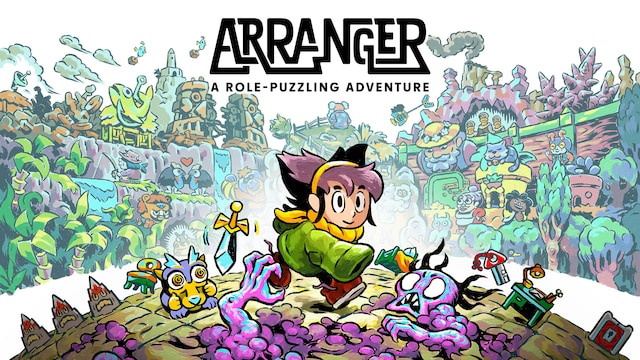
Arranger: Jemma Takes a Step and the Whole World Slides With Her
It’s no longer being given away · it costs US$19.99 again
See it in the store ↗This page stays as a record of what was given away.
Availability can vary by region.
A debut team with Braid's artist in its ranks, and a split verdict: some praise how original the mechanic is, others find it tiring after a few hours.
A Grid That Walks With You
Every step Jemma takes drags the whole world along behind her. She is the village misfit, and the game opens as she leaves the warm, narrow place where she grew up, looking for a corner where she finally fits. What she finds out there is beautiful and frightened at once, pinned down by a force the game itself calls "static" — something that does not move, and lets nothing around it move properly either.
There is one mechanic, and it carries the entire game. You take a step, and the row or column of tiles you are standing on slides with you; reach the edge of the map and you come out the opposite side, as if the world were a cylinder. Objects wrap around too, and that is where most of the puzzles come from. It is an RPG with no experience to pile up and no inventory to open: the challenge lives in the floor, not in a list of items.
It arrived on July 25, 2024, the first game from a team that already came from other heavyweight credits — among them the artist behind Braid. The main campaign is generous, with optional challenges for anyone who wants more than the story asks for.
From the Screen to a Collector's Box
In February 2026, long after the original release, Furniture & Mattress LLC teamed up with British publisher Lost in Cult to put the game into physical editions — retail copies for PlayStation 5 and Switch, plus a collector's version with a box of its own, an essay and an interview with the team.
That is not the usual fate of a debut: a new studio's first game tends to slip off the digital shelf without a sound. The team, though, is the same size it always was — the post-release update notes are small bug fixes, signed off with a single name, Nico, at the end. If you like a good game sitting on a real shelf, this one can take its place there too.
Short, Beautiful, and Over Too Soon
On Steam, the store where the game is sold, dissenting voices are rare: the common thing is for players who finish it to come away recommending it. The praise that keeps returning is for the mechanic — hours past the first room, it still rearranges the map in ways that catch players off guard — and the art holds attention throughout. You take the first step baffled, and on the second you are already working out the next puzzle just by looking at the floor.
One player who spent six hours taking it slow, soaking in the scenery and striking up conversation with the characters, on August 31, 2026, came away with a single complaint: it ended too soon. Another, at eleven hours, sums up the balance as a thoroughly pleasant game with an interesting mechanic and a new rule in every new area — and recommends it. What is left over, in the end, is people wanting more time inside the game, not less.
Too Easy, and Preachy at the Wrong Moment
A player who spent only two hours with the game, on September 24, 2026, sums up the letdown: the puzzles barely ask for effort, the answer shows up before the challenge turns interesting, and crossing long stretches of the map stops being part of the adventure and becomes a chore you want to skip. If you have ever solved a puzzle without even moving the first piece, you know the feeling.
The harshest criticism, though, comes from someone who stayed longer. A player who reached eleven hours, on November 30, 2025, grants the striking art and the original mechanic — but describes the soundtrack as repetitive, the storytelling as far too didactic, close to a sermon, and the dialogue as forced, demanding the player's attention instead of earning it. That is the same number of hours logged by the satisfied player in the section above: the difference is not in the time put in, it is in what each of them went looking for.
An Afternoon, Not a Weekend
It suits anyone after a small story that wraps up in a single afternoon, with no inventory to open and no experience to pile up — the puzzle lives underfoot, not in a list of items. Anyone after escalating difficulty will run into the very complaint recorded here: the answer comes too early, and there is no second act in which the mechanic proves more than it showed at the outset.
For anyone who just wants to follow Jemma through a world that folds around her, the problem is not whether you like it: it is that the game ends before you are ready to put it down.