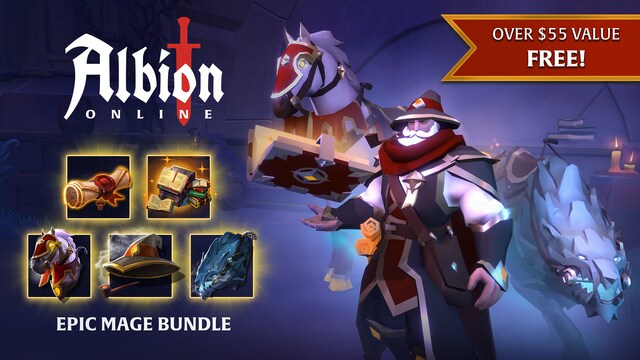
In Albion Online, the armor you wear is who you are
It’s no longer being given away
See it in the store ↗This page stays as a record of what was given away.
Availability can vary by region.
The very economy players build together is what leaves those who arrive alone most exposed.
The armor is who you are
Swap leather armor for plate, grab a staff instead of a sword, and in Albion Online you've become someone else — not by picking a new class, because there are no fixed classes here. Your gear is your identity, and it changes as fast as you change clothes.
The entire economy comes from the hands of the people who play: nearly every item in the game, from a simple tool to a suit of war armor, was crafted by someone, out of resources that same person gathered and then sold or traded in markets scattered across the world. Guilds fight over territory, tax whole cities and climb a seasonal ranking that never stops. It's an open world built — and torn down — by the very hands of those who play it, yours included, the day someone decides they want what you're carrying.
The map is still growing
Released on May 16, 2018, Albion Online didn't stop on launch day. In one of the studio's most recent posts, the Sandbox Interactive team itself filmed a video walking through the making of a brand-new region called Ancient Lands: a fresh space that promises to blend exploration, fighting creatures and player-versus-player combat within the same area, with portals of different sizes taking in larger or smaller groups. It's the centerpiece of an update called Dragonfire, presented alongside co-creative director Michael Schwahn — a sign that the team that designed this world is still inside it, opening up new ground.
Losing is part of it — and that's the hook
On Steam, where the game is sold, is where the voices that keep coming back live. One player with 457 hours logged, in a review from August 8, describes the early going as chaos: player combat, the economy and the fight over territory all thrown at you at once, with situations that feel unfair — losing your gear to another player, to one wrong call, sometimes to nothing at all. The difference, he writes, is that every loss teaches you something, and after a while you can spot your own mistake before you make it again. A second player, with 685 hours logged, sums it up the same way: there are good people and bad people on the other side of the screen, and what hooks you is fighting real people, knowing the loss is real too.
That same logic carries across languages. A review in Spanish, with 2,034 hours played, compares the start of the game to a first brush with a hard drug: it doesn't win you over right away, but after that there's no stopping, and the player recommends it even to anyone willing to lose their friends over it. A Brazilian player with 179 hours, in a review from August 10, calls the economy interesting, admits you can buy an advantage, but insists you can still go far without spending a thing.
Not everyone comes away from that attachment unscathed. A player with 1,957 hours of playtime, in a review from July 29, still recommends Albion Online — and in the same breath calls the community toxic, complains about the Brazil server and says the game used to be better than it is today. Recommending it after 1,957 hours is no cheap compliment: it's the mark of someone who stayed too long to admit they'd ever walk away.
On your own, the fall comes fast
The other half of the experience punishes anyone who shows up without company. A review from August 16, 87 hours in, sums up the problem for those who play alone or have little free time: in the red and black zones and in Avalon there's always someone willing to kill for no reason at all. A player with 18 hours, in a review from August 4, points the same way. Without a guild behind you, he writes, stepping into a risk zone means being surrounded alone by a whole group and losing everything at once; gathering resources only really pays off for those who subscribe to the game's paid plan and stack up learning points. A third, with 7 hours played, sums it up with irony: the farm is the heart of the game, and it only truly pays for those who pay for it — if he's going to pay for a farm, he writes, he'd rather buy Stardew Valley.
Some never get that far. A review from August 16, 3 hours played, says the game doesn't work: the code promised by email never arrives. And those who push past a hundred hours find another kind of wear — a review from August 3, 111 hours played, calls the RPG very good and in the next paragraph complains about the extreme number of bugs, above all in the anti-cheat system.
The most serious complaint comes from someone who stayed for years. A player with 653 hours says he's been playing since 2021. In his review, published on August 2, he describes the original concept as solid — putting on a role and swapping weapons to become someone else — and blames a change of studio after 2023 for the gradual erosion of what made the game popular, starting with the split of the servers. Another veteran, with 274 hours played, still calls the game simple and good, but describes every recent update as a fresh cut to the strength of anyone who plays alone — one weakening after another, shrinking what's left for those without a group.
For those who already have a group
Albion Online rewards anyone who arrives ready to team up — a guild, a steady group, someone to share the risk and the reward. Those who take that on find what the longest accounts describe: the satisfaction of failing, learning from the mistake and coming back better prepared, inside an economy that truly responds to every decision. Those who prefer to open the game alone, with no commitment to anyone else, run into the opposite: every risk zone turns into an ambush, every hard-won prize can vanish to another player, and the same system that builds the world's economy is what makes it hostile to anyone who arrives unaccompanied. It's not the genre that decides this — it's whether or not you have someone to call before you choose your first weapon.