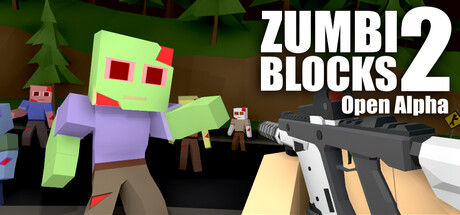
The island where zombies climb out of the ground and one man holds it all together
No deadline: it stays in the catalogue until the store pulls it.
Claim it on Steam ↗You claim it in your own store account; Clairo doesn’t claim it for you.
Availability can vary by region.
Zumbi Blocks 2 is a one-developer alpha: with friends, the reload jam turns into a running joke; alone, it turns into a reason to quit.
One island, a secret underground, and zombies that sprout from the soil
You wake up alone on an island, with no explanation of how you got there or how to leave, and the only lead lies buried underground, where the zombies come up in waves. The town around you is generated afresh every match, and that is where you scavenge for resources and trade gunfire or blades with the undead, in first or third person. Sooner or later you run into the fixed bosses posted at the most dangerous points on the map, including one that closes out every run.
Zumbi Blocks 2 started as the sequel to a browser game that was already free, and it inherited that game's knack for co-op as much as its pull for players who would rather plant their flag on the island alone. Adrian Kaminski, who handles development and publishing single-handedly, released it on April 15, 2023, and the game remains an open alpha: what is playable at this stage is a slice of what the project promises to become.
One man, asking for help to finish something that already plays
There is only one person behind the island. Adrian Kaminski keeps the game going with updates that land on a near-monthly rhythm, and the studio's own posts read like someone working without a safety net: he asks for direct donations from anyone willing to fund what comes next, and promises to put every supporter's name on a credits screen. One of those updates also arrived to fix a bug that wiped saved games, the kind of failure that would rarely reach players at a bigger studio.
The plan spelled out in those same posts is to sell a paid version further down the line, and players are already standing on its construction site: higher-tier weapons are being built exclusively for that future edition, while the free edition keeps getting a run of additions of its own, with reworked zombie models, Turkish added to the languages, game modes that unlock via achievements, and a helicopter rescue sequence that closes out the match for anyone who survives the final wave. The ground that spits out zombies is the same ground that will hold up that paid release; for the moment, the two live in the same version.
Nostalgia for the browser days finally has a real game to land on
Anyone chasing nostalgia recognizes the terrain fast: one player has zero hours in this sequel yet has followed the browser version since the days when there was no computer in the house, and calls the reunion pure nostalgia. The rest of the positive write-ups keep the same beat, in more than one language, with praise for the weapon variety, for the number of zombies on screen at once, and for how smoothly it runs even on weak machines.
The pattern among people playing in a group is simple: the experience gets better in company, rough edges and all. After 11 hours on the island with friends, one player sums the balance up as positive and points to switching weapons with the number keys as the only real friction, the sort you feel in the first few minutes and forget afterwards. Someone who has reached 447 hours, on the other hand, wants nothing but the official version, and spends part of the write-up pitching new bosses: a hospital with a doctor, a fire station, a supermarket, a football stadium.
Among the people rating the game on Steam, approval runs broad and dissenting voices are rare, and it is precisely those few voices that carry the most specific complaints, the ones that follow.
The reload jam and the final boss turn up in every language
The most common complaint comes out of badly calibrated difficulty: even on easy, you can die to a trap that feels written to cheat you, which is what one player described after 3 hours on the island. Some come to the game out of obligation to a friend rather than any desire of their own: 7 almost solid hours of doing someone a favour, according to the account, with repetition weighing heavier than fun. And then there is the newcomer who hits scarcity first, with no ammunition, no resources, lost in an empty town for a good long while and nothing happening.
The most revealing grievance, though, crosses languages. One account in Chinese, after 6 hours of play, describes a weapon swap being cancelled out whenever any action interrupts the animation, and the final confrontation arriving with no relief and no satisfying answer. Days later, an account in Russian, with 4 hours played, unloads the same irritation at the same boss. The gun jams at the same instant in two different languages; the complaint does not change, only the alphabet does. Together, those voices point at the exact spot on the map that the studio's own posts are still trying to sort out, update after update.
Bring friends and you come out ahead; go in alone and you snag where the harshest write-ups did
Round up a group in voice chat first and you win twice over: the reload jam becomes a joke you retell later, and the boss that sticks in more than one language loses half its weight when there are people beside you to laugh along. Go in alone, after a clean challenge, and you snag right at the point where you lose the rhythm of a firefight for hitting the wrong key, which is exactly where the harshest write-ups tripped as well. For anyone who followed the browser version as a kid, the island works as a reunion rather than a novelty to test; and for anyone just wondering whether an alpha built by a single person is worth installing, the answer sits in the studio's own posts: the project moves, bugs turn into repairs, and what is missing shows up on the developer's to-do list sooner than in the experience of people who have already played.