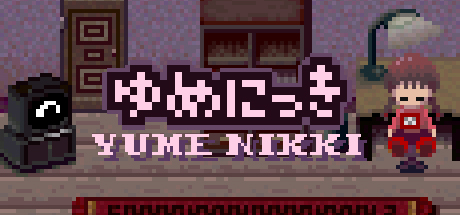
In Yume Nikki, every door turns the dreamer into something else
No deadline: it stays in the catalogue until the store pulls it.
Claim it on Steam ↗You claim it in your own store account; Clairo doesn’t claim it for you.
Availability can vary by region.
The game explains none of what it shows, and that is precisely what splits players between fascination and boredom.
Doors, Effects, and not one instruction
You step into a dream with no map, no arrow pointing to the exit, and no one to talk to. The store page sums Yume Nikki up as a trek through an extremely dark world inside a dream, and it means that literally: walking is the only thing on offer. Examine certain characters or objects and you earn an Effect; using an Effect changes how your own character looks, and a few Effects come with moves or animations of their own, triggered by the 1 or 3 keys on the number pad. Use the same Effect twice and the original appearance comes back — and an Effect can only be discarded in rooms full of doors, as though changing shape and changing room were, deep down, the same act.
There is no stated goal and no story told out loud. The store page itself calls the game divisive even among the people who already love it, and says it became one of the most famous independent games to come out of Japan — authorship appears as a single name, kikiyama, and distribution belongs to PLAYISM. There is a secret ending, and the store turns the question straight back on whoever is reading: will you get there? The game points to no right door; it only guarantees that you will pick one, and that you will lose yourself behind whichever it is.
One name, and a work that never stopped
The store page has never said who kikiyama is beyond the name. The public announcements attached to the game come from the distributor, PLAYISM, rather than from the author: a notice that the community manager was leaving, a holiday break in Japan, a promotion for another title in the house — none of it about the game itself.
The piece of news that changes something is a different one: Yume Nikki got a larger version, titled Dream Diary, with new stages and expanded maps, and anyone who already owned the first version found that expansion included. A work that looks abandoned, with no visible owner, kept being built from the outside.
The good kind of fear: having no idea where you are
First-timers usually read the tone wrong: the opening minutes look like pure visual noise, with nothing to hook onto. 12 hours in, in a review dated September 21, one player admits to nearly quitting during those first aimless minutes of wandering — and came out the other side wanting more, sorry there was no game left to carry on with. Someone who pushed further, 124 hours logged in a review dated September 20, describes being stuck in a kind of claustrophobia that never grates: the world closes in and grips them all the same. That player calls the game and its sequel absolute favorites, and grants that the experience drives off a good share of the people who try it — and held on to them anyway.
Among the people writing in Portuguese, the praise lands on the same points every time: the pixelated art, the soundtrack, the landscapes, the encounters that go unexplained. A review dated September 24, with 1 hour logged, adds all of that up and confesses a detail no spec sheet carries: its author was frightened of this game in childhood. Another, dated September 28 with 5 hours, names the best time to play as after midnight, when the mood tips into real discomfort.
Even among the people who recommend it, some confess to getting properly lost: a review dated October 2, with no playtime on the profile, describes giving in and looking up a guide after filing the dream away as a run of images too loose to tie together alone — and wonders whether every odd object hid a metaphor, or just chance.
Plenty of walking, and no arrival
The most consistent complaint goes after neither the visuals nor the music: it goes after the absence of instruction. A review dated December 23, with 2 hours played, describes hours spent with no progress and no clue what to do, sparing praise only for the soundtrack — with a warning that anyone short on patience will hate hearing the same track for that long. Another, dated September 13 with 1 hour, raises a similar grievance: hunting for a secret here means bumping into random objects and hoping one of them reacts, and whoever dug through the game's files says they found a prank left behind by the creators themselves — a message from people who understood exactly how much time the player was about to lose.
From the far side of the world, a review in Chinese, dated September 29 with 4 hours, arrived by way of the wrong genre: it came looking for classic Japanese horror and left with neither a scare nor a meaning, just boredom — the same word that resurfaces in an English-language review dated October 9, with 6 hours, which separates the praise (the soundtrack is excellent) from everything else (the gameplay wears down anyone who dislikes picking over every detail). A third, from 2021 with 1 hour played, describes a great deal of walking and very little interaction, leans the comparison toward Death Stranding, and admits the style is not theirs — while betting that fans of that other game will recognize themselves in this one.
The sharpest complaint separates the game from its packaging: a review dated December 5, with 8 hours played, calls the game itself an all-time favorite and still takes this Steam version apart — a shallow menu, weak controller support, an English translation with an error in it, and a blurry pixel resampling that the community already works around on its own, with a fan-made version. The trouble, in that case, is not the dream: it is the wrapping that delivers it. Anyone who already has the catalog of games built in RPG Maker in mind sees even less value: a review dated November 5, 2025, with no playtime logged, grants the work its place in history and still advises against it as a first encounter with the genre.
For people who like getting lost, and only them
Yume Nikki works for anyone who can walk for 20 minutes without understanding why and find that, on its own, enough. It does not work for anyone who needs an objective on screen or someone to explain what each door means — that player will open a guide within the first hour, exactly as happened to the one who tried unaided and gave up on going it alone.
It does not work either, at least in this Steam version, with its partial controller compatibility, for anyone on a controller or anyone who cares about a sharp image: that player will feel the weight of a badly hung door, while whoever plays on a keyboard and tolerates a blurry picture will miss the difference. What remains, for everybody else, is what holds up from the first screen to the last: a soundtrack nobody complains about, and a world that repeats itself in no other game.