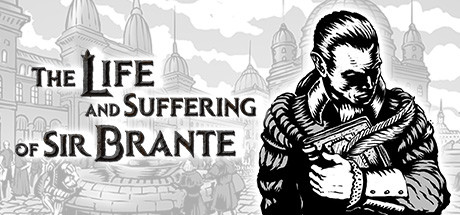
The Life and Suffering of Sir Brante: born a commoner in an empire that answers to two gods alone
It’s no longer being given away · it costs US$27.73 again
See it in the store ↗This page stays as a record of what was given away.
Availability can vary by region.
The store promises that every decision truly weighs here; the players who lived through them largely say they felt the opposite.
Born a commoner in an empire of two gods
Brante is born a commoner, with no right to a name or a voice, in an empire built on the authority of two gods who split mortals into castes: nobles in command, clergy shepherding the faithful, commoners holding the whole thing up with their own labour. To become the rightful heir of the family the game is named after, he has to live an entire life — birth to death — against tradition, prejudice and uprisings with the power to topple the structure the whole Empire rests on.
The story arrives as pages from Brante's own diary, the text paired with images that place the setting or the person he is speaking to. The game is split into chapters, and every session builds a plot of its own out of the choices and skills stacked up along the way. From childhood on, attributes such as resolve, sensitivity and endurance shape his personality, his view of the world and the relationships he manages to keep — opening or closing the roads into the plots that follow.
A continuation for Brante's world, not for his plot
The studio is clear that the continuation extends the world rather than the story: The Life and Suffering of Prince Jerian landed as a standalone drama — no sequel, no prequel, no direct offshoot — set in the same empire, carrying the same lesson that power can weigh as heavily as the lack of it.
Brante's journey also outgrew the computer: the game reached the Nintendo Switch and the Switch 2, bringing along the same experience that had lived only on computers.
A whole life, told in choices that hurt
One account, 66 hours in, says the game is hard to describe without giving away the ending: almost all of it is text, propped up with images that place scenery and characters, and the plot turns on politics and religion as the core of every choice. Pressed for something it resembles, that account reaches for a single parallel — Disco Elysium — and insists that even the best ending exacts a sacrifice, because the tragedy spares no outcome, not even the kindest one.
Another account, 43 hours deep, points to the moment decisions stop nudging small details and start redrawing the whole course of the story — including the fate of characters the player admits to having grown attached to, aware that one wrong call can cost them their lives.
From Japan, a 5-hour account describes a world that blends fantasy and science fiction in a setting charged with revolution: fixed castes of nobility, clergy and common people, gods, firearms, magic and near-alien figures sharing one backdrop. A player writing from Russia, in turn, boils the premise down to living Brante's entire life, birth to death, deciding the fate of the family and, with it, of the empire.
It is inside this same group that the rigidity first surfaces. After 62 hours, a player who recommends the game asks for one simple thing: a difficulty setting, because the requirements for certain choices and achievements struck them as far too stiff. The write-up from Poland, which treats the game as the peak of its genre, concedes the same fatigue — the sheer volume of text wears you down, and the demands of the stats sometimes frustrate.
When the stat outshouts the choice
Among those who advise against it, the praise does not vanish. An English-language account with 10 hours logged lists what works: a setting drawn from a revolution few other games touch, careful writing even with its spelling slips, and a tension that will not let go. Yet it is that very account that warns against putting time into the game.
The reason is mechanical, not narrative. The same account describes a point in the game where, without specific stats prepared well in advance, a run of bad news sets in and turns old choices into wasted effort — a flaw, in that writer's reading, common to independent visual novels. A Russian account of 3 hours sums up the effect more bitterly: the attributes and bonds built up across the game count for nothing when the final chapter decides Brante's fate on its own.
A Portuguese-language account of 33 hours describes the machinery from inside: at certain points several options lock shut at once, leaving a single road open — and that road brings benefits running against everything the earlier choices stood for. The harshest version of the same complaint comes from Germany: the developers settle on one path that works, and any decision outside it ends in permanent death.
Even so, this is the small voice: on Steam, where the game is sold, the players who came through the empire's hardest choices walked away recommending it, and the dissenters are the exception, not the rule.
Who has the patience to start over, and who does not
One profile runs through the whole of Brante: the player willing to replay the same stretch as many times as it takes to land the attribute they are missing. That is what one player in Russia did across 50 hours, finishing along three different paths — noble judge, cleric and untitled commoner — and calling their own patience a weapon.
Anyone with no stomach for redoing decisions already made finds the exit sooner. So it went for a player in Germany with 16 hours logged, who pulled the recommendation the moment they worked out that only one path leads anywhere. Here the latitude charges you in playtime rather than money: whoever refuses to pay in restarts never reaches the end of the story.