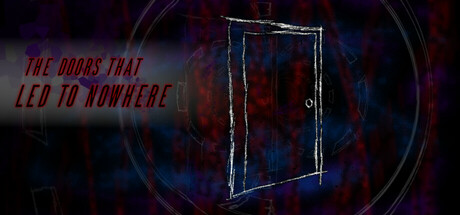
The Doors That Led to Nowhere: the sword of everyone who fell here first
No deadline: it stays in the catalogue until the store pulls it.
Claim it on Steam ↗You claim it in your own store account; Clairo doesn’t claim it for you.
Availability can vary by region.
A single-player action game that stakes everything on ten bosses and a sword borrowed from fallen creatures, kept alive by one person who never stopped tuning its most hated boss.
A sword borrowed from the dark
You open your eyes in the dark with no memory of how you got there, and the first thing the story puts in your hand is a sword that isn't yours: it belonged to fallen creatures who tried this same road and never came back. That is where The Doors That Led to Nowhere begins, and it explains nothing more — it just opens the next door. Beyond it lies a strange world steeped in shadow, full of blood-hungry creatures, and the only exit is on the far side.
The game is first-person and splices two instincts together, the shooter's and the climber's. You push forward with sword strikes, but also with measured jumps, slides and a quick dash that works as well for slipping out of an attack as for reaching a ledge that looks out of reach. The sword channels power too: you can pour lightning into enemies and teleport across the battlefield, in a system with a high skill ceiling, where getting better owes more to practice than to luck. Ten otherworldly bosses wait along the way, each with its own way of killing you, and the lost souls and chaos remnants left over from every win go into strengthening health and damage — pieces of everyone who tried and failed, folded into you.
There are five hours of world to cross, with more than one possible ending depending on the path you take. You play alone — Steam lets you share the licence with your family, not the adventure — and it installs on Windows as well as Mac.
Solomon, alone, against the electric boss they built
The name at the bottom of the update notes isn't a team's: it's one person, who signs off as Solomon and who, going by those posts, spends a good part of the time watching recordings of other people playing in order to decide what to adjust. Released on 8 November 2024, the game picked up a run of fine-grained tweaks over the following months — and the most visited target was Cerapter, an electric boss with the temperament of a superboss, whose attacks lost power with every update: a longer cooldown, less damage, a slower wind-up on the lightning. The point, as Solomon tells it, was never to strip the challenge out in one go — it was to test the water in small doses, one adjustment at a time, so that what was left would be a hard boss rather than an impossible one.
The same kind of attention shows up in the smaller details: players asked, and Solomon added camera inversion, moved the function keys around and cut the black bars for anyone on a wider monitor. In one of the updates, after noticing how many people were missing the wall jump, a grace window appeared for the moment you leave the wall — a little extra room for anyone who mistimes it by a fraction of a second.
Almost a year later, in October 2025, came a single notice: a security flaw in the Unity engine, found by a firm hired to look for exactly that sort of thing, fixed with no record of any player affected. Open the post expecting alarm and you won't find it. You'll find two lines about the problem and an immediate return to the usual subject — opening doors and dying to the game's horses.
The combat that kept someone there for ten hours
Someone who played for ten hours and wrote about it on 14 September 2026 has nothing to say about story or atmosphere: the subject is melee. Dash and teleport, in that telling, aren't stage tricks — they work for landing hits as much as for getting out, and each of the ten otherworldly bosses asks you to read its arena on its own terms, not to repeat a recipe.
It's that fit between fighting and moving that makes progress feel like something won rather than something lucky — and the account doesn't stand alone: in the portrait the store itself puts out, the game is rated very positive, and complaints there are scarce.
The real tension, though, isn't whether the combat lands — it's whether learning a system with a skill ceiling that high pays off for a world that ends after five hours. Walk in without the patience to memorise a boss pattern and the tension settles itself for you, the first door still shut.
For whoever is still standing after the fifth boss
If you like throwing yourself at a boss over and over, learning its pattern and then taking it down clean, five hours here are five hours well spent: ten otherworldly bosses, a sword that doubles as lightning and teleport. And a lone developer who keeps going back over their own tuning, almost a year after release, whenever some boss grates on players too much.
Anyone after a long campaign, or someone at their side to split the journey with, will look elsewhere: this is played alone, and the world is small on purpose. What you get in exchange is the sword in your hand from the first second in the dark — and the fact that when that sword fails you against one boss too specific, there's someone on the other side watching, ready to adjust.