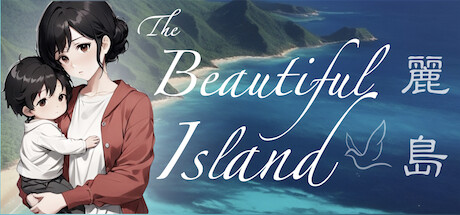
The Beautiful Island: play the side that lost the war
No deadline: it stays in the catalogue until the store pulls it.
Claim it on Steam ↗You claim it in your own store account; Clairo doesn’t claim it for you.
Availability can vary by region.
One player sees a landscape worth recommending the game for; another sees proof that a machine built it instead of a studio.
Two islands, one war
On an island that looks a lot like Taiwan, the fighting has already stopped when the story opens — though not in the same way for everyone. You can play the side that lost and was annexed by its neighbor, or the side that held out and still runs its own affairs. The one stepping off the boat is Jan, an engineer coming back to find the people he met on an earlier visit, and learning how the war reshaped what each of them thinks about the neighbor.
The choice runs deeper than picking a side: you decide whether to stay out of it or step in and try to help, and that decision shapes who Jan runs into and what those people are willing to admit. The story closes in different ways depending on what you choose — some endings kinder, some harsher — yet the studio says it plainly in its own story description: there is no good ending to a war.
The game is credited to TBF and Ma Ke, and it shipped on February 27, 2025 — a date that carries more history than it looks, because the month that followed release went into repairs.
The month the studio spent apologizing
After launch, the studio's message board turned into a repair log. The achievement that asks you to collect every character's opinion refused to unlock for a lot of players: Harry's line never showed up, then started appearing on its own once the game had been restarted, while Charlie's depended on visiting his house in one of the story's scenes, because a bug kept his statement from being recorded. Post after post went up over that one problem, each of them ending in an apology.
Amid the patching, the game picked up a Taiwanese translation — the language of the people who inspire the island in the story — and later a Japanese one, along with a promise, made at the time, of voice acting for the prologue and the epilogue.
A view that wins you over, with a caveat
A player who visited the island on June 30, 2026 praises the setting first: locations handled with care, a plot thick with mystery, and the pull of wanting to know which secret came next. In 2 hours of play they also saw the other side — a sluggish opening, technical freezes, no one to share the trip with — and they recommend it anyway, to anyone after a calm atmosphere with no violence.
The same day, another player recommended it after just 1 hour of play — thin grounds for a verdict, but enough to sum the case up with a borrowed thought: war is a trap laid by bitter old people who push the young into killing each other. It is the same handsome surface that another player would later swear was artificial.
The picture that convinced no one
On July 19, 2026, a player turned the game down over its artwork, without ever getting as far as playing it. The record shows 0 hours of play. Characters whose faces and lines shift from one scene to the next, some barely readable as human, and a distrust they extend to the store page itself, riddled, in their view, with the same kind of slip — the kind you cannot stop seeing once you have seen it. The hunch is that all of it, art and words alike, came out of artificial intelligence rather than a real studio.
There is a complaint about the story's political streak too, which was not what they came for. But the real reason is the art: the same screen that drew praise from another player was, for this one, proof of a con — the beautiful island became grounds for distrust instead of wonder.
For those who get past the opening, and those who quit at the first image
It works for anyone willing to take a slow opening in exchange for a story about ordinary people caught in the choices of a war that was already over — no combat, only conversation, decision and reunion. It works for solo players too: there is no partner to call in, and that never changes across the whole game.
It does not work for anyone who judges a game by its first image. If the art looks off on your screen, it will look just as off in the closing scene as in the opening one, because this is no passing effect — it is the game's whole style. The same view one person calls a careful portrait, another calls a machine pretending to draw, and whether you install it comes down to which pair of eyes is yours.