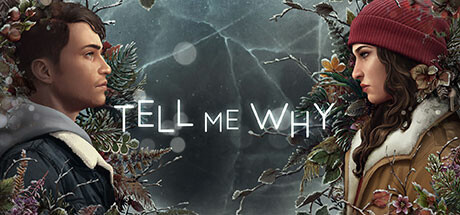
Tell Me Why: the memory that changes with whoever remembers it
It’s no longer being given away · it costs US$19.99 again
See it in the store ↗This page stays as a record of what was given away.
Availability can vary by region.
What separates the players who finish in tears from the ones who quit early isn't how moving the game is — it's how far each of them will take Tyler at his word about his own childhood.
Two versions of one memory
Tyler and Alyson Ronan have carried since childhood a bond nobody in the family ever managed to name: the twins can relive a scene from the past together, except each of them sees a different piece of it. That mismatch — not a villain, not a crime waiting to be solved — is what brings the siblings, only recently back in each other's lives, to the small town in Alaska where they grew up.
The store's own page calls their childhood beloved but troubled, and the game uses puzzles to open the way into a world the two invented as children, the Book of Goblins: a way of telling, from inside their imagination, what real life never let them say plainly. Every choice the player makes weighs on the relationship between them and on the strength of the bond itself.
Behind the story stands DONTNOD Entertainment, the studio that made Life is Strange, with Xbox Game Studios publishing. The store page also credits field research and a partnership with mental health and gender identity advocates in the writing of the script — care that, further along, splits opinion between those who call it sensitivity and those who call it too much message.
An award, a delay and the Portuguese voices that weren't there yet
Tell Me Why arrived on August 27, 2020 with its first two chapters, and closed the siblings' story a few weeks later, when the third chapter completed the trilogy.
In December 2020 the team took the Games for Impact award at The Game Awards; the studio itself credited the win to the people who played it too, calling the prize a merit it shared with the players and fans who had followed the twins' journey.
The Brazilian Portuguese dub landed only months after release, alongside the French, German and Latin American Spanish versions. The covid-19 pandemic held up the recording sessions, and the studio acknowledged that in many cases there was no safe way to record the actors at that point.
The intimacy that wins over even the players who wanted something else
On Steam, where the game is hosted, players lean toward recommending it, and the same reason keeps surfacing in one write-up after another. A Brazilian player who closed out the campaign in 15 hours singles out the dynamic between the siblings and the way one and the same event changes face depending on who is remembering it; for that person, the game touches family, identity and trauma without having to overreach to land a feeling. Another Brazilian, 32 hours on the clock, praises the turn near the end and the way the script handles subjects tied to the LGBTQIAPN+ community.
A player who spent 10 hours with it credits part of the pleasure to the Portuguese dub, even while finding the script too far-fetched in places; it is easy to picture yourself in that seat, deciding which version of your own memory you would rather accept. And someone who reached 67 hours, long enough not to be speaking from a first impression, puts the experience almost on the level of Life is Strange 2.
A positive verdict isn't always unmixed praise, though. One player with 15 hours logged likes the story and in the same breath describes the relationship with the protagonist, Tyler, as love and hate, because of the difficult temper the character drags across the family and gender drama around him. An English-speaking player, after only 2 hours, recommends the game for its setting but admits the story never spoke to him — proof that the same scripting choice that moves one person pushes the next one away.
The half that refuses the bargain
On the other side, the most common complaint is pacing. One Brazilian player wrote in without ever getting out of the introduction — 0 hours logged — because the game won't let you skip the opening; the objection is curt, but it sums the problem up: far too slow, dialogue that fails to convince from the first minute. In Latin America, in Spanish, another player lasted 1 hour: he came looking for another Life is Strange and left with little idea what he had just played.
If your patience for a dragging opening is already thin in any game, here it gets tested well ahead of the first real choice. An English-speaking player complains of padding — a simple story stretched past what it can carry — after 10 hours. Another saw everything the game had to offer in 9 hours and still calls the plot shallow.
Russian-speaking players are the harshest on the protagonist. One, at 3 hours, calls the way Tyler is built preaching dressed up as a character. Another, who got to 9 hours but prefers Twin Mirror, says the icy Alaskan atmosphere is the only high point. It is the mirror image of what the most devoted fans describe: where one side sees care, the other sees a sermon.
Who takes on the Ronan bond, and who walks away halfway
Anyone who has already accepted the invitation of Life is Strange will recognize the proposition here: a story that moves on choice rather than action, with adult siblings in place of teenagers and a frozen town in place of an American campus. The payoff is realizing, on a second look at the same scene, that your own memory has holes in it too.
Players who come in expecting to recognize Life is Strange at once leave frustrated — the same disappointment turns up in more than one language, people who dropped it inside the first hour. And players with no tolerance for a script that keeps pushing them to sympathize with a difficult protagonist don't reach the end either: the complaint comes too early, and too often, to be coincidence.
What remains is the real divide, and it is not about whether Alaska looks good or the dub sounds good — on that, almost nobody disagrees. It is about how much each player is willing to give up in order to accept Tyler's version of his own story.