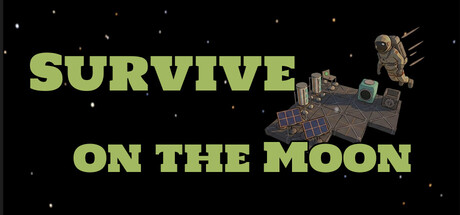
Survive On The Moon: a lunar survival game that won't let you stand still
No deadline: it stays in the catalogue until the store pulls it.
Claim it on Steam ↗You claim it in your own store account; Clairo doesn’t claim it for you.
Availability can vary by region.
The store page promises automated factories that don't exist yet, and the players who showed up at launch won the whole thing too fast to feel any danger at all.
A base that can't stop moving
The store lists automation among the game's features, then notes, right beside the entry, that this piece isn't available yet: the promise of switching on a factory and letting it run alone while you explore does not, for the moment, exist in practice. It's a rare kind of spec-sheet honesty — sales material describing what still has to be built.
The rest of the premise is easier to deliver on. You're stranded on the Moon in command of a modular rover that can't sit still — staying put is not an option. To survive, you pull wealth out of the lunar soil, process regolith and minerals into more advanced parts, and fit fresh modules onto the vehicle — living quarters, laboratory, factory — turning it gradually into a kind of fortress on wheels. In co-op, four people at most share a single session, working together to rebuild a rocket and get back to Earth.
The project comes from a small team — Amael, Noé, Françoise and Rani — with Les Industries Lavigne handling distribution. The studio calls the work a tribute to the space-simulator community, drawn from real scientific principles, and promises that no advantage can be bought with money: the only way to earn one is to survive.
Turning the rover into a factory on the move won over the player who came back in October
For players who click with that, the shift that convinces is easy to describe and hard to put down: the base doesn't stay in one place, it drives. One player who returned to the game on October 5, after two hours of play, describes the pleasure of clamping fresh modules onto the rover — living quarters, laboratory, factory — and watching the vehicle grow one piece at a time, each module felt as part of their own survival. Harvesting lunar material and processing it into more advanced components is what gives the play loop its structure, as they see it.
It's a single defence, not a chorus: the audience for Survive On The Moon is still small, and it splits almost down the middle between players who recommend the game and players who warn against it. Even the praise comes from a short stay — two hours were enough to form an opinion, come back months after release and write it up.
Players who arrived at launch won in fifteen minutes — and that isn't how it was meant to go
On April 20, release day, two players tell similar versions of the same crooked ending: they joined a session, assembled the rocket and flew home to Earth in under fifteen minutes of play. One saw an anti-asteroid weapon listed among the items but never found one available — the threat that would justify all that movement never turned up. That same player describes a fault that let them multiply a single resource with repeated clicks on the gather button after crafting an item; the other suspects they were handed more supplies than they should have been. Neither of them met real conflict on the road to the rocket — and without conflict, the reason to keep going is missing.
A player who arrived a few days later, on April 26, liked the idea but found the crafting system too simple, with no real choices, and reports running out of oxygen once — even after refilling the tank, health kept draining with no way to heal. Their promise is to come back if the studio keeps fixing things and widening the crafting tree.
On May 13, another account — this one in French, after two hours of play — confirms the trouble didn't stay in the first day: the game runs well overall, but moving the rover too fast lets it clip into the scenery, and stacking a single resource eats several slots and stalls progress. The recommendation, at this point, is not to recommend it.
For players with the patience to build what the game is still building
Survive On The Moon asks for patience on two separate fronts. The first is with the game itself: the automation the store promises as part of the survival loop is flagged, in that very feature list, as not yet available — anyone hoping to switch on a factory and leave it running alone while they explore finds, at this point, only manual crafting. The second is with the faults that carried from release into May: movement that clips into the scenery, resources that jam or multiply, and no working weapon for the threat the game's own name announces.
Players with the patience for both — and, ideally, company for a group game, since four-player co-op is where the project places its bet — find a modular building loop that at least one person found good enough to come back to months after release. Players after the survival squeeze the premise promises, with real risk and a threat that demands something, will finish the run far too fast and without quite understanding why.