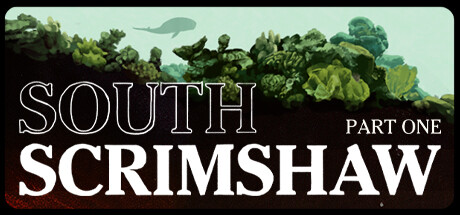
South Scrimshaw, Part One: an alien whale's life, told as a nature documentary
No deadline: it stays in the catalogue until the store pulls it.
Claim it on Steam ↗You claim it in your own store account; Clairo doesn’t claim it for you.
Availability can vary by region.
Over 400 painted illustrations, a solemn narrator and not a single choice to make: one lone creator turned three years of almost unseen work into a story set in a foreign ocean.
A mind nudged awake inside the egg
You have no name yet, no sea, no heading — only a consciousness stirring inside an egg and being prodded awake. The body comes first; everything else follows. That's how South Scrimshaw, Part One opens, and the voice describing the scene sounds like the narrator of a TV wildlife show, except the nature is invented and the ocean belongs to another world.
It's a linear visual novel: you read and you look, with no branching paths to choose between. In place of wildlife photography there are more than 400 illustrations painted in watercolor, ink and digital media, with music and sound effects underneath. This part has four chapters covering an entire life, from the birth of a male calf to the end of his adolescence, scattering along the way details of the interplanetary human expedition observing him.
The trick is in the pose. The game mimics the solemn tone of nature documentaries so closely that it signs off with the customary thanks to viewers like you, and brings all that gravity to bear on a science that doesn't exist. Who is actually behind that voice is the question the next section answers.
Three years without readers, then an answer
All of it is the work of one person: Nathan O. Marsh is credited as both developer and publisher. The project took more than three years to make, and Marsh described the mood at launch as more a tally of losses than a celebration, since up to that point hardly anyone had read the work. In the first three days, Marsh said, far more support came in than in all the previous years combined.
The rest followed. An art book of more than 200 pages came out as a separate add-on, meant to fund the work for those who wanted to see more of the project, and the games press picked up on the alien-whale premise shortly after release.
On the sequel, Marsh thanks everyone following along, says the work was done under very precarious conditions and promises longer chapters than those in this first part, with more ambitious artwork. The delay on the fifth chapter, Marsh hopes, will make sense once it arrives.
For those happy to drift with the current
Nobody chooses anything here. Anyone looking for puzzles, combat or decisions that change the course of the story will quit in the first chapter, and there's nothing to complain about: the format tells you exactly what it is.
Those who like looking at paintings, listening to a score and letting a narrator's voice lead the way will find what the game promises, on a modest machine running Windows or Linux. This part's story stops at the end of the whale's adolescence; the rest is saved for Part Two.
It's a documentary in which the only thing you control is how fast you read.