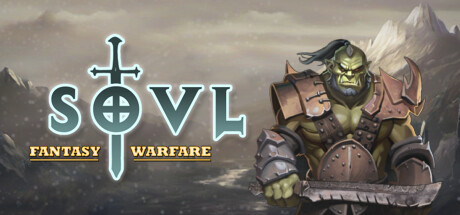
SOVL: Fantasy Warfare: you make the plan, the dice make the call
No deadline: it stays in the catalogue until the store pulls it.
Claim it on Steam ↗You claim it in your own store account; Clairo doesn’t claim it for you.
Availability can vary by region.
A fantasy miniatures war that fits on your screen, and two arguments that never leave the table: are the dice fair? And what about the art?
Armies on screen, luck in your hands
You build your army with care: commander, units, gear, color scheme. You head into battle with a plan. Then the dice roll. In SOVL: Fantasy Warfare, whether a charge lands, a volley of arrows drops someone or a spell takes hold comes down to a roll, just like at a miniatures table.
That's no accident. SOVL started life as a ruleset for fantasy wars played with miniatures on a tabletop, and Dalen Studios brought it to Steam, where it launched on June 29, 2023. The war ends only when one side falls.
The digital version includes a procedural campaign called Trail of Death, in which you start with a small warband and grow it into a mighty army capable of taking on the final boss. There's an army builder for every faction, matches against the AI to test your unit compositions, and online matches on Steam for anyone who wants to crush a friend.
Conquest: the tabletop gets a map of empires
The October 2026 update, version 1.33, is the biggest the game has ever had. It brings Conquest, still in testing: you pick a faction and build an empire on a campaign map, turn by turn, against AI-controlled rivals, while every battle is still fought out on the table. Alongside it came a new connection system for online matches and a smarter combat AI.
The studio tinkers with the game often. In February 2025, units gained miniature models that appear as you zoom in and can be switched off in the settings; in March 2026, a knights faction arrived, and the campaign got new enemies and survival battles. Not every change goes down well, as the complaints about dice and art show.
Cursed dice, and they keep coming back
The praise heard most often is that the game carries the tabletop over to the screen without losing its flavor. One player with 59 hours, coming from tabletop wargames, writes in Spanish that the system keeps the tactical charm of miniatures and cuts the tedious parts: setup, measuring, digging into the rulebook. Given the choice between a big fantasy strategy game and this one, he'd pick this one. Someone with 113 hours describes a simple, solid recreation of tabletop army gaming. Another, at 97 hours, says no game that cost him nothing has ever given him so much fun and so many hours.
The odd thing is that the dice, target of the biggest complaint, also turn up among the compliments. One player with 17 hours says the dice seem to hold a personal grudge against them, and that this makes the tabletop experience as real as it gets. Someone with 12 hours says watching a well-laid plan survive dubious rolls is what makes every battle fun, except when the dice decide to have a plan of their own.
The price of that fun shows up in the fans' own caveats. Another player, also at 17 hours, warns that most factions are paid and that the single-player content is too thin to justify spending money: good for a handful of hours without paying. And the 113-hour player only vouches for the game to those who can look past the AI-generated art.
When luck seems to pick a side
The heaviest complaint comes from those who've played the most. With 197 hours logged, one player wrote in Spanish, in October 2026, that rolls against the AI are unbearable: he needs high results for even a slim chance, while the machine, needing far less, hits almost everything.
At 36 hours, another mocks an on-screen notice insisting the dice are fair and doubts the code is an honest draw. At 18 hours, a third says the latest update made the game swingier. Chance, which the tabletop celebrates, turns into an accusation when the opponent is a machine.
The second front is the art. One player with 47 hours stopped playing once add-on packs with AI-generated art started arriving. Another, with 7 hours, likes the gameplay so much they would buy every pack and defend the game wholeheartedly if that changed; as long as it doesn't, they'd rather not play. Meanwhile, a player with 8 hours, writing in Russian, points out that half the fun goes into building armies and tweaking settings, and that the content is sliced up into paid packs. The harshest criticism here doesn't come from people who hate the game, but from people who wish they could like it more.
Plan all you like, lose to the dice
Install it if building an army, moving units and accepting the dice's verdict sounds like the best part of an afternoon of tabletop gaming. The rules are easy to learn, and players coming from miniatures say the game spares you the measuring and the rulebook lookups. You can spend hours in matches without reaching for your wallet.
Skip it early if your mood can't survive a streak of bad rolls: nobody around here swears the dice are fair, and the people who've played the most complain the most. Skip it too if AI-generated art is a matter of principle for you, because that's what drove away more than one player.
The plan is yours; the outcome belongs to the dice.