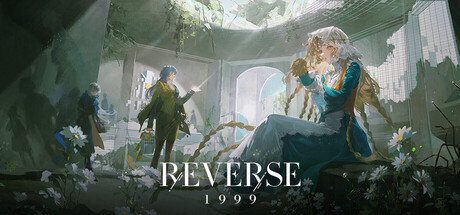
Reverse: 1999 sends the rain upward and the century backwards
No deadline: it stays in the catalogue until the store pulls it.
Claim it on Steam ↗You claim it in your own store account; Clairo doesn’t claim it for you.
Availability can vary by region.
A Storm scrambles the twentieth century, the cast speaks in accents from every corner of the map, and the game bets everything on its story — which is what sorts the players who stay from the ones who walk away.
A storm that rises instead of falling
On the last day of 1999 the Storm breaks over the world, and an entire era reels backwards in front of you while the rain climbs instead of falling. You play the Timekeeper, a witness to the ages, free to walk through whatever periods the Storm leaves exposed. Sonetto, an arcanist aligned with the Foundation, travels with you, and the job is easy to state and hard to finish: head for the places where the Storm hits hardest, find the other arcanists who can feel it coming, and pull them clear of a timeline about to sweep them off.
The trip opens in the Roaring Twenties of 1920 and runs to the turn of the millennium, and every era repaints the screen: pop art, classical oil painting and other styles mix into a world where ordinary humans share uneasy ground with arcanists — the people history filed away as witches, sorcerers or something worse. The voice cast carries the plot in the accents of its characters' origins, British, Italian, French and more, scattered along a timeline that respects neither borders nor decades.
Fights are not settled by brawling. You build the team, cast arcane spells and spend skills to bring the enemy down, on your own, with no second person required at your side.
A history lesson that never feels like one
The game landed on Steam in October 2024, made by the studio Bluepoch, but the players who champion it talk about something else: the writing. One Brazilian player with 95 hours on PC — and more than 130 on her phone, where she plays more often — says gameplay is usually the only thing she cares about, yet she caught herself rereading stretches of the story and hunting down the characters' side stories just to understand more.
A player who has reached 359 hours since release goes further, calling it the most memorable RPG they have played, because the plot braids philosophy, literature, mathematics and physics from different eras without demanding any prior background from the player — and crediting the soundtrack for pulling them back through the stretches where they almost quit. If you are the sort who stops mid-mission to read a side character's biography, you are in good company.
That appetite for a long story turns up among players on English too: one with 119 hours lists the large cast, drawn from different countries, as a selling point, along with a flow of resources he finds generous for anyone who wants to pull new characters without spending. The player who dropped the game after its six-month mark and came back later, 137 hours in total, praises the opposite: even skimming the story rather than digging into it, he can follow the main thread, the turn-based card combat is simpler than it first looks, and the game puts no pressure on the wallet of someone who only wants to log in and log out each day.
The look of the characters becomes a reason to stay all by itself. A write-up in Russian, from a player with 116 hours, says the character cards alone are worth the time, so finely drawn and so loaded with cultural references of every kind — even if the combat, in her view, will not win everybody over. That is the pattern repeated on the positive side: the gacha never comes up as a reason to keep going. What comes up is the writing, the cast, the soundtrack; the gacha, at best, fails to drive anybody off.
The same story turns into a wall for anyone who can't read English
The barrier cited most by the players who quit is not the combat, it is the language. A Brazilian player with 9 hours logged in September 2026 says the first battle was enough to hold her attention — but that without a command of English, the story and the purpose of the items she picked up stayed out of reach. With no Portuguese version, she gradually lost the thread and left the game behind. If your English is not fluent, the very plot that thrills everybody else becomes, for you, an unreadable wall of text.
Players who do read English trip over a different problem: the sheer volume of text. One with 5 hours sums the experience up as pure reading and warns that if that holds no appeal, nothing else repays the effort. Another, also at 5 hours, describes being handed too much information in one go, with no pause to digest between one revelation and the next.
The complaint that recurs most, though, is aimed at the character gacha. A player with 36 hours, after following the game for more than a year, says the luck banked in failed attempts does not carry over from one pull to the next, and that certain banners are built against anyone already close to landing the character they want — which is why he stopped putting money into it.
The same pattern shows up among players who have poured plenty of time in. One with 8 hours watched an update raise the ceiling on character progression and, in the same package, wipe out what those characters had already banked, and answered by taking the decision to task in public. A player at 193 hours went further, leaving a negative review purely on principle, annoyed at the way the rebalancing treated the characters he had chosen to back.
English, patience and a stomach for gacha: the list of entry requirements
Reverse: 1999 is open about what it asks for: reading time, a working grip on English, and a stomach for a gacha that decides which characters end up on your team. Bring all three and you find a rare kind of RPG — a multicultural cast, a soundtrack that pulls people back after months away, and a story that blends philosophy and physics without asking anybody for a diploma.
Anyone who cannot read English is shut out of the whole conversation, not just one piece of it: the missing Portuguese translation is no footnote, it is a door slammed in the face of the players who would recognise themselves most readily in a cast speaking with accents from every corner of the world. Anyone who wants a quick battle with no reading attached, or who has been burned by an update that zeroes out progress already earned, gives up well short of the first arcanist. This is not a game you switch on and simply play: it is for you, if you are willing to start by reading.