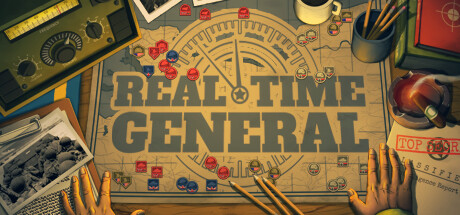
Real-Time General: a war that takes two months to end
No deadline: it stays in the catalogue until the store pulls it.
Claim it on Steam ↗You claim it in your own store account; Clairo doesn’t claim it for you.
Availability can vary by region.
Four hundred generals, a map of Normandy and orders that take as long as they would in real life.
Trenches take hours, battles take days
Digging a trench takes hours. A battle can drag on for days. Nobody fast-forwards anything in Real-Time General: every action takes as long as it would in reality, and the full campaign lasts two months.
It's June 6, 1944, and you're a general with a map, a radio and 400 other players. One battalion on its own won't cut it. An artillery barrage, a tank squadron, a flanking move — none of it happens unless somebody coordinates with somebody else. You pick your uniform — American paratroopers, the British artillery regiment Essex Yeomanry or the Canadian armored regiment Fort Garry Horse — and your role: infantry, armor, artillery, anti-tank, headquarters, intelligence, engineering, naval artillery, air support or logistics.
Can't make it? The war carries on without you. You queue up your orders at the start of the day, come back later and find out what your troops got up to. Battalions that gain experience unlock new units and perks, and players who rack up medals and promotions earn the right to command others.
Normandy, drawn over the real ground
This is no generic backdrop. Normandy has been modeled on its real geography: beaches, woods, marshes, villages, plus the roads, crossroads and bridges worth seizing. Hills and folds in the terrain are there for setting up a flank or an ambush.
Every place your troops reach comes with historical photos and footage pinned to the map: soldiers splashing ashore at Omaha Beach, British paratroopers silencing artillery batteries behind enemy lines. There are more than 2,500 historical documents in all. The game doubles as a history lesson.
For players who find the waiting half the fun
The audience is narrow and clearly defined. Do you like planning, bargaining for artillery support over chat and watching the consequences land hours later? The map is yours. Would you rather push a button and watch things happen, or play solo? You'll give up at the first slow order, because a lone battalion achieves no objective at all.
The game is 2D, runs on Windows and copes fine with a modest machine. The war here is slow on purpose: what the game asks of you is patience and conversation, and that is exactly what it delivers.