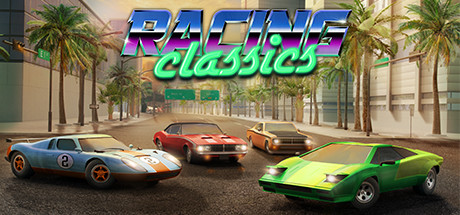
Racing Classics: a vintage drag strip where the wheel is never yours
No deadline: it stays in the catalogue until the store pulls it.
Claim it on Steam ↗You claim it in your own store account; Clairo doesn’t claim it for you.
Availability can vary by region.
Sixteen classics from the 70s and 80s line up on the drag strip, but career progress hangs on a tank that refills by itself — or fills in one go, with currency you can buy inside the game.
Throttle, shift, nitro — and that is the whole of it
A game that sells the drag-racing fantasy — two cars side by side, flat out toward the finish line — is missing a part you would think obvious: the steering wheel. One player with zero hours on the counter summed the experience up in 2024: speed and gear changes are yours to command, the line is not — the track decides where the car goes.
It is a drag-racing simulation dressed in the style of the 70s and 80s: sixteen classic cars, each tunable part by part — gearbox, engine, nitro system — and ready to take on a rival in straight-line races. Story mode gathers more than 45 stages, with leagues and a leaderboard for anyone who wants to run the same route again chasing a better time. The studio behind it is T-Bull, which released the game in 2019.
Recommending it is not the same as being happy with it
Players who arrived back in 2019 praised visuals that stay smooth even on low settings, with the picture in the almost square shape of old screens, and described controls that click after a few minutes of practice. A player with 19 hours in the game, writing in 2024, echoed the praise for the graphics and the range of cars, likening the upgrade parts to those of any souped-up racer — but added a warning: anyone who likes harder-edged action games gets bored fast, because every race follows the same script, throttle, shift, nitro.
The yardstick shifts once the long-haul players get specific. With 47 hours on the clock, one of them tallied it item by item in 2025: a soundtrack that merely does its job, simple but functional visuals, and a mechanical tuning system that let them down, too thin to give any depth to building the ideal car. Another, at 10 hours, finished the main campaign satisfied — and a moment later had nothing left to do. Go past the main story wanting more and that is what waits: the game empties out along with the credits. Some recommend it with gritted teeth. A review in Polish, favourable in its official verdict, describes the same foundation as a poorly disguised phone game, one where the parts to upgrade your car get expensive fast and charge you in waiting.
You command the speed, never the line
The complaint flagged at the top gets a name here: a player with zero hours on the counter, in 2024, boils the game down to a machine for flooring the throttle and changing gear, with no steering at all. If turning the wheel was the point for you, this drag strip is not yours — the car only goes faster or slower, never to one side or the other.
The heaviest criticism comes from someone who stuck with it for seven hours, in 2020: closing out the campaign mode in full means buying, with the game's own currency, the cars that certain race categories demand, and that person describes constant prompts to spend real money, adverts included. The verdict was not to recommend it — a small game that treats the person playing as a revenue stream first and a player second. Another, who lasted a single hour that same year, frames the problem differently: what may work on a phone wears thin on a computer and does not convince. Even so, the harshest grievance also took seven hours to ripen. It did not arrive in the first few minutes.
Enough for a weekend — not for the whole garage
Racing Classics serves anyone who wants to sit down, hit the throttle and change gear without learning a technical curve: the classic cars of the 70s and 80s are the shop window, the straight-line launch is the verb, and that is everything the game promises to deliver. If your Saturday off asks for one silly, loud thing on screen, this is it. It also serves anyone untroubled by having category progress depend on an in-game currency that either piles up as you play or gets bought — and people who bristle at that kind of wall learn from the reviews themselves that they will run into it.
Anyone after a real simulator, with the steering in their own hands, drops out inside the first kilometre: here the wheel is not yours to turn, only the speed is. And anyone planning to live in the game for months should remember the account from the player who finished the main campaign and found the void on the other side — the fun lasts the length of the story, no further.