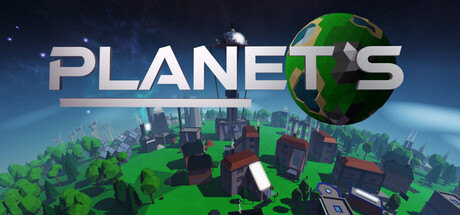
Planet S: one solar system, 24 planets and a fork between science and war
No deadline: it stays in the catalogue until the store pulls it.
Claim it on Steam ↗You claim it in your own store account; Clairo doesn’t claim it for you.
Availability can vary by region.
Plain visuals, lightning-fast rivals and a baffling tutorial: what to expect from a space strategy game its studio keeps patching.
When your workers have to become scientists or soldiers
You start with a ship and enough material to found a single colony. Around you, the solar system holds up to 24 planets generated at random by the game, each with its own look, soil fertility and resources. Claiming an empty planet takes nothing more than building a spaceport on it.
The hard part comes later. Residents demand goods, goods demand production chains, and those chains grow more tangled with every housing tier you reach. At some point your first planet can no longer keep up, and expansion stops being a choice and becomes a necessity.
In the second stage, the game forces a decision. Your workers can become science residents or military ones, and each type generates its own research points, with an upgrade tree and buildings exclusive to it. You can play solo or bring friends along, strike deals or go after your neighbors — and the same match takes on a different face depending on the path you chose.
Yesterday's graphics, a system that sticks
On Steam, where the game is sold, players who stuck around tend to open by apologizing for the visuals and close by praising everything else. One with 10 hours on record admits the game looks old but considers it a very good colony game. Another, at 34 hours, points to the sheer number of mechanics and how light it is: it runs well and takes up little disk space.
The fullest picture comes from someone with 19 hours. To them, the game is a carefully crafted collection of ideas whose core recalls a resource-trading board game, only set in space and wrapped in city-building. They stress that you don't need to be aggressive to win, which makes room for attackers and defenders alike. A third voice, with 11 hours, likes precisely the simplicity, and someone who spent 7 hours with it found the difficulty low — good for passing the time once the top-tier buildings are unlocked.
This is where the charm shows its cost. Simplicity that welcomes is also simplicity that runs dry.
Too fast, too repetitive, confusing right out of the gate
The complaints contradict each other in a curious way. One player who logged 7 hours and left unhappy grumbles that the computer-controlled opponents are fast at everything, even on the lowest difficulty; someone else, also at 7 hours, found the game easy. For the first, keeping pace with the AI is an ordeal; for the second, a match is a stroll. The difficulty is adjustable, and the gap between the two accounts shows that finding the right setting takes some trial and error.
Those who quit early tell a different story. After 1 hour, one player found the tutorial very confusing and the gameplay less than clean, though they saw potential. After 2 hours, another gave up out of boredom: everything felt repetitive, and they regretted that you can only colonize your own solar system, with no route to others.
There is also an old warning, from someone who stayed 3 hours, that the program pushed the graphics card to its limit. Among the voices gathered here, it is the only one in that vein, and the studio's latest updates are still dealing with crashes.
The studio's news feed is built on fixes, not promises
Glimmerlight Games ships fixes. Its Steam news feed is a string of small updates, and two of them change the face of the game. One raised matches to eight players, human or computer-controlled, with a reworked diplomacy menu to handle the crowd. Another moved save files out of the installation folder, where anyone not using an administrator account simply lost their progress.
The latest one carries a detail that says a lot about the game's mood: the studio closed a loophole that let players squeeze infinite money out of computer-controlled opponents through diplomacy. Talks with the AI had a back door, and then came the fix.
For players who build production chains and aren't itching for new scenery
Planet S suits people who like watching a colony grow more complicated bit by bit: more residents, more demands, more planets to supply. Anyone after action-game pacing loses nothing, since the game never asks for quick reflexes and lets you save at any moment. On the other hand, it requires a processor with at least four logical cores and won't run on Intel integrated graphics, which rules out a share of basic laptops from the start.
Those who push through the confusing first hour and accept plain visuals will find machinery that keeps people playing for 34 hours. Those expecting a second solar system, or a tutorial that holds their hand, give up early.