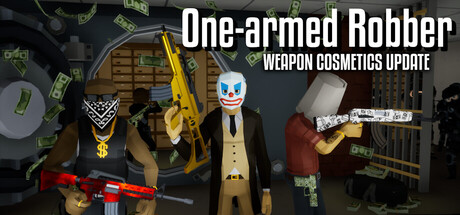
A robber with one arm, and the partner who lends the other
No deadline: it stays in the catalogue until the store pulls it.
Claim it on Steam ↗You claim it in your own store account; Clairo doesn’t claim it for you.
Availability can vary by region.
The first heists ask for nothing but the nerve to walk in one arm short; players deep into the game say the later ones ask for your wallet as well.
One arm, two hands — if you bring a partner
One-armed robber begins in a deliberately stupid place: you come in the front door of a bank as the robber with a single arm, and the security team will cut you no slack for it. The obvious way out is to call a friend: together, the heist adds up to two arms, and the jobs one person cannot handle at the same time — hauling the bag while also answering whatever walks in — stop being a problem. Slip in quietly with a suppressor on your weapon, or come in trading fire with an extended magazine and ammunition to spare: the choice is yours, and the game pushes you toward neither.
Inside the vault the goal never changes: take as much loot as you can and get out alive. When the canvas bag will not hold everything, you sprint back to the truck for an empty one, or shout for your partner to help carry. Weapons and tools unlock with experience, and every new tool opens another way to solve a room that used to have a single answer.
A small studio patches its own game, and the press abroad took notice
One-armed robber is signed by Duhndal, which distributes it too — no label sits between the studio and the player. In January the studio dropped automatic matchmaking for an old-fashioned server list, handing players back the choice of where to drop in. Months later came weapon skins and a new map, at no charge.
A PCGamesN piece, reposted on the game's own community wall, described trading a bigger-name heist franchise for this one and praised the physics of its action; the same article recorded a harbour area and a batch of explosive weapons arriving in a single update. The studio's most recent fixes aim squarely at that kind of complaint: guard sightlines were adjusted so you are not caught in ways that feel unfair, and key rooms across the maps were redrawn to read more clearly.
From the joke of the solo player to the reckoning of the one who never stopped
A player with six hours in sums the experience up with sour humour: loves it, except that their friends are too useless to help on the heists, so they had to finish the whole thing alone. The complaint is good news in disguise — it shows the game holds up without a partner, even though it was designed for two hands. A second account, at sixteen hours, describes the satisfaction of juggling several things at once inside a single heist to meet the objective; it is the variety of tasks, not the repetition, that keeps this player hooked.
A third player, after thirty-two hours, still calls it one of the favourites among the no-cost titles they have tried — and it is that same player who misses more frequent updates. A fourth account, at four hours, praises how well the game runs even on their weaker computer, and takes pleasure in facing waves of guards who blunder badly. Writing in English, someone with five hours logged sums the package up as light to install, steady on modest machines, and better in company.
The harshest opinion, though, does not come from someone who dropped in and left: it comes from a player past ninety-nine hours of holdups. That player keeps playing, but lays out what the hours revealed — nearly every new map sits locked behind a payment, the gear picked up along the way makes the heists far too easy past a certain point, and genuinely fresh jobs barely turn up. It is the same old compliment — the game grips you — only spoken by someone who found out what staying costs.
The mutiny comes later: when the stock heists run out
A German player, six hours in, points to a design choice that wears you down more than any enemy: failing near the end of a heist sends you back to its start, with no save point along the way. That is the complaint of someone who wants to keep going, not of someone who wants out.
A Spanish-language write-up, after a single hour of play, is blunter: it argues the item shop weighs more than the optimisation, and that the player's computer — above both the minimum and the recommended specs — stuttered anyway.
From there the same subject repeats in one language after another. A Czech player, at twenty-one hours, sums it up as fun but starved of new updates and loaded with item purchases: the crates cost nothing, the fresh skin or trinket inside them does. A Russian, after thirteen hours, reports clearing the available heists without paying and coming to feel that the next map cost more than it was worth. A Swede, at six hours, has nothing against the shop as such — only asks that it sell decoration rather than the most profitable heist in the game.
The criticism, in the end, is not that the game is bad: none of these accounts says that. It is about where the opening generosity stops — the first heists cost nothing, the ones after them route you via the shop, and the queue of new content moves slower than the people playing would like.
Install it if you have someone to split the bag with
One-armed robber serves players with a regular partner well — or at least someone willing to show up here and there: the game was built around two hands working together, and you learn which group you belong to the moment you settle whether there is anyone to call. Solo players, like the one griping about useless friends, feel the absence even as they finish the heists. It also suits anyone on a modest machine who wants a short, chaotic session without installing anything heavy, and the accounts confirm that more than once. It does not suit anyone expecting a catalogue that grows as fast as the urge to play: once the maps and heists available without payment run dry, the same wall shows up in account after account, and it does not move just because the player keeps pushing.