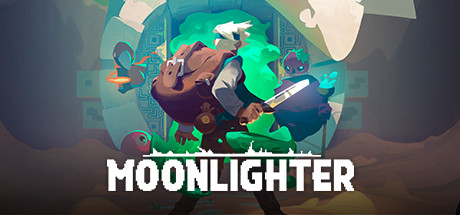
Moonlighter: behind the counter by day, deep in the dungeon by night
It’s no longer being given away · it costs US$19.99 again
See it in the store ↗This page stays as a record of what was given away.
Availability can vary by region.
Being merchant and hero at once is a charming idea — until the controls get in the way.
By day at the register, by night in the dungeon
Half of Moonlighter plays out behind a shop counter. Will is a shopkeeper in the small village of Rynoka who dreams of becoming a hero, and the village has grown up beside a dig site where portals to other realms have opened. By night you step through those portals and come back hauling whatever you can carry; by day you put the loot up for sale in your own shop. The twist that changes everything: selling isn't automatic. You have to guess what each thing is worth — ask too much and the customer grumbles and walks out; ask too little and you realize too late that you got shortchanged.
The dungeon is the other half. Combat comes down to weapon, timing and positioning, and you don't bring everything back: your bag is cramped and forces you to choose what leaves with you. Every descent can end in death, and death sends you back to the start — but the gold you've banked and the gear you've built and enchanted stay with you. That back-and-forth is what the game lives on: you risk the dungeon to stock the shop, and you work the shop to fund the next descent.
The studio already has its eye on the sequel
Moonlighter is nothing new: it came out in 2018 and, ever since, Digital Sun has patched it to death. There have been balance tweaks, quality-of-life fixes, minibosses and new gear, a Companions system, more than a hundred room layouts and a New Game+ mode for anyone who finishes and wants to start over on a harder setting. In May 2026, the studio celebrated the game's eighth birthday. The version that arrives today is the most polished it has ever been.
But the studio's attention has moved to a new address. Moonlighter 2: The Endless Vault is already in early access and is slated to release in September 2026. That fact changes how you read the original — and this is where the harshest criticism finds its ammunition, because while the sequel was growing, an old complaint about the first game went unanswered. Which complaint? The next section tells you.
They thought it was all dungeon; they stayed for the shop
Those who stay tend to stay for the same reason. A player with 243 hours, writing in late July, says he started out thinking it would be just another little dungeon game and got hooked once he realized half the fun is at the counter — working out the price of each item becomes a puzzle you solve by eye, and haggling and catching a thief inside the shop is every bit as fun as heading down to fight. Another, with 36 hours, admits flat out that the game is repetitive and recommends it anyway; a third strung together eleven hours in his first sitting. The routine of looting, selling, upgrading the shop and upgrading your gear is simple, and that's exactly what holds you.
The sharpest observation, though, doesn't come from those who hated it — it comes from those who like it. A player with 9 hours says the gameplay is great and, in the same breath, that the controls are the worst part of the package: he spent twenty minutes remapping everything before he could play in peace. Another, with 27 hours, praises it and still cries for help — he's colorblind, can't tell the gelatinous enemies from the scenery, and begs for a colorblind mode. Liking the game, here, almost always comes with a 'but.' The reviews gathered in this article were taken from the game's own page on Steam.
The menu you can't open on the keyboard
The complaint that comes up most, in Portuguese, English and Chinese, is the same one: keyboard and mouse. Several players — some with zero hours logged, because they never got past the title screen — gave up because they couldn't figure out how to set up the keyboard. The way to open the menu in that configuration is buried in a support page that the studio itself has flagged as something it won't fix. Switch to a controller and you hit another wall: some report that the triggers, instead of performing the dodge, only paused the game. It's the kind of barrier you run into before you even get a chance to like it.
Those who make it through the door find other limits. A Brazilian with 15 hours quit at the lava boss and sums up the problem: after the second dungeon, the loop that charms turns into a chore — and he ran into bugs too, like a ring that was supposed to grant immunity and didn't. A player who wrote in English, with 6 hours, makes the most honest critique of all: he says the art and the soundtrack are top-notch, and that's exactly why it hurts — the combat is tough, the dodge is clumsy, and the shop side is, deep down, trial and error dressed up as strategy. Nobody there thinks the idea is bad. What wears you out is the execution — and the walking away.
Keep a controller nearby — or don't even start
Moonlighter is for anyone who enjoys the double rhythm: the risk of the dungeon by night and the small pleasure of running a counter by day — setting prices, serving customers, grabbing the thief before he slips off with the goods. The pixel art, as lovingly done as the Zeldas of the Super Nintendo era, helps keep you there. Anyone who likes a short, clear loop that rewards you every time around tends to warm to it fast.
The ones who'll quit have a clear address too. If you play on keyboard and mouse only, you'll hit the wall before the game even starts. If you're after precise combat, the attacks will feel stiff. And the loop that grips some starts to weigh like a task around the second dungeon — that's the point where a lot of people walk away. The overall reception still leans firmly toward the good: the large majority recommend it. But what stops most of those who quit isn't the dungeon or the shop — it's the controls. Without one in hand, you stop at the door.