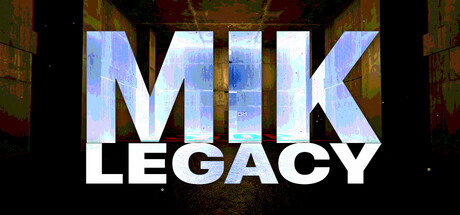
Mik-Legacy: the prototype a 14-year-old kept rewriting
No deadline: it stays in the catalogue until the store pulls it.
Claim it on Steam ↗You claim it in your own store account; Clairo doesn’t claim it for you.
Availability can vary by region.
The same thing that holds up the game's atmosphere is what snags the character mid-jump — and that is where the experience splits.
A sketch of a world that has already ended
Mik-Legacy started out, in its creator's own words, as a bad project he made at 14 — and it is that version, untouched, that makes up the game available here. Inside an abandoned facility there is no one to meet: only empty corridors, forgotten rooms and the silence of a world that has already passed. You cross the place chaining jumps, climbs and sprints across the ruins, in a short, linear experience that calls itself complete on its own terms, with no apology for its size.
Anyone who has walked those corridors describes brutalist architecture, all metal and steam, built from few polygons with the edges on display — a look that carries much of the atmosphere on its own, with no need for fine textures. The studio itself treats this release as a prototype: the original version that was meant to be just an update and grew, along the way, into an entirely new game, still in production.
From a teenager's bad project to the prologue of the game to come
The first version of this game came out on 1 November 2021 — the start, according to the creator himself, who signs as Stefaaan06, of a long road as a solo developer. Over four years, the project saw five different versions. It also moved Steam pages twice, on a path that ends at the one carrying this name.
October 2025 brought the version that occupies this page: a relaunch with new levels, achievements and a full soundtrack, described by the studio itself as an older version of the game that was coming. Shortly after, an update patched a serious security flaw that Unity, the engine used across part of the games industry, had just disclosed. On 1 November 2025, the project's anniversary, the studio went back in: it added new mythology to the world and adjusted the sound, a sign that the childhood sketch is still being looked after while the bigger game remains unfinished.
The atmosphere lands first, the parkour stumbles later
On Steam, where the game is scored, the store sums up the general reception as mixed — and the split comes less from the genre than from how much each player will put up with the jumping. One player from 5 July 2026 boils the experience down to a world of mysterious atmosphere, low-polygon visuals and heavy architecture. They say the parkour worked for them in this roughly 15-minute prototype, which served as the groundwork for the project that followed.
The player who came back on 23 August 2026 went further. They describe a session of about 50 minutes as one of the most striking they have had, even while aware that what they are playing is an old version of the game. The parkour, for them, is fun but still somewhat stiff — mostly in the weight of the character and in the collisions — a flaw this player already expects to see fixed in the larger title the studio is preparing.
Other accounts from August 2026 repeat the same pattern: they like the mood and the story doled out in pieces, in notes and computer screens scattered around the facility, but they warn that the movement drags more than it should. On 9 August 2026, one of those accounts narrows the appeal to monumental structures and a narrative full of gaps, carried along by a mysterious voice — the same element that returns, in a far more hostile register, in the harshest complaints about the game. And on 18 August 2026, another player, who also enjoyed the old version, advises anyone giving it a try to go straight for the newer version of the game.
When the ground does not trust the character
On 18 August 2026, more than one person wrote about the same problem, each in their own way. One says they like the mood and the visual style, yet find the movement so uncomfortable that it nearly made them sick. The other goes straight at the level design: the character jumps farther than the gaps between platforms ask for, so the jumps are too generous where they should fall short — and the password puzzle along the way adds nothing to the experience for this player.
The one who played the version on 9 August 2026 wrote the longest case against the game. They had four hours logged in the game on the side — the heaviest play time among the complaints — and compare the mysterious voice that comments on the player to the one in another classic set in a hostile complex, yet say they do not find the same rigor of puzzle here, since the codes turn up a few steps away from whoever needs them. They also complain about the controls: simple actions such as dragging an object ask for an extra key on top of the click that ought to be enough on its own. Even so, this is the person who stayed longest — the harshest complaint did not come from someone who quit early, it came from someone who kept playing.
Who a self-declared sketch is for
This is the kind of game that pays off most for people who enjoy seeing a project mid-road — the game still in production, far from finished. Anyone willing to accept stiff jumps and an unpredictable character fall in exchange for an abandoned setting with real weight comes away satisfied, as the accounts of players who reached the 50-minute mark with no regrets make clear. Anyone who needs precise control, a puzzle that holds up past the first glance or a movement curve without jolts will run into the very points the unsatisfied part of the audience has already run into — and for those who get motion sick from an erratic camera, the risk is literal, not a figure of speech.