Meteor 60 Seconds!: Earth ends in a minute, and that minute is yours to spend
No deadline: it stays in the catalogue until the store pulls it.
Claim it on Steam ↗You claim it in your own store account; Clairo doesn’t claim it for you.
Availability can vary by region.
Plant an apple tree, or commit some petty crime — the game promises you can do absolutely anything in the face of the end, and the reviews disagree about how much of that promise is real.
One minute left, and anything goes
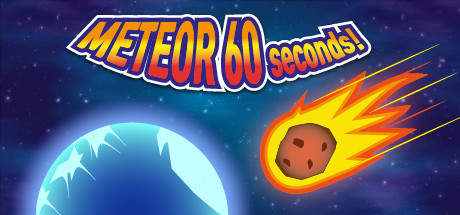
NASA confirms that a colossal meteor is about to destroy the planet, and the game drops the announcement without ceremony: one minute of life is left, and what happens to it is up to you. The studio's own list of examples mixes the absurd with the domestic — commit some petty crime or, at the other extreme, plant an apple tree — and the gap between those two poles is where the game finds its comedy. The action plays out in side-scrolling form, pitched like a comic strip.
The store page lists multiple endings among the game's features, and that is the pledge the harshest criticism comes back to later: different decisions ought to open different paths.
The studio did not stop at the first meteor
Shortly after release, AvoCavo — the studio behind the game — translated the text into Russian, Chinese, German, Spanish and French, on 1 April 2018. On 3 April of the same year, it took the game to phones as well.
Years later it came back to the same subject in a separate game, 'Meteor Volleyball', released in 2022. In 2023 it switched genre entirely with 'Youtuber Survivors', an action game in which the player teams up with fitness, piano and gaming video creators to hold out as long as possible. If the quick-gag tone of 'Meteor 60 Seconds!' worked for you, the same studio is behind both.
Laughing at its own simplicity, and recommending it anyway
The players who approve of it do not pretend the game is big. On 7 September 2026, a Brazilian review builds its entire verdict as a fill-in-the-form gag — it likens the graphics to an almost primitive drawing and the complexity to a cartoon for very small children — and recommends it all the same. It is the kind of joke you recognize if you have ever laughed at a game for being deliberately bad.
A few days later, on 12 September 2026, a Russian review describes a short, varied session, good enough that the writer makes up a scoring scale of their own just for that moment. Neither text logs a full hour of play — the praise is quick because the experience is too.
The same complaint, twice over: short, and always the same
The criticism that recurs is not about difficulty, it is about repetition. On 26 February 2024, a Brazilian review sums up the disappointment. The game is over in 20 minutes, and it leaves the player no reason to come back.
An older one, from 2 March 2018, agrees on a different detail: whatever you choose during that final minute, the road converges on the same kind of ending, and the options along the way did not strike the player as creative. Go in expecting your choice to carry weight and it feels like pressing a button that was wired to nothing. This is the promise of multiple endings hitting its ceiling: the game offers decision, but no branching.
For people with a minute to spare, not an afternoon
This is a one-sitting game, not an afternoon's worth: anyone willing to spend twenty minutes on a joke about the end of the world comes away satisfied, like the texts that recommended it while laughing at its own graphical poverty. Anyone expecting the choice to matter — expecting an apple tree to lead somewhere other than a petty crime — closes the game with the same complaint as the detractors: having decided without the decision changing anything.
The game lets you pick the final scene of your own life; it just will not let you write a different ending. If what you are after is a good joke that fits into a break in the day, it is served. If what you are after is consequence, what is left is a clock at zero and nothing else.