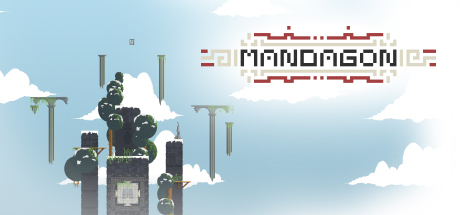
Mandagon drops you into the Tibetan limbo, and not everyone wants out
No deadline: it stays in the catalogue until the store pulls it.
Claim it on Steam ↗You claim it in your own store account; Clairo doesn’t claim it for you.
Availability can vary by region.
A contemplative platformer about sacrifice and about Bardo, the Tibetan limbo between two lives: the same stillness that some players call relief, others call a game that ends when it should be getting started.
A gate that will not open without a sacrifice
You climb. Mandagon sets you loose on a vertical map drawn from Tibetan theology and philosophy and sends you upward, platform after platform, toward a gate that opens only for a genuine sacrifice. The game calls that in-between state Bardo — the Tibetan word for the limbo between one life and the next — and the whole map is built as a translation of it: what brought you there is something you never quite learn, only that you have to keep climbing.
There are no enemies, no combat and no way to die; the threat here is never physical. Exploration is free and non-linear across a 2D world that unfolds as you ascend, and totems scattered along the route hand over the story in loose lines, with no dialogue and no cutscenes. This is a game built around atmosphere: the soundtrack carries the dramatic weight that the deliberately simple play does not.
The adventure fits into a single sitting and ends the way it begins: without warning. That abrupt cut, more than any puzzle, is what splits players from there on.
A small studio that never let go of this world
Blind Sky Studios released Mandagon on August 3, 2016, and handles its own distribution as well — a small studio running its own game end to end. In 2017 the studio ported the climb to Android, proof that the map held up even on a phone screen.
April 2018 brought the most ambitious announcement: a sequel called Mandagon: Bones of Clay, promising to expand the world, the narrative and the philosophy behind it. The studio itself described the production at the time as barely under way.
In late 2019, Blind Sky gave its audience something else back: the soundtrack and the digital artbook started shipping inside the game's own installation, for anyone who already had it in their library. Install the game and both files come along, with nothing on the start screen to announce them — a quiet gesture from a studio that never took its eyes off this world.
The same compliment, from opposite ends of the world
Players tend to come away recommending Mandagon, and what that result hides is more interesting than it looks: the favourable write-ups and the harsh ones point, almost every time, at the same quality of the game. On the recommending side, it reads as relief. One write-up dated September 13, 2026, posted after an hour of play, sums up the tone: with no enemies and no way at all to die, you can simply follow the map — which keeps you from getting lost — and enjoy the soundtrack, which carries most of the mood.
In Portuguese, the praise comes out drier. A Brazilian write-up from September 14, 2026, also after an hour, calls the game short and calm and measures it against the studio's other releases — the line of someone who knows the catalogue and knows what to expect.
The praise that keeps coming back on the favourable side is the same one: short, beautiful, relaxing. It is sincere — and it is also the exact complaint of players who wanted more. One player who reached five hours, longer than most, puts the problem bluntly: the visuals are lovely, the soundtrack is good, but something is missing — because climbing without pause is not the same as having something at stake.
When the credits roll in the middle of the tutorial
The complaint that recurs among players who advise against it is not about technical faults: it is about pacing. One write-up after another describes the same sensation — still being in the tutorial when the credits come up. A player who finished the game in March 2018, after an hour of climbing the map, thought they were still solving the opening puzzle when the credits appeared without warning; they called the result a game that forgot to happen. If you have ever started a game convinced the best part came after the intro, you know the shock: here, the intro was the whole game.
The impatience on the other side is more literal: in January 2017, another player gave up after ten minutes, saying there were only artifacts to collect and platforms to unlock, and nothing else. Those who last longer do not change their mind, only their vocabulary: in February 2018, another account describes a melancholy, beautiful look that had turned repetitive and empty in under half an hour.
The art and the soundtrack are almost never the target — quite the opposite, they draw praise even in the harshest write-ups. The target is what sits between one lovely screen and the next: walk, jump, repeat, with nothing that changes what your hands are doing. Underneath it all, nobody there calls the game bad; what they say is that it ends outright, just as it was about to turn into something else.
It depends on what you are looking for in limbo
Mandagon is not a game for players who want to be tested: there is no difficulty curve, because there is no risk anywhere along the way. It is something to open in a loose session with no strings attached, climbing a beautiful map with a soundtrack written for exactly that, reading a few totems on the way up. Take that deal and satisfaction comes quickly.
Open it expecting a goal that grows, an obstacle that can kill you or a story that stretches past a single sitting, and you will close the game at the very moment the credits roll, feeling you never got past the introduction to something that never came into being. The Tibetan Bardo that gives the game's state its name is the wait between one life and the next. That wait, not the gate at the top of the map, is what decides who stays and who walks away.