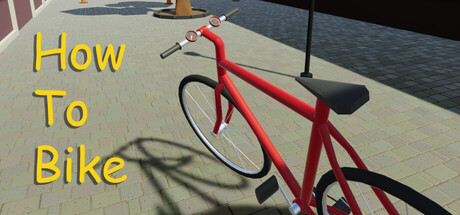
How To Bike: learning to balance all over again, no training wheels
No deadline: it stays in the catalogue until the store pulls it.
Claim it on Steam ↗You claim it in your own store account; Clairo doesn’t claim it for you.
Availability can vary by region.
Pedaling is the easy part: the handlebars demand an attention your body forgot it ever paid.
A frame, a fork, two wheels and no training wheels
Ever stopped to think about how you keep a bike upright? Most people couldn't tell you: balance comes from tiny adjustments of the handlebars, deliberate yet unconscious, and that is exactly what this game takes away from you and hands back to your head. Pedaling isn't the challenge here. Steering is.
The Steam page, where the game is distributed, lists what's included: a frame, a fork, two wheels, no training wheels, no fall protection and no automatic balancing. The bike physics are realistically simulated, there's a single map to explore, calm music and saving at any time. The blurb promises the most relaxing experience of your life and adds, in parentheses, that it isn't annoying at all. A promise that refutes itself.
Fur Yaroslav is credited as both developer and publisher, and the game came out on Windows on December 15, 2025. The advertised playtime runs from 15 minutes to many hours, for the stubborn.
What the physics teaches those who stick with it
The most detailed defense comes from a player who spent 2 hours on the bike and wrote in Russian. In this player's view, every turn of the handlebars and every shift of weight affects balance, which is why learning to ride becomes visible there, almost instructive. The game challenges and soothes at once, and every ride finished without a fall becomes a small victory.
The same text, however, also tallies the cost of what it praises. With no simplification and no assistance, newcomers may find it all too demanding, and the focus on a single skill narrows the game: not everyone will settle for so little variety. Writing like this describes a niche simulator, for players who value honest physics and are willing to practice stubbornly in exchange for a sense of progress.
Down before the first pedal stroke
The shortest complaint is also the bluntest. A French player who logged less than an hour sums up the experience like this: no sooner does the pedaling start than the rider is on the ground, and the promise of realistic physics didn't convince. The tone is ironic, not analytical.
It's the same difficulty the Russian player celebrates, seen by someone who never reached the point where it pays off. The disagreement isn't about whether the game is hard. It's about the moment a fall stops being punishment and becomes learning.
Who can take the first fall
It's night, you've toppled over again, and the handlebars turned just a touch the wrong way. If that scene sounds like an interesting problem rather than an insult, this game was made for you: one map, one bike, no help and the urge to understand your own balance.
Anyone expecting a leisurely ride, variety or progression gives up early, like the French player. The game teaches you to ride again, but only if you're willing to fall in order to learn.