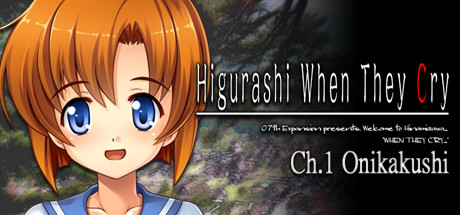
Hinamizawa has fewer than two thousand people, and every June someone doesn't come home
No deadline: it stays in the catalogue until the store pulls it.
Claim it on Steam ↗You claim it in your own store account; Clairo doesn’t claim it for you.
Availability can vary by region.
Onikakushi is the opening question of a series that stretches across chapters, and it refuses to hand over an easy answer.
A small village with a death on its calendar
Hinamizawa sits in rural Japan, in a summer placed in the 58th year of the Showa era. The village is small — fewer than two thousand people — and it keeps a grim habit: every year, in June, someone dies and someone vanishes. The string of deaths traces back to a dam project that split the neighbourhood decades earlier, and to a murder that was buried at the time and is happening again, almost as ritual. Conspiracy, coincidence or curse — the plot doesn't hand you the answer up front. The story warns you in its own voice, too: someone who belongs in the circle of friends is missing, and someone who has no business being there turns up out of nowhere.
The format is a sound novel: you read as the protagonist while music, backdrops and character portraits carry the scene in place of commands and combat, closer to a narrated book than to an action game. Onikakushi is the first chapter of the Higurashi series: 07th Expansion created the story, and MangaGamer and Sunflower Ocean brought this chapter to Steam, where it arrived in May 2015. It is only the opening act; the cycle at Hinamizawa runs far beyond what this first reading reveals.
A single chapter from a story that never stopped
Onikakushi risks looking like a loose fragment, the bottom step of a long staircase with no promise that the rest exists. The studio settled that doubt itself: in November 2023, announcing Hou+ for Steam, it described the cycle of tragedies around Hinamizawa and its circle of friends as closed, while pointing out that other fragments, other memories and other worlds had yet to be explored — a sign that this first reading is only the way into something much larger.
The translation work moves at the same pace. In January 2026, 07th Expansion released Onikakushi in Simplified Chinese and promised the following chapters one at a time over the months ahead. More than a decade after the chapter reached Steam, the studio is still handing out pieces of the same story, and the fragment in front of you belongs to a project still under construction.
The slow start is deliberate, and it ambushes whoever sits through it
The complaint that comes up most among players who recommend Onikakushi is, oddly enough, praise in disguise: the opening drags, and you feel every minute of it while the story takes its time. One player with 17 hours logged, writing in September 2026, calls the start absurdly slow — slow enough to be funny — and says the horror turns constant after that and never lets up. Another, with 10 hours on the clock that same month, describes an acceleration that lands like a sharp blow after the early calm, and says the game keeps gnawing at your head long past the credits. A Brazilian player with 11 hours put the reading off for years — she knew the story only from the 2006 anime and feared the game had aged badly — and ran into this version by chance; what won her over was the way the mystery unfolds in small pieces, carried by a soundtrack and a voice cast that gave her an immersion she had not expected.
What stays after the turn is always the same pair: mystery and sound. One player who put together a joke list about the game, with 28 hours on the profile, judged the soundtrack beautiful and the story grand, pleased that the whole thing runs even on a weak computer. In that list's own terms, the length is filed as medium, somewhere between 15 and 50 hours of reading. Even unreserved praise finds a crack: a Russian player with 15 hours calls the series' psychological horror the high point of the franchise, yet hates the post-credits scene, with the cast chatting about what a good horror movie they pulled off — comic relief that tramples, in this player's reading, the dread the chapter spent hours building.
One slow start, two ways of walking out
For players who drop Onikakushi, the sluggish opening never pays off: it is the waiting you feel when a line of dialogue stretches out and the plot still hasn't caught. A German player with 13 hours invested, writing in September 2026, describes nearly every line in the script taking a long detour on the way to the point, with constant repetition and flashbacks; the character portraits, the new ones and the originals alike, also struck them as ugly, enough not to carry on to the next chapter. Harsher still, a player with no hours logged at all, in September 2026, denies the thing is even a game: to them it is a click-and-read simulator, without so much as an option to speed up the text of the opening, which crawls through a dull introduction while the plot has yet to start. A third write-up, 22 hours and already in October 2026, agrees that the atmosphere and the story work, but insists that repetitive text and a poorly handled translation make the reading too tiring to open the following chapter.
One complaint is of a different kind, and it has nothing to do with pacing. A French player with no recorded hours came back to the franchise after childhood memories of the anime, but says that within the first few lines she recognised the sexualisation of teenage characters, a habit she points to as common in horror games and one that, to her, adds nothing to the plot. However good the writing, however lovely the music, however interesting the characters, that was enough to close the chapter and not return — a rejection that is not about patience but about what the game chooses to show.
Who closes the book, and who turns the page
There is barely a game inside Onikakushi: there is text, there are portraits and there is sound, and it asks you to accept that bargain first — the scare comes later. That bargain is what splits readers into two camps. If you are willing to walk into a village that takes its time baring its claws — and which, as both the players who finished it and the studio itself say, when it speaks of chapters and translations still on the way, is only the first piece of a far longer story — you come out of this first chapter with a reason to open the second.
Anyone who turns that bargain down has two equally fair reasons to quit, and they are different reasons: patience with a script that repeats itself and doubles back is one bill; discomfort with the way the chapter treats its teenage characters is another, and no beautiful soundtrack covers that second balance. On Steam, where the chapter gets rated, the players who finish it tend to recommend it — but that comes from people who already paid the price of the slow start, not from those who decided, in the first few scenes, that the price does not add up.