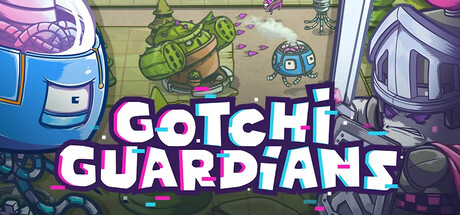
Gotchi Guardians: the farmer who wins by spraying apple juice on their own towers
No deadline: it stays in the catalogue until the store pulls it.
Claim it on Steam ↗You claim it in your own store account; Clairo doesn’t claim it for you.
Availability can vary by region.
Reaching the first tower takes an account of the game's own — email and phone number included — and that is the exact spot where part of the criticism stops dead.
Seven rivals, one guardian, and a logic that has no business working
Seven rivals shuffling their own tower mazes at the same time, each one trying to outlive the same waves you face: that is the foundation of Gotchi Guardians. Every match rolls events mid-run — which towers unlock, how many extra enemies join the queue, what buff the Licks pick up — and the call belongs to the players themselves, against the rivals fighting to survive alongside them. In one of those events, the Licks dubbed Steady Lads start hauling explosive gas tanks or huge, sticky ammunition, and unlocking that buff can rescue the player who picked it just as easily as it can sabotage them.
The Knight is a stubborn block that returns every hit taken — playing it means choosing to get beaten up on purpose. At the opposite end of the temperament sits the Farmer, who reinforces their own towers by spraying apple juice over them and pulls the Licks away with inflatable dummies: on paper the strategy should collapse, and it does not. A third, the Soldier of Fortune, turns gold into power — cashing the profits out at the right moment pays better than hoarding them. At launch, those three share the roster with the Pirate, the Archer and the magician Shaaman, six guardians in all, each one pulling the match toward a style of its own.
Every five rounds closes a 'day', and the whole room has to survive a Lick boss attack to move on. Season performance earns Stars and Stardust, which unlock G-Bucks and cosmetic items when the season turns over — the kind of hook built to bring the player back for the next one.
After launch, the in-game shop stands out more than the buffs
The patch board at Pixelcraft Studios has not rested since launch, in July 2025. Weeks later came the feud between the Lick dubbed Sparky and the Stohns faction, dropping a stealth mechanic into an event designed to test traditional defences. A brand-new boss followed, Old Sparky, one more obstacle for anyone trying to close out the day.
October is where the turn happened: a Halloween-themed event brought a reworked progression system and a new tower, the Goldpetal Bank, built around economy; balancing passes came after it, along with an item dubbed Leaky Battery, meant to inflict negative conditions on rivals. The update that followed, which the studio itself called a beautification, took care of visual effects — and also pushed the part of the game that sells further into view. It is the same change that resurfaces on the other side, in the criticism of players who felt, the moment the game opened, how much it asks for at the door, without letting you properly play.
The player who expected nothing, and the one who came back almost a year later
A day after launch, on July 31, 2025, a review arrived from someone who had put eight hours in expecting nothing at all from it — and came away hooked on the chaos of the matches, where every round lands differently from the previous one and the rivals themselves wreck each other's plans.
In July 2026, another review praises the gentler side of the game: placing the guardians, levelling up their abilities and watching the waves melt while the team grows on its own at the bottom of the screen. For anyone with only an hour in the evening, it is the kind of match that holds up unattended while you deal with something else — each new guardian shifts the personality of the round, and each map shifts the scenery.
The front door stops more people than any tower
Gotchi Guardians asks for an account of its own to play with other people — email, phone number, a sign-up separate from the Steam account the player already has. That is where a good share of the discomfort surfaces: on the critical side, several reviews were filed without a single hour of play — the very point where you would have to decide whether to hand over your email.
On October 16, 2025, one player complained about having to create that separate account just to play with other people, when the title already sits inside Steam itself — a redundant demand, as they saw it. A day after launch, on July 31, 2025, another review pressed the same point harder: asking for an email and a phone number at the debut of a studio with no track record reads like charging for trust it has yet to earn; that same review also found the voice of the character Sergeant Drill odd, too artificial in its delivery, and noted that the single-player mode feels like an afterthought, an appendix to the multiplayer.
The suspicion picked up a concrete fact on November 9, 2025: a review reported that the registered email sat exposed in a public technical channel of the game, even without appearing on the player's screen, and linked an outside report on the case.
Some players never got as far as that argument: on October 3, 2025, a review described the game shutting itself down every time they tried to open it, leaving room for no verdict beyond the crash. Another, on August 24, 2025, went the opposite way from the cuteness praised elsewhere: it found the game's voice work grating and the visuals far too loud on the eyes. In none of these complaints does the tug-of-war between towers come up as the problem — the trouble sits at the door, not on the board.
For players with patience to spare for the sign-up
Anyone who plays solo on principle, or who will not hand over an email and a phone number to try out the debut of a studio with no record behind it, closes the page without planting a single tower — and that is exactly where a good share of the criticism gathered here shows people walking away. Whoever makes it past that door finds a room for seven rivals shuffling their own mazes at the same time, a knight who profits from taking hits, and a farmer who wins by spraying apple juice. What Gotchi Guardians charges is not money — it is trust, billed right at the entrance, far from the first wave.